
Window Outline Lighting: Year Round Tracks or DIY for Homes

Window Outline Lighting: Year Round Tracks or DIY for Homes
For most homes, window outline lighting works best as LED strips or modules for budget DIY jobs, or a permanent track-mounted LED system with app control for a clean, year-round finish. Outdoor suitability and controls decide the outcome. Check for UL listing and ENERGY STAR guidance on LED efficiency before you buy, and compare installer cost against your own time.
TL;DR:
- Buy products listed and marked for wet locations, match the power supply to voltage and current markings, and keep all components within one compatible system.
- A photocell switches lights on at dusk, while a timer sets shutoff; app scheduling and dimming add control over color changes and late evening brightness.
- Adhesive channels work only on smooth, stable trim in mild conditions; dust, cold, rough surfaces, wind, and snow can loosen or damage a run.
- LED output gradually falls toward 70% of its original level; heat shortens useful life, and drivers often fail before strips, so inspect twice yearly.
- Low voltage strips are reasonable DIY projects, but line voltage, new circuits, and panel work should be handled by a licensed electrician.
Which window outline method fits your home?
Three approaches cover nearly every window outline project. Each looks different, lasts a different amount of time, and asks something different of you.
- LED strips and modules: Low-voltage strips, many of them field-cuttable, sit in aluminum or plastic mounting channels. Look at the IP rating on the box, because it tells you how well the strip handles spray and rain. This is the most common DIY route and the cheapest way to start.
- Neon-style tubing: Flexible tubing gives a smooth, continuous glow with no visible dots, which suits storefront windows and a retro look. It usually needs a transformer or driver placed nearby and a firm mounting surface, so plan where the power unit will live.
- Permanent track-mounted systems: Discreet brackets hold color-matched tracks, and the lights stay up all year. App control lets you switch colors for holidays or game days. Professionals usually install these, and we recommend them for anyone who wants a polished edge that never comes down.
Strips and tubing are typically DIY projects. Track systems are usually professional work, and our own InvisiLights Track Mounted and InvisiClips / Trackless installs follow that model.
How do you confirm a product is made for exterior windows?
“Outdoor” on a package is marketing, not a rating. UL’s guidance on landscape and outdoor luminaires says line-voltage luminaires are evaluated for wet-location requirements, and that low-voltage systems still need attention to the power unit, cable and compatible listed components. A water-resistant claim alone is not enough for permanent exterior use.
For outline lighting, the electrical code treats it much like a sign. NEC Article 600 and UL 48 require electric signs and outline lighting to be listed and marked for wet, damp or dry locations, with installation instructions included. Inspectors are expected to verify those markings and review the instructions.
Run through these checks before you pay:
- Look for a listing mark and a location marking such as “Suitable for Wet Locations” for any exposed window frame.
- Read the voltage and current markings and confirm the power supply matches them.
- Confirm the installation instructions are in the box or downloadable.
- Compare ingress ratings, and see our IP65 vs IP67 breakdown if you are unsure which fits your exposure.
- Keep strips, drivers and connectors from one compatible system rather than mixing brands.
What controls and brightness settings look best?
Controls change how your windows feel at night more than the lights themselves. A timer or photocell keeps lights off during daylight and shuts them down late, which cuts wasted energy and keeps light from spilling into a neighbor’s bedroom. Our photocell vs timer guide walks through which one suits your routine, and app control with dimming gives you the most flexibility.
Brightness matters just as much as schedule. An outline should define the window, not light the yard. Our outdoor brightness by zone guide gives lumen ranges for different areas, and a good starting point is a lower setting than you think you need.
- Choose warmer color temperatures for a classic, welcoming look on brick, wood or siding.
- Reserve cool white for modern facades or storefronts that want a crisp edge.
- Use dimming to step brightness down after dinner.
- Use color changes for holidays and events, then return to a steady neutral white.
Pro Tip: Start with a low brightness setting, step back to the curb, and raise it only until the window frame reads clearly. Over-bright outlines cause glare on the glass and in your own living room.
How do you mount an outline for a clean, durable edge?
A good outline depends on how it is fastened. Whichever method you choose, work in this order:
- Clean and dry the window trim, then mark a straight reference line so the run does not drift.
- Fix the rail, track or channel first, using continuous sections wherever possible so the lights sit evenly.
- Treat seams and corners with the manufacturer’s corner pieces or a tidy cut, and keep joints weather-sealed.
- Seat the light strip or tubing into the channel and test it before you close anything up.
- Secure the run against wind and snow load, then route the lead wire to the power supply.
Track-mounted systems produce the cleanest edge because small, discreet brackets hold a color-matched track that blends into the trim. We use custom 3D-printed brackets for exactly that reason. Adhesive-backed channels and PVC frames are acceptable on smooth, stable surfaces in mild conditions, but adhesive loosens on dusty, cold or rough materials, so check the trim first.
Properly installed windows make everything easier, and this window installation guide covers the trim and frame work that outline lighting sits on. For a worked example, see our notes on bay window outline lighting.

How should you handle power and wiring?
Most outline systems run on low voltage, which keeps the lights themselves safer to handle. Line-voltage systems, such as many neon-style setups, carry more risk and are usually best left to a licensed electrician. Either way, use a listed power supply that matches the product’s voltage and current markings.
- Check the cable marking: Look for Class 2 marking on low-voltage cable, and follow the power supply’s placement rules, since many need shade, airflow or a protected spot.
- Hide the route: Run wire behind siding, through J-channel or inside trim so the only thing visible is the glow.
- Keep connections dry: Use connectors rated for exterior use and avoid leaving splices exposed.
- Plan the power source: Put the supply near an outdoor outlet or a dedicated circuit rather than stretching long extension cords.
- Know when to call a pro: Hire a licensed electrician for any new circuit, line-voltage connection or work inside a panel.
Guidance summarizing NEC Article 600 also suggests checking voltage and current markings, wiring instructions and mounting details before purchase or installation.
How long will outline lighting last, and what needs checking?
LEDs rarely burn out suddenly. ENERGY STAR explains that LED lifetime is based on gradual lumen depreciation, usually measured to the point where output falls to 70% of the original, and that higher operating temperature shortens useful life. Expect a slow dimming rather than a dead strip.
- Common failure causes: Heat buildup, moisture intrusion and weak connectors cause most trouble.
- Inspect twice a year: Look for yellowed channels, loose clips, cracked seals and flickering sections.
- Check the driver: Power supplies often fail before the lights do, so test them and keep a spare.
- Verify the warranty: Know what parts and labor are covered before you commit.
Our guide to making permanent lights last covers drivers, connectors and mounting in more depth.
Why we favor professional permanent installs
DIY strips are a fair choice when the budget is tight or the project is seasonal, and plenty of people get good results. Over several winters, though, adhesive fails, wires sag and the weekend ladder routine gets old. A permanent, app-controlled track in a color-matched finish can reduce that cycle, and discreet hardware may make the premium easier to justify. If you want your windows to look finished every night without lifting a finger, pay once and do it properly.
— Luis T
Permanent window outline lighting from Capital Pro Lighting
Imagine changing your window colors from your phone and never climbing a ladder again. We install permanent outdoor lighting across Albany and the Capital Region. Our permanent systems use custom color-matched tracks, 3D-printed brackets for a clean finish, and app control for holidays and events. Our pricing page lists InvisiLights Track Mounted from $2,500 and InvisiClips / Trackless from $2,000, and you can request your own quote there.
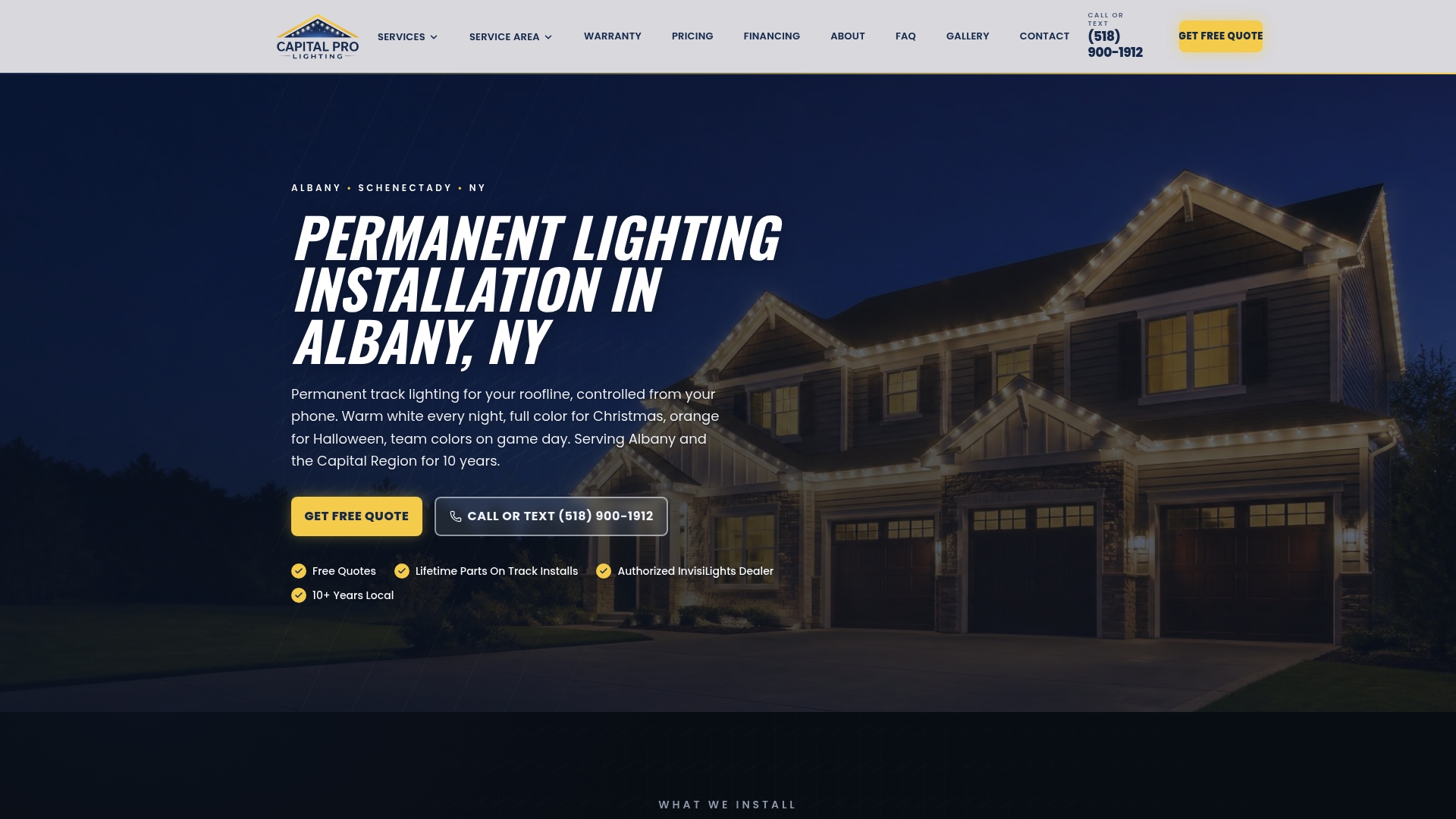
Ready to see what your windows could look like? Request your quote today.
FAQ
Is window outline lighting safe to use outdoors?
Yes, when the product is listed and marked for the location where you install it. Look for a wet-location marking on exposed frames and follow the included installation instructions.
How long do LED window outline lights last?
LED lifetime usually describes gradual dimming to about 70% of original output rather than sudden failure, as ENERGY STAR explains. Heat management and driver quality strongly affect real-world life.
Should I use a timer or a photocell for window lights?
A photocell turns lights on at dusk automatically, while a timer controls exactly when they shut off. Many homeowners combine them, or use app scheduling to get both.
Can I install window outline lighting myself?
Low-voltage strips in channels are a reasonable DIY project if you follow the instructions. Line-voltage work and new circuits belong with a licensed electrician.
Sources
Recommended
Ready for a Brighter Home?
Free, no-pressure quotes across the Capital Region.
No obligation. Local installer. Same-day callback.
Reviewed by Capital Pro Lighting
Capital Pro Lighting installs permanent outdoor lighting, architectural lighting, and holiday lighting across Albany and New York's Capital Region. We install UL listed permanent lighting systems and have 10 years in business. More about our team.


