
IP65 vs IP67: 6 Questions to Choose the Right Outdoor Rating
IP65 vs IP67: 6 Questions to Choose the Right Outdoor Rating
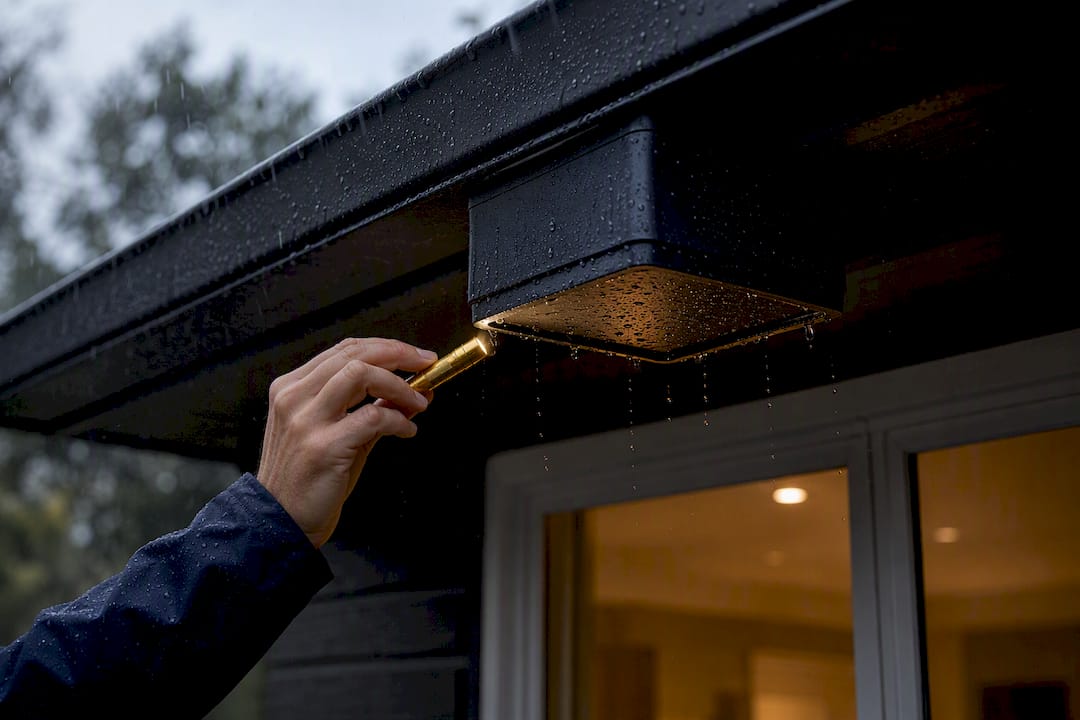
Both ratings mean an enclosure is completely dust-tight, but the water protection splits sharply: IP65 resists low-pressure jets from any direction, while IP67 covers temporary immersion at about 1 meter for 30 minutes. For roofline lighting, security cameras, and most outdoor fixtures mounted above grade, IP65 is enough. Reach for IP67 only when standing water, flooding, or full submersion is a real possibility.
TL;DR:
- IP65 enclosures resist low-pressure water jets but are not tested for submersion, making them suitable for rain and spray exposure above ground.
- IP67 enclosures can handle temporary immersion at about 1 meter for 30 minutes, but their water protection does not automatically include jet-proofing.
- Manufacturers should explicitly test or certify for both IP65 and IP67 if an enclosure faces multiple hazards; a single rating often indicates only one test was performed.
- IP ratings only cover solids and water under lab conditions and do not account for impact, corrosion, chemicals, or UV damage that affect outdoor durability over time.
- Selecting the correct IP rating depends on specific site conditions, with IP65 suitable for most above-grade outdoor fixtures and IP67 reserved for areas prone to flooding or submersion.
IP65 vs IP67: What the Lab Tests Actually Measure
The confusion around IP65 vs IP67 starts with a reasonable but wrong assumption: that 7 is just a bigger, better version of 5. It isn’t. They test different hazards entirely, and IEC 60529 treats them as separate problems with separate procedures.
Both ratings start with the same first digit, 6, meaning the enclosure blocks 100% of dust and other solid particles. That part is identical. The second digit is where they differ:
- IP65 is tested against low-pressure water jets from every angle, simulating rain or hose sprays.
- IP67 is tested for temporary immersion under water at a shallow depth and limited duration.
Here’s the part that trips people up: an enclosure certified IP67 hasn’t necessarily proven it can handle a direct jet spray, and an IP65 enclosure hasn’t proven it can survive being dunked. The IEC standard’s consolidated testing framework keeps these as distinct test families precisely because the failure modes differ. A jet applies focused, moving pressure at a seal from one direction at a time. Immersion applies constant pressure from every direction at once, for half an hour. A gasket that shrugs off a hose blast might still weep water after 30 minutes underwater, and vice versa.
Manufacturers who tested for both will usually say so with dual coding, something like IP65/IP67 on the same datasheet. If you only see one rating listed, assume only one test was run.
Reading the IP Code Correctly
An IP rating is a two-digit code, and each digit answers a separate question. The first digit, running from 0 to 6, describes protection against solids: dust, dirt, tools, fingers. A 6 means total protection. The second digit, running from 0 to 9, describes protection against liquids, and this is where the scale changes meaning as it climbs.
- 0 to 4: dripping water, spray, and splashing from limited angles
- 5: low-pressure water jets from any direction (IP65)
- 6: high-pressure jets (IP66)
- 7: temporary immersion up to 1 meter for 30 minutes (IP67)
- 8: continuous immersion beyond 1 meter, defined by the manufacturer
- 9: high-pressure, high-temperature washdown (IP69K)
Dual coding shows up because a product might genuinely pass two independent tests. Enclosure ratings that carry both an IP65 and IP67 label, for instance, tell you it resisted jets and survived a half-hour underwater. That’s a genuinely more capable seal, not a marketing flourish.
Be skeptical of any listing that just says “waterproof” without a number. That word has no fixed engineering meaning, and it tells you nothing about which test, if any, the product passed.
What IP Ratings Don’t Cover
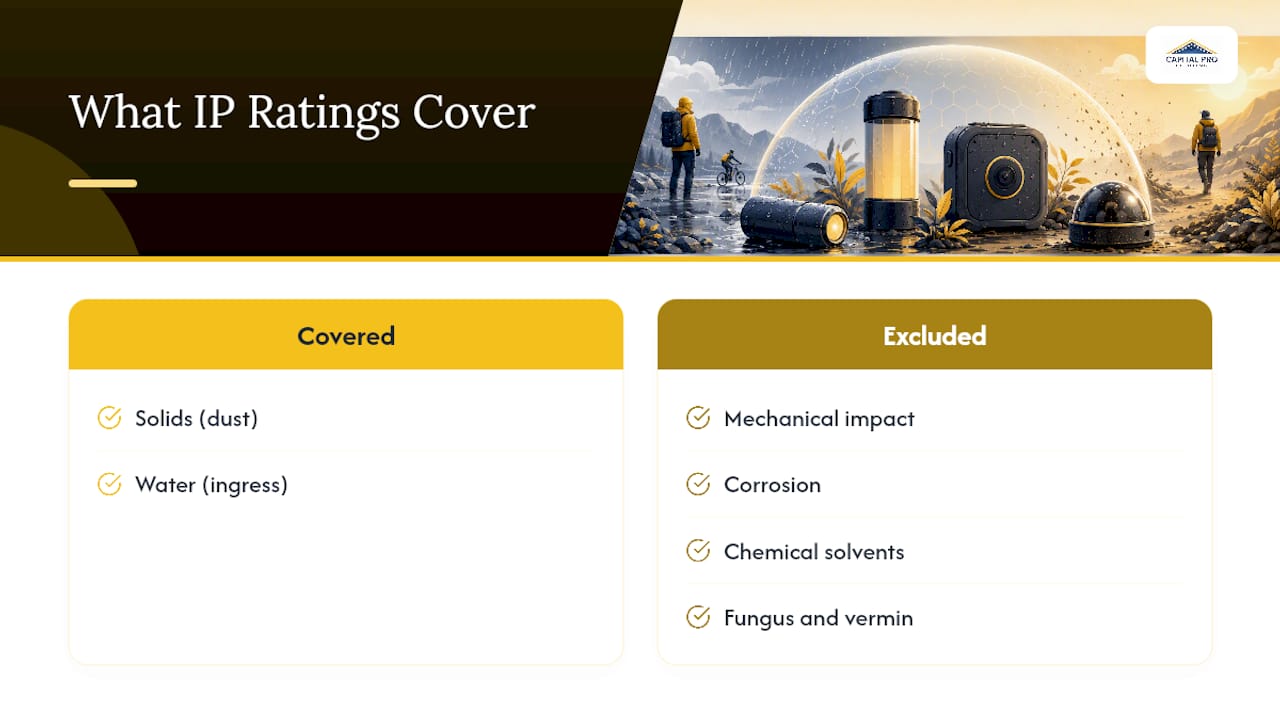
IP ratings feel like a complete durability score, but they measure exactly two things: solids and water, under lab conditions. IEC 60529 explicitly excludes mechanical impact, corrosion, chemical solvents, fungus, vermin, solar radiation, icing, and condensation from its scope.
That’s a long list of real-world hazards a rooftop fixture, a coastal junction box, or a ground-mounted transformer will actually encounter. An IP66-rated housing can still crack from UV embrittlement after three summers, or corrode shut at the seams near salt spray, and still technically hold its original rating on paper.
Real-world extreme-weather testing on outdoor hardware, including NREL’s work on solar equipment, shows that stresses like wind-driven rain, hail, and repeated temperature cycling create wear patterns that lab-based IP testing never simulates. Equipment that passes its rated test in a controlled chamber can still degrade under years of freeze-thaw cycles and storm exposure.
Treat an IP number as one input among several, not a full warranty against the weather. Material choice, seal quality, and mounting location do the rest of the work.
Choosing Between IP65 and IP67: A Practical Decision Path
Most procurement mistakes go one direction: over-specifying. Someone assumes IP67 is the safer bet, pays more, and gets an enclosure that runs hotter because a fully sealed housing has nowhere to vent heat. Guidance from Airbus on protection-rating misconceptions makes this point directly: IP67 is not automatically the better choice. It’s the right choice only when immersion is a genuine risk.
Here’s the decision path that actually works:
- Identify the hazard first. Rain and splash exposure calls for IP65. Washdown with a hose or pressure sprayer calls for IP66. Standing water, flooding risk, or submersion calls for IP67.
- Check for dual-rated hardware if your installation faces both risks, say, a junction box that gets hosed down and occasionally sits in pooled water after a storm. Look for products explicitly tested against both jet and immersion standards rather than assuming one implies the other.
- Weigh the thermal trade-off. A fully sealed IP67 enclosure holding electronics needs a heat-management plan, since sealing out water also seals in heat. That adds cost and design complexity that most above-grade fixtures don’t need.
- Read the datasheet for test specifics, not just the number. A vague “IP67 rated” claim with no test report is a weaker guarantee than a spec sheet naming the lab and test parameters.
- Watch for missing cable-gland detail. The rating on the housing means nothing if the wire entry point wasn’t sealed to the same standard.
Pro Tip: Ask any supplier for the actual test certificate, not just the rating number on the box. A rating without a report is a claim, not proof.
Materials and Installation: Where Ratings Actually Fail
An IP rating describes a brand new enclosure in a lab. What happens five years later depends almost entirely on materials and how it was installed.
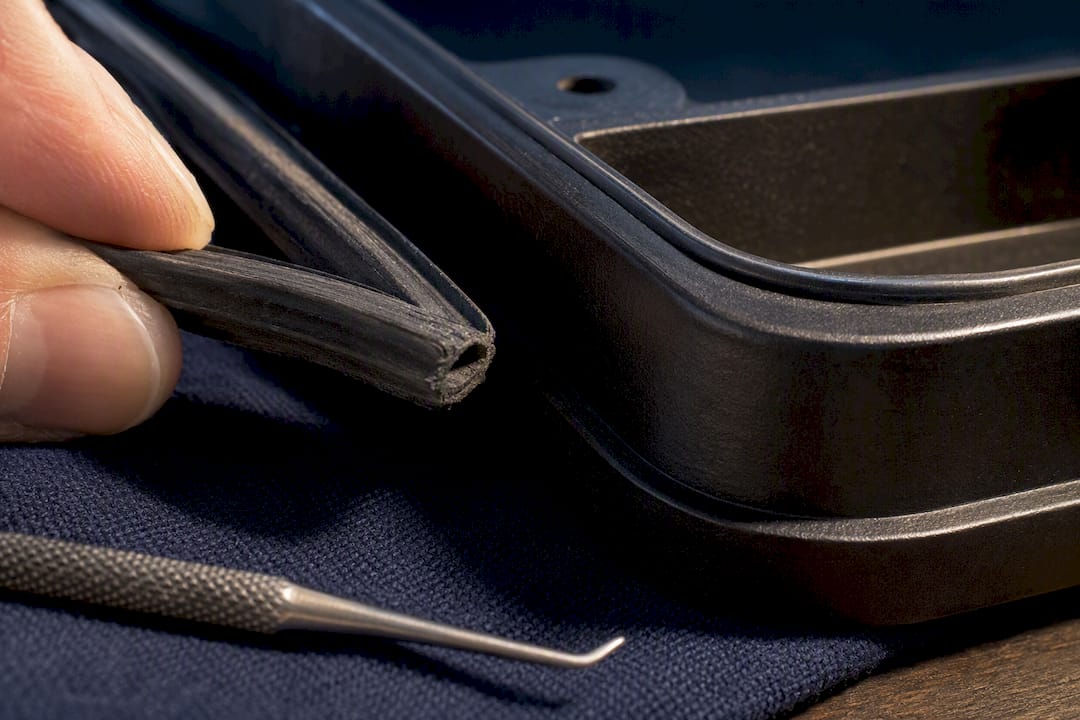
- Silicone gaskets hold flexibility across a wider temperature range than EPDM rubber, which matters for fixtures that see both July heat and January cold on a rooftop.
- Polycarbonate housings resist impact well but can yellow and become brittle under prolonged UV exposure unless treated; stainless steel avoids UV degradation but costs more and adds weight.
- Overdriven mounting screws are one of the most common field failures, crushing a gasket flat and creating a gap that no rating survives.
- Mismatched cable glands installed by someone in a hurry defeat the seal at the one point most installations get wrong.
Regular visual inspection of gaskets and fittings, ideally once a year, catches degradation before it turns into a water intrusion problem; see examples of expert work in the Project Gallery for inspiration on durable outdoor installations.
Pro Tip: A seal that looks fine can still be compressed past its working range. If a gasket looks flattened rather than rounded, it’s due for replacement regardless of how new the fixture looks.
Matching Products to Ratings: Quick Reference
Different outdoor products face different water exposure, and the rating should match the actual site conditions, not a blanket assumption.
- Roofline and permanent home lighting: IP65 covers the vast majority of installations, since fixtures mounted under an eave or along a gutter line face rain and wind-driven spray, not submersion.
- Security cameras and doorbell units: IP65 is standard for wall-mounted units; IP67 makes sense only for units mounted low near sprinkler zones or areas prone to pooling.
- Ground-level junction boxes and low-voltage transformers: IP67 is the safer baseline here, since anything at grade level risks sitting in puddled water after heavy rain.
- Portable or handheld equipment used near pools or docks: IP67 fits, since accidental drops into water are a realistic scenario.
- Coastal or below-grade installations: bump up material specs regardless of IP rating, since salt spray and soil moisture accelerate corrosion that no water rating addresses.
Retrofitting an older fixture is a good moment to re-check the rating against the current site, especially if landscaping or grading has changed how water collects near the mounting point.
A Six-Question Checklist Before You Specify
Walk the installation site and answer these honestly before locking in a rating:
- Does this location ever collect standing water, even briefly, after rain?
- Will the fixture face routine washdown or pressure spray?
- Is it mounted at or below ground level rather than on a wall or roofline?
- Is it within reach of salt spray or coastal air?
- Does the housing need airflow for internal heat dissipation?
- How accessible is it for annual seal inspection?
Three or more “yes” answers to questions 1, 2, or 4 point toward IP67 or a dual-rated component. Mostly “no” answers with straightforward wall or roof mounting means IP65 covers the job without unnecessary cost. A mix of washdown and pooling risk means insist on dual certification rather than guessing which single test matters more.
How Capital Pro Lighting Approaches IP Ratings on Real Roofs
We specify fixtures and sealing systems based on where they’ll actually sit on a house, not a default rating pulled from a catalog. A roofline run under deep eaves gets different sealing consideration than a ground-level accent light near a downspout that floods every spring.
That approach shows up in the details: a lifetime parts warranty on track installations, custom 3D printed brackets that keep water from pooling at mounting points, and over a decade of watching how Capital Region winters treat different seal materials. On one recent job, moving a planned ground-level junction box six inches uphill let us specify a simpler, less expensive enclosure instead of an unnecessary IP67 upgrade.
— Luis T
Get Roofline Lighting Sealed Right the First Time
Guessing at IP ratings from a spec sheet is one thing. Standing on a ladder finding out a gasket failed after two winters is another. Capital Pro Lighting installs permanent, phone-controlled roofline lighting built with sealing systems matched to how New York weather actually behaves, not just a lab test on a box.
Every installation comes with a lifetime parts warranty and custom brackets designed to shed water instead of trapping it against the housing, an approach shaped by 10 years of installations across the Capital Region. If you’re weighing a DIY fixture upgrade against a system that’s sealed, warrantied, and controlled from your phone, request a quote for permanent outdoor lighting and get a rating recommendation specific to your roofline, not a generic catalog number.
Sources
- Degrees of protection provided by enclosures (IEC 60529)
- Degrees of protection provided by enclosures (IEC 60529) - consolidated version
FAQ
Is IP65 enough for rain?
Yes. IP65 is tested specifically against low-pressure water jets simulating wind-driven rain, which covers the vast majority of outdoor rain exposure for wall-mounted and roofline fixtures.
Is IP67 completely waterproof?
No. IP67 covers temporary immersion up to 1 meter for 30 minutes, not permanent submersion, high-pressure spray, or indefinite water exposure, and the term “waterproof” has no fixed technical meaning under IEC 60529.
Is IP65 okay for outside?
For the majority of above-grade outdoor fixtures, including roofline lighting and wall-mounted cameras, IP65 is the appropriate baseline since it’s built specifically to resist rain and spray from any angle.
Can I shower with IP65?
Not reliably. A shower produces sustained water contact at close range that can exceed what the IP65 jet test simulates, so IP65-rated electronics are generally not recommended for direct shower use.
Ready for a Brighter Home?
Free, no-pressure quotes across the Capital Region.
No obligation. Local installer. Same-day callback.
Reviewed by Capital Pro Lighting
Capital Pro Lighting installs permanent outdoor lighting, architectural lighting, and holiday lighting across Albany and New York's Capital Region. We install UL listed permanent lighting systems and have 10 years in business. More about our team.


