
5 Fixes You Can Do Tonight for Wildlife Friendly Outdoor Lighting
5 Fixes You Can Do Tonight for Wildlife Friendly Outdoor Lighting
The most effective fix is simple: use less light, and aim what’s left. Turn off anything that isn’t doing a job, shield the rest so it points down, swap to warm or amber bulbs, and put timers or motion sensors on the switches. DarkSky’s five lighting principles and National Park Service guidance back this exact order of operations, and Capital Pro Lighting builds it into every permanent installation it runs.
TL;DR:
- Immediate actions like turning off unnecessary lights and installing timers provide the largest impact for wildlife and cost less than $15.
- Swapping to warm or amber bulbs below 3000 Kelvin and using shielded, full-cutoff fixtures significantly reduce light spill and blue-wavelength damage.
- Proper fixture aiming, lower mounting heights, and timed or motion-activated lighting can drastically decrease ecological harm without needing full fixture replacements.
- Seasonal and species-specific adjustments, such as curfews during migration and insect activity peaks, further minimize environmental disruption.
- Permanent, professionally installed systems offer more durability and control than DIY fixes, especially for properties with multiple problem fixtures.
A Prioritized Wildlife Friendly Outdoor Lighting Checklist for Tonight
You don’t need to replace every fixture this weekend. Work through these in order, since each one delivers more impact for less effort than the next.
- Turn off or curfew anything unnecessary. A plug-in timer costs less than $15 and instantly cuts hours of wasted light.
- Add motion sensors where lights only need to fire occasionally. Driveways, side yards, and gates rarely need to glow all night.
- Swap bulbs for warm or amber options, ideally 2200 to 2700 Kelvin. Skip the cool white and daylight-marked packages entirely.
- Shield or re-aim existing fixtures so light points down, not out or up. A $10 shield or a simple tilt often solves this without new hardware.
- Drop the lumen output and mount fixtures lower where you can. Less height means less spill into trees, gardens, and neighboring yards.
That order matters. Shutting off unused lights takes zero dollars and delivers the biggest win, while a full fixture overhaul is worth doing eventually but shouldn’t hold up the easy stuff.
Fixtures and Bulbs: What to Buy and What to Avoid
Skip the decorative globe fixtures that throw light in every direction; instead, consider outdoor lighting designs that focus on shielding and aiming light properly. A shielded, full-cutoff fixture that aims light straight down does more for wildlife than any bulb swap alone. The National Park Service’s outdoor lighting principles make this point directly: fixture shape and aiming usually matter more than the bulb inside it. A bare bulb in an open fixture scatters light into the sky and into tree canopies no matter how warm its color temperature reads.
Color temperature still counts, though. Aim for bulbs rated below 3000 Kelvin, and lean toward the 2200 to 2700 Kelvin amber range whenever the fixture allows it. Keep in mind that Kelvin rating is a proxy, not a guarantee. Two bulbs with the same CCT can have different spectral power distributions, meaning one might still carry more blue content than the label suggests.
- Avoid: cool white or daylight bulbs (4000K and above), unshielded floodlights, uplights aimed into trees.
- Choose: warm or amber LEDs (2200 to 2700K), full-cutoff or shielded housings, lower lumen output than you think you need.
Lumens matter as much as color. Pathway lights generally need low lumen output appropriate for functional visibility, while entry doors may justify somewhat higher lumen output. Anything brighter than that outside a security context is usually overkill.
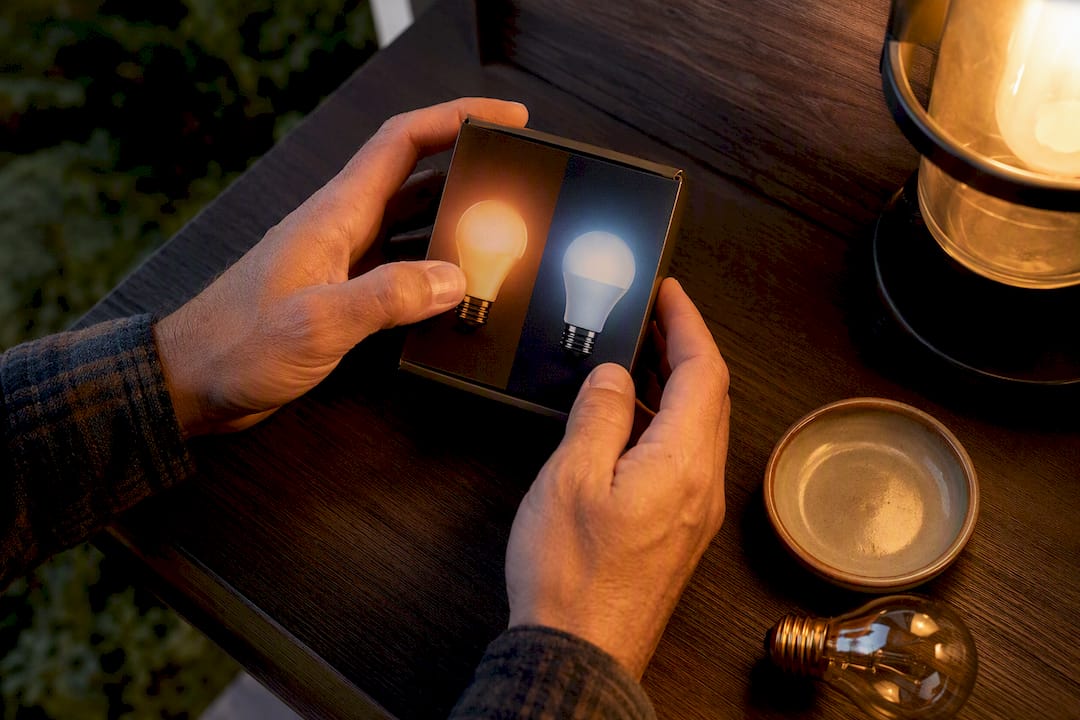
Pro Tip: Hold a bulb’s packaging next to your porch light before buying. If the box says “daylight” or shows a blue-white color swatch, put it back.
Blue-heavy light does measurable biological damage. A 2024 meta-analysis found that blue-wavelength light causes substantially higher melatonin suppression in nocturnal species than yellow or amber wavelengths do. That’s the mechanism behind nearly every “switch to warm light” recommendation you’ll see from wildlife groups.
Controls, Placement, and Aiming to Stop Light Spill
Where and how long your lights run often matters more than what’s inside them. A dim floodlight that stays on until sunrise can do more ecological damage than a brighter one that shuts off at 11 PM.
Start with timing. Set motion-activated lights to run for 2 to 5 minutes per trigger, long enough to walk to your door, short enough to avoid becoming ambient lighting. For fixed lights near woods, water, or migration corridors, a curfew between 11:00 PM and 5:00 AM during spring and fall migration cuts exposure during the hours birds and insects are most active, a window the National Wildlife Federation recommends for lights-out programs.
Placement rules of thumb that actually work:
- Mount fixtures as low as function allows. Lower mounting concentrates light on the ground instead of spraying it sideways.
- Use dark-colored, non-reflective surfaces near fixtures. White gravel and pale pavers bounce extra light upward.
- Separate zones deliberately. Keep bright, functional lighting on walkways and steps, and keep garden beds, ponds, and pollinator plantings as dark as safety allows.
National Light Pollution Guidelines frame this as starting from darkness and adding only what’s needed, rather than starting bright and dimming down. That mental flip changes how you shop for fixtures in the first place.
Species and Seasonal Considerations That Change Your Approach
Different animals respond to light differently, and the calendar changes what matters most.
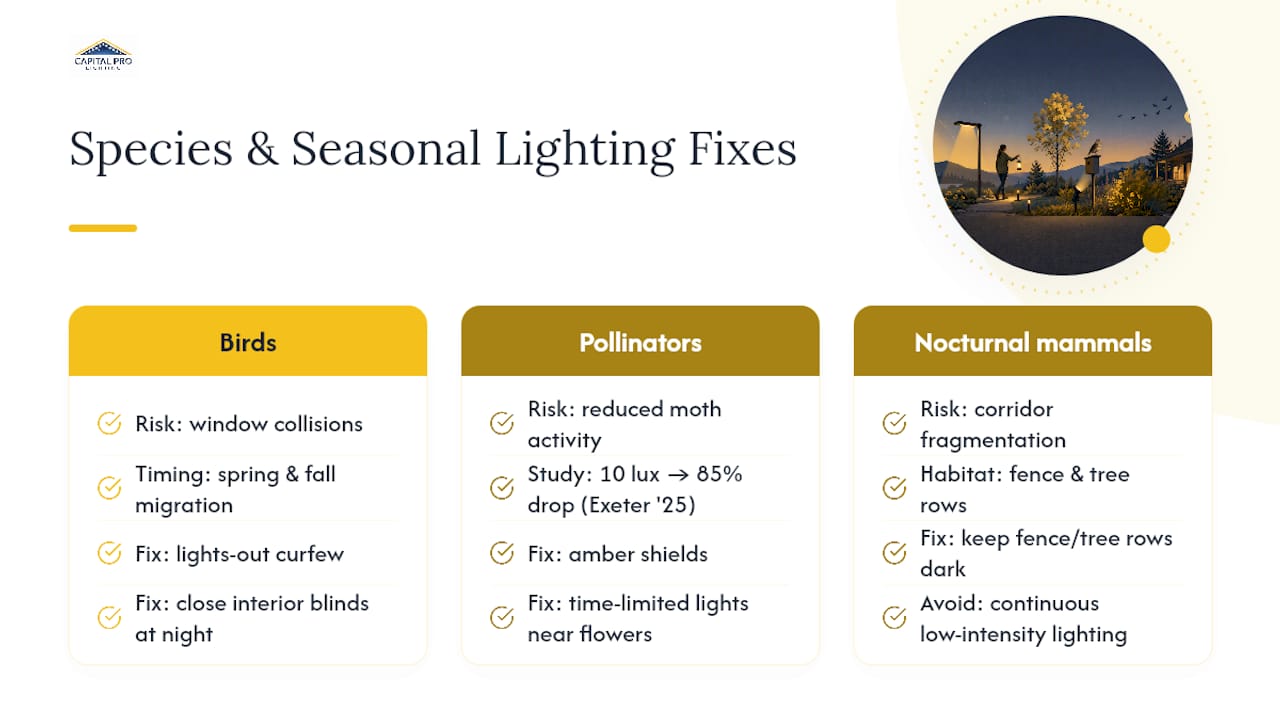
Birds face the sharpest seasonal risk. Migrating species navigate partly by starlight, and bright ground lighting or illuminated windows can pull them off course or into collisions. A lights-out curfew during spring and fall migration windows, plus closing blinds on lit interior rooms at night, addresses both outdoor and indoor sources at once.
Pollinators and insects react fast to spectral content. A 2025 University of Exeter study found that white LED lighting at just 10 lux, dimmer than most porch lights, reduced nocturnal moth activity by as much as 85%. Moths pollinate a wide range of night-blooming plants, so that drop in activity ripples into the rest of the yard. Amber shields and time-limited lighting near flower beds help.
Nocturnal mammals like bats, raccoons, and opossums rely on dark travel corridors between feeding and denning areas. Continuous illumination along fence lines or tree rows can fragment those routes, even at low intensity, pushing animals into riskier paths near roads.
Retrofitting vs. Permanent Installations: Which Fits Your Yard
A few porch fixtures and a couple of timers? DIY retrofits handle that fine. A property with multiple problem lights, inconsistent aiming, or a wish list that includes seasonal color changes and app-based scheduling starts to outgrow what off-the-shelf timers and clip-on shields can do well.
Run through this before deciding:
- How many fixtures actually need fixing, and are they scattered across the roofline, landscape beds, and entries?
- Do you want app-based control so schedules and curfews happen automatically instead of relying on you to flip a switch?
- Does your household want the flexibility to shift color and brightness for holidays without re-wiring anything?
- What’s the budget for a one-time professional fix versus years of buying and replacing consumer-grade fixtures?
Piecemeal DIY setups fail in a specific way: a motion sensor drifts out of adjustment, a timer’s battery dies, a shield falls off. Permanent programmable systems solve that failure mode differently, with fixed aiming set once during installation and schedules that run from an app instead of a mechanical timer.
Capital Pro Lighting installs roofline systems with precise aiming set during installation, phone-based scheduling and dimming, a lifetime parts warranty on track installations, and custom 3D-printed brackets for a clean, shielded finish that avoids the light spill that loose clip-on fixtures often create.
For homeowners in the Capital Region weighing a full retrofit against years of adjusting consumer fixtures, that’s often the more durable answer.
The Honest Limits of Doing This in Your Own Yard
No fixture, bulb, or app setting makes a light truly wildlife-friendly. It only makes it less harmful. That distinction matters for how you set expectations: the single highest-impact action available to any homeowner is still turning off a light entirely, not finding the perfect warm-toned replacement for it.
One yard’s changes also only go so far. A single dark property surrounded by floodlit neighbors doesn’t restore a migration corridor or a pollinator route. The bigger lever is coordination: pushing for neighborhood Lights Out programs, or raising the idea of a seasonal municipal curfew with your town council or a local conservation group during migration windows. Individual fixture choices are the starting point. Getting a whole street or a whole town to adopt the same curfew is what actually changes what a bird or a moth experiences flying over your neighborhood at 2 AM.
— Luis T
Why Capital Pro Lighting Is the Retrofit-Free Way to Get This Right
Swapping bulbs and clipping on shields works, but it’s a project you’ll redo every year as fixtures drift, batteries die, and holiday lights get tangled up in the garage. Capital Pro Lighting installs a permanent roofline system once, aimed correctly from day one, then controlled entirely from your phone, no ladder, no re-shielding, no annual bulb hunt for the right Kelvin rating.
Every installation comes with a lifetime parts warranty on the track system and custom 3D-printed brackets built for a clean, shielded finish rather than a bolted-on floodlight look. You can dim it, schedule curfews, or shift it warm for everyday use and switch colors for a holiday without touching a single fixture. Capital Pro Lighting has installed these systems across the Capital Region for over a decade, including permanent lighting in Delmar and Schenectady. If your property spans multiple problem fixtures or you just want scheduling that never depends on you remembering to flip a switch, check the service area coverage and book an assessment.
Sources
- Meta-analysis on ALAN biological effects (Wiley 2024)
- Five principles for responsible outdoor lighting (DarkSky)
- National Light Pollution Guidelines for Wildlife (DCCEEW / Tethys, 2023)
- Artificial nighttime lighting is suppressing moth activity (University of Exeter, 2025)
- How light pollution impacts wildlife & how you can help (National Wildlife Federation, 2023)
FAQ
What kind of outdoor lighting is bird friendly?
Shielded, downward-aimed fixtures using warm or amber light below roughly 3000 Kelvin, run on timers or curfews during migration season, reduce collision and disorientation risk for birds the most.
Is there an outdoor light that doesn’t attract bugs?
No bulb eliminates insect attraction entirely, but warm amber LEDs with shielded housings attract far fewer insects than cool white or blue-rich lights, since a 2025 study found even dim white LED light can suppress nocturnal moth activity by up to 85%.
What is wildlife friendly lighting?
It’s outdoor lighting designed around DarkSky’s five principles: purposeful, shielded, low-level, controlled by timers or sensors, and warm-colored, aimed at reducing harm rather than eliminating it entirely.
Do outdoor lights deter wildlife?
Yes. Continuous bright lighting disrupts feeding, mating, and migration behavior in birds, insects, and nocturnal mammals, which is why reducing duration and intensity matters as much as color choice.
Should I hire someone to fix my outdoor lighting, or handle it myself?
Simple fixes like timers and bulb swaps work fine as DIY projects, but properties with multiple fixtures or a desire for app-based scheduling and consistent aiming often get more reliable results from a permanent installation, like the systems Capital Pro Lighting installs across Albany and the Capital Region.
Ready for a Brighter Home?
Free, no-pressure quotes across the Capital Region.
No obligation. Local installer. Same-day callback.
Reviewed by Capital Pro Lighting
Capital Pro Lighting installs permanent outdoor lighting, architectural lighting, and holiday lighting across Albany and New York's Capital Region. We install UL listed permanent lighting systems and have 10 years in business. More about our team.


