
4 Questions Homeowners Must Ask Their Permanent Lighting Installer

4 Questions Homeowners Must Ask Their Permanent Lighting Installer
Hire a licensed electrician who offers a documented commissioning process and a clear parts warranty, not just the lowest bid. Commissioning catches wiring and control problems before you’re stuck with them, and a strong warranty tells you the installer stands behind the work. Start by requesting an on-site estimate that includes a walkthrough of how the system will be commissioned and tested.
TL;DR:
- Confirm the installer has insurance and bonding, pulls permits before work begins, and uses permanent outdoor rated wiring with GFCI protection on every circuit.
- Require a written Sequence of Operations, live app testing, scene programming, and homeowner training; powering on alone does not verify schedules or dimming.
- Compare itemized quotes for materials, labor, controls, and permits, using starting prices of $2,000 for trackless lighting and $2,500 for track mounted systems as reference points.
- Confirm whether the warranty covers parts alone or parts and labor, transfers to a buyer, and includes service response times and call fees.
How to choose an installer: checklist and exact questions to ask
Picking the right installer comes down to asking pointed questions before you sign anything, as explained in this article on Why Local Installer Knowledge Matters for Your Home. A polished sales pitch means nothing if the crew behind it skips licensing requirements or treats commissioning as optional.
Start every conversation with these basics:
- Ask to see a current electrical license, proof of liability insurance, and bonding documentation.
- Ask who pulls the permit for your job and confirm it happens before work begins.
- Request a sample Sequence of Operations (SOO) or commissioning checklist so you know what “finished” actually looks like.
- Ask what the warranty covers, for how long, and whether it transfers if you sell your home.
- Request two or three references with before-and-after photos from similar roofline or app-controlled projects.
Once you’ve cleared those basics, dig into the technical side of the quote:
- Ask whether the installer runs permanent, weather-rated wiring or relies on extension cords for any part of the job.
- Confirm GFCI protection is included on every outdoor circuit powering the system.
- Get an itemized quote that separates materials, labor, controls, and permit fees.
- Ask about financing options if the project spans multiple phases or a larger budget.
A contractor who hesitates to answer any of these is telling you something.
Pro Tip: Ask for the commissioning checklist in writing before you pay a deposit, not after the crew leaves your driveway.
Installation, safety, and code items to verify (GFCI, permits, proper wiring)
Correct installation isn’t just about how the lights look from the street. The National Electrical Code requires GFCI protection on outdoor dwelling outlets, and that single requirement cuts the risk of electrocution from outdoor electrical equipment. Any installer who skips it, or can’t explain how it’s wired into your system, is cutting a corner that matters.

Permits matter too. A permit means a third-party inspector checks the work, which protects you if something goes wrong later and can affect insurance claims tied to electrical damage. Ask who’s responsible for pulling it: a reputable installer handles this as part of the job, not as an upsell.
During the final walkthrough, look for these signs of a properly finished job:
- No extension cords anywhere in the system, only permanent, outdoor-rated wiring.
- Sealed junction boxes and corrosion-resistant mounting hardware.
- Labeled circuits and an accessible disconnect point.
- A live app test showing the controller responds correctly to commands.
Red flags include a contractor who won’t name who pulls the permit, gives you a vague one-line warranty, or claims to be “basically licensed.” None of those should survive a second conversation. For more on how GFCI protection factors into outdoor lighting specifically, see our explanation of GFCI requirements for outdoor lights.
Controls and commissioning: what to require for long-term satisfaction
A lot of installers stop at “start-up,” plugging the system in and confirming it turns on. That’s not the same as commissioning. Department of Energy guidance on outdoor lighting controls breaks deployment into three stages: component installation, system start-up, and commissioning, and treats commissioning with a documented Sequence of Operations as the step that determines whether the system behaves the way you expect.
Before you accept a handoff, insist on these controls and deliverables:
- A working app with schedules, dimming, and scene programming (holiday colors, game day, everyday white).
- A documented firmware update path so the controller doesn’t become obsolete.
- A written Sequence of Operations and a short training session on how to use the app yourself.
- Control-ready hardware that supports future add-ons without a full rewire.
Good controls also support responsible outdoor lighting. DarkSky International’s Five Principles recommend using light only when needed and dialing in warmer color temperatures, both of which are far easier when your system has real scheduling and dimming built in rather than a simple on/off switch.
Pro Tip: Ask to see the scenes programmed live during your walkthrough, not described verbally after the fact.
Budgeting and costs: how installers price projects and how to compare quotes
Permanent lighting is typically priced per linear foot, per feature (like a dedicated controller or extra circuit), or as a fixed project total. Roof height, roofline complexity, custom track color-matching, and networked controllers all push the price up, and so does any home that needs a dedicated circuit run from the panel.
To compare quotes fairly:
- Ask every installer for a line-itemed breakdown: materials, labor, controls, and permits listed separately.
- Compare a fully commissioned setup against a bare-bones start-up only package. The cheaper quote may be missing the SOO and training entirely.
- Ask about re-visit fees if adjustments are needed after the first install.
- Weigh the quote against what you’d otherwise spend each year on ladders, lights, and labor for seasonal takedown.
The InvisiLights Track Mounted option starts from $2,500 as a one-time cost, while the InvisiClips / Trackless option starts from $2,000 one-time, giving you two reference points when a competing quote seems unusually low or high.
Maintenance, troubleshooting, and what warranty promises mean in practice
Permanent lighting still needs occasional upkeep: an annual check of the track and lenses, firmware updates for the controller, and a look at fasteners after a hard winter. None of it takes long, but skipping it is how small issues turn into service calls.
Before you call for help, check the basics yourself:
- Check whether the GFCI outlet has tripped and reset it.
- Confirm your phone and the app are actually connected to the home network.
- Check that the controller still has power at its source.
When you review the contract, ask specifically about response time for service calls, whether there’s a service-call fee, and whether the warranty covers parts only or parts and labor. Watch for exclusions around storm damage or unauthorized modifications, and ask whether the warranty transfers if you sell the house. Our troubleshooting guide for permanent lights walks through more of these checks in detail.
Pro Tip: Keep your warranty paperwork and the installer’s contact info in the same folder as your home insurance documents, you’ll want both in one place if something goes wrong.
What ten years of installs taught me about avoiding mistakes
After more than ten years installing permanent lighting around the Capital Region, the pattern is consistent: almost every repeat service call traces back to a system that was never properly commissioned. Homeowners who got a written Sequence of Operations and a real training session at handoff rarely call back for anything beyond routine maintenance. One system I revisited had been “working” for months with mismatched scene settings because nobody walked the homeowner through the app. A ten-minute training session during commissioning would have prevented it entirely.
— Luis T
If you want help: what Capital Pro Lighting offers and how to get an estimate
We install permanent roofline lighting with licensed work, full commissioning, and a parts warranty on our track installations. Our InvisiLights Track Mounted and InvisiClips / Trackless options both include app control, so you can switch colors for a holiday or a game day without touching a ladder, and our custom 3D-printed brackets keep the finish clean against your roofline.
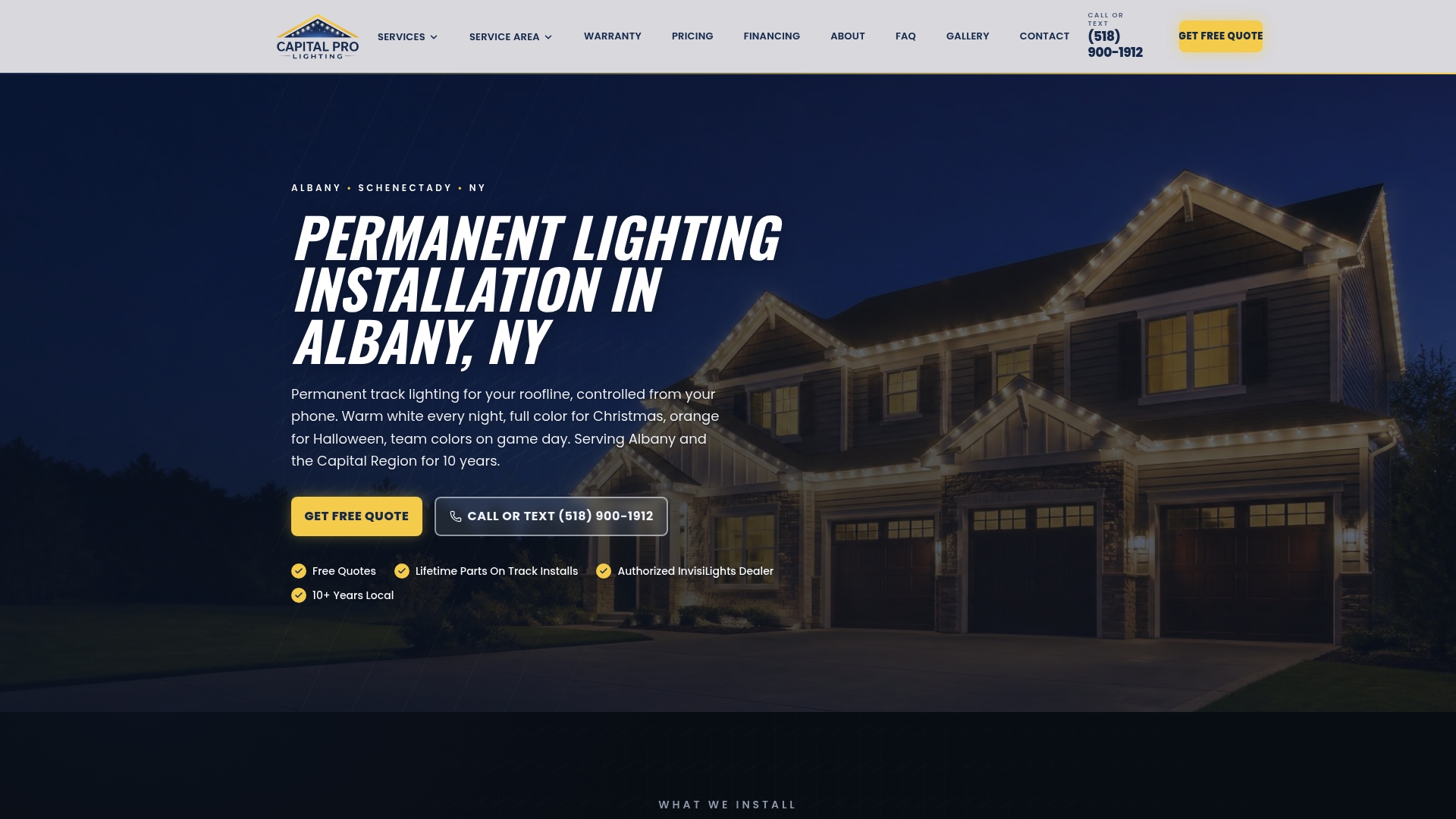
When you request a quote, expect an on-site estimate that includes a commissioning walkthrough, not just a number scribbled on a business card. Visit our permanent outdoor lighting page to see what’s included, or head straight to our pricing page to request your estimate.
FAQ
How much does it cost to have someone install permanent lights?
Pricing depends on roofline length, height, and the controls you choose. As a reference point, our InvisiLights Track Mounted option starts from $2,500 one-time and our InvisiClips / Trackless option starts from $2,000 one-time.
Which company is the best for permanent outdoor lights?
The right choice depends on your roofline, your control preferences, and how the installer handles commissioning and warranty coverage. We offer app-controlled color changes, custom color-matched tracks, and a lifetime parts warranty on our track installations as part of that comparison.
Is permanent lighting worth it?
For homeowners who switch colors for holidays, game days, or everyday accents, permanent lighting removes the yearly cost of ladders, tangled strands, and seasonal labor. Whether it’s worth it depends on how often you’d otherwise pay for seasonal installation and takedown.
How much does permanent lighting cost per foot?
Per-foot pricing varies by installer based on roof complexity, mounting type, and controls, so it’s best compared using a full itemized quote rather than a single rate. Ask each installer for a line-itemed breakdown so you can compare materials, labor, and controls directly.
Sources
- Electrical Safety Foundation (ESFI) — Ground-fault circuit interrupters (GFCI)
- DarkSky International — Five Principles for Responsible Outdoor Lighting
- U.S. Department of Energy — Outdoor lighting control system fundamentals
Recommended
Ready for a Brighter Home?
Free, no-pressure quotes across the Capital Region.
No obligation. Local installer. Same-day callback.
Reviewed by Capital Pro Lighting
Capital Pro Lighting installs permanent outdoor lighting, architectural lighting, and holiday lighting across Albany and New York's Capital Region. We install UL listed permanent lighting systems and have 10 years in business. More about our team.


