
Do Outdoor Lights Need GFCI Protection? The Real Answer

Do Outdoor Lights Need GFCI Protection? The Real Answer
Most hardwired outdoor light fixtures do not need GFCI protection, but any outdoor receptacle almost always does. The National Electrical Code splits the rule along that exact line: NEC Section 210.8 covers outdoor outlets on circuits up to 60 amperes, but it carries a long-standing lighting outlet exception that lets many permanently wired luminaires skip GFCI protection while the outlets that power plugs, transformers, and holiday lights do not.
- If your fixture is hardwired directly to a switch or junction box, it’s usually exempt.
- If it plugs into an outdoor outlet, including a landscape transformer or a string of holiday lights, that outlet almost certainly needs GFCI protection.
Pro Tip: Not sure which category your setup falls into? Trace the wire. If it ends in a plug, treat the receptacle it’s plugged into as needing GFCI, no exceptions.
Key Takeaways
GFCI protection is required for outdoor receptacles on most residential circuits, while many hardwired outdoor light fixtures remain exempt under the NEC’s lighting outlet exception.
| Point | Details |
|---|---|
| Receptacles need GFCI | Any outdoor outlet you plug something into, including a landscape transformer, generally requires GFCI protection. |
| Hardwired fixtures often exempt | Fixtures wired directly to a junction box typically fall under the lighting outlet exception. |
| Moisture causes most trips | Water intrusion at connectors is the leading cause of nuisance trips on outdoor lighting circuits. |
| Local rules can be stricter | Building departments sometimes require broader GFCI coverage than the NEC baseline alone. |
| Professional installs reduce trips | Capital Pro Lighting separates lighting and receptacle loads and backs installations with a lifetime parts warranty. |
GFCI for Outdoor Lights: What the Device Actually Does
A GFCI, or ground fault circuit interrupter, watches for a mismatch between the current flowing out on the hot wire and the current returning on the neutral. When even a tiny amount leaks somewhere it shouldn’t, like through a person, a puddle, or damaged insulation, the device cuts power in a fraction of a second.
Outdoors, that speed matters more than it does inside a dry living room. Rain, sprinkler overspray, and condensation all create paths for current to escape, and a shock outside often happens with wet hands, wet ground, or both. Class A GFCIs built to UL 943 trip at somewhere between 4 and 6 milliamps of leakage, which is well below what a human body can tolerate safely.
- GFCI receptacle: protects only the outlets wired to its LOAD terminals downstream.
- GFCI breaker: protects every device on that entire branch circuit, including hardwired fixtures.
The two aren’t interchangeable in scope, and picking the wrong one is one of the more common mistakes homeowners make when retrofitting older wiring.
What the Electrical Code Actually Requires Outdoors
The current NEC baseline is Section 210.8(F), which applies to outdoor outlets supplied by single-phase branch circuits rated 150 volts or less to ground and a standard ampere threshold that includes most residential outdoor circuits. That 60-ampere ceiling is broad enough to catch nearly every residential outdoor circuit, which is why the code reads as a near-universal requirement for outdoor receptacles.
The exceptions are what trip people up:
- Lighting outlet exception: many hardwired luminaires, the kind screwed into a junction box with no plug involved, are excluded from mandatory GFCI protection.
- Dwelling vs. non-dwelling split: Section 210.8(B) enforces outdoor receptacle protection somewhat differently for commercial or non-dwelling occupancies than it does for a house.
- Special equipment carve-outs, including a temporary exception for certain outdoor HVAC equipment that is scheduled to expire in September 2026.
None of that overrides your town’s own rulebook. Local building departments frequently adopt the NEC with amendments, and some jurisdictions require broader GFCI coverage than the national code alone would demand. Always confirm with your local building department before assuming the baseline is the whole story.
Do Your Specific Outdoor Lights Need GFCI? A Quick Rundown
Every homeowner’s setup is a little different, but most fall into one of these buckets:
- Hardwired porch or post lantern: usually no GFCI required. It’s a fixed lighting outlet covered by the exception.
- Plug-in landscape lighting transformer: yes. The 120-volt outlet feeding the transformer needs GFCI protection, even though the 12-volt cable running to the fixtures generally does not.
- Holiday string lights plugged into an outdoor outlet: yes. That’s exactly the scenario the receptacle requirement targets.
- Lighting near a pool, hot tub, or fountain: yes, and often at a stricter standard than a standard outdoor outlet, given the elevated shock risk near standing water.
- Crawl space lighting: typically yes for the receptacle serving it, since crawl spaces fall under damp or wet-location logic in most code interpretations.
- Low-voltage 12V fixtures after a transformer: no, the low-voltage side isn’t the concern. The 120-volt supply into the transformer is.
The edge case worth flagging: a single circuit that feeds both a receptacle and a hardwired fixture. In that layout, the whole circuit often needs protection at the breaker level, even though the light fixture itself would be exempt on its own.
How to Add GFCI Protection to an Outdoor Circuit
Two practical paths get you there, and the right one depends on what’s already in your panel and how your outlets are wired.
- Install a GFCI receptacle at the outdoor outlet. This protects everything wired downstream of its LOAD terminals. It’s the cheaper option and the one most DIYers reach for first, but it only protects that string of outlets, not the rest of the circuit.
- Install a GFCI breaker at the panel. This protects the entire branch circuit, hardwired fixtures included, from one point. It costs more but eliminates guesswork about what’s covered.
Both approaches share the same weatherproofing requirement. Outdoor receptacles need weather-resistant (WR) construction and an in-use cover rated for wet locations, not just a spring-lid cover that only closes when nothing is plugged in.
- Expect a basic receptacle swap to run a modest few hundred dollars in parts and labor.
- A panel-level breaker swap costs more and may require an electrician if your panel isn’t a compatible brand or has limited slots.
Pro Tip: Label every GFCI you install with its date and location, then test it the same day you install it. A five-second habit now saves a confused afternoon later.
Why Outdoor Lights Trip a GFCI (and How to Fix It)
A GFCI doesn’t care whether the fault is dangerous or just annoying, it trips the moment it detects imbalance. That sensitivity is the point, but it also means small problems announce themselves loudly.
Moisture is the top culprit by a wide margin. Field diagnostics on landscape lighting circuits attribute the majority of trips to moisture intrusion at connectors or fixture housings, with damaged wire insulation and failing transformer windings rounding out the usual suspects.
Work through it in this order:
- Unplug or isolate the transformer first to see if the trip stops.
- Divide the lighting run into zones and reconnect one section at a time.
- Let anything that got wet dry out fully before testing again.
- Inspect wire connectors and fixture housings for cracked seals or corrosion.
- Check for nicked or brittle insulation along exposed runs.
Never bypass a GFCI to make the tripping stop, and don’t keep mashing the reset button hoping it sticks. A trip that returns after a dry, sunny day usually means a real fault, not a fluke.
When to Call a Licensed Electrician
Some situations are worth handing off. Call a licensed electrician if:
- You don’t know how your outdoor circuit is laid out or which breaker feeds it.
- A GFCI keeps tripping after you’ve isolated and dried every section.
- The fix involves touching your service panel or a shared multi-outlet circuit.
- Local permits or an inspection are required for the work.
Check with your building department about local amendments before you start, since some municipalities require GFCI placement shown on plans and accessible testing points at inspection. Have a rough circuit map, photos of the fixtures, and a clear answer on whether your transformer is plugged in or hardwired ready before that call.
How Professional Installers Handle GFCI Compliance
Electricians who install permanent outdoor lighting for a living tend to separate receptacle loads from lighting loads early in the design, rather than daisy-chaining everything onto one circuit and hoping it behaves. That separation is exactly why trade guidance for GFCI installations often favors circuit reconfiguration over just slapping a GFCI on a problem circuit and calling it solved.
Done right, a professional install gets you:
- Fewer nuisance trips because moisture-prone connections are sealed and rated for the location.
- Correct in-use covers and weatherproof boxes on every outdoor outlet.
- Clear circuit labeling so troubleshooting later doesn’t start from zero.
- Warranty coverage on parts, which matters when a fixture or connector fails years down the road rather than in year one.
An installer’s take
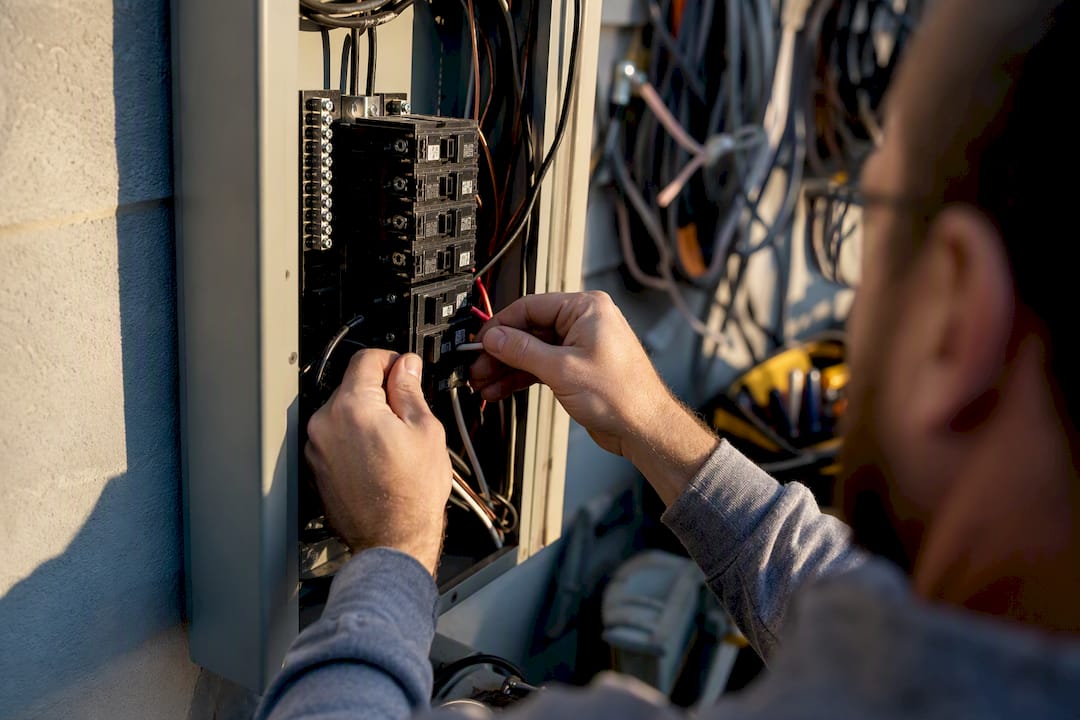
Most pros wire lighting and receptacle loads on separate circuits from the start, because it keeps a single moisture issue from tripping every light on the property. A quarterly push of the TEST button and a quick visual check catch most problems before they become service calls.
Get Permanent, Compliant Outdoor Lighting Without the Guesswork
Capital Pro Lighting installs permanently mounted, app-controlled lighting systems with weatherproof wiring and GFCI or panel-level protection built in correctly the first time, so you’re not troubleshooting trips or wondering if your setup meets code.

- Every install accounts for code-appropriate circuit separation and weatherproofing from day one.
- Every track comes with a lifetime parts warranty, so you’re covered long after installation.
No more climbing a ladder every November to untangle strings, and no more guessing whether your landscape transformer is wired correctly. If you’re in the Capital Region, check service availability for your address and request a quote, or explore permanent lighting options in Albany to see what a proper installation looks like.
Sources
- NEC requirements for GFCIs and AFCIs (ECMweb)
- Outdoor Lighting GFCI Requirements NEC 2026: Section 210.8(F) Guide
- Does outdoor lighting need GFCI? (LedLightingInfo)
FAQ
Is GFCI required for outdoor lights?
Outdoor receptacles generally require GFCI protection, but many hardwired outdoor light fixtures are excepted under the NEC’s lighting outlet rule.
How do I keep outdoor lights from tripping a GFCI?
Isolate and dry out wet connections first, since moisture causes most trips, then inspect for damaged insulation or a failing transformer before assuming the GFCI itself is faulty.
Do I need a special GFCI outlet for outdoors?
Yes, outdoor GFCI receptacles need weather-resistant construction and an in-use cover rated for wet locations, not a standard indoor GFCI.
What should you never plug into a GFCI outlet?
Avoid plugging in equipment with known ground faults or damaged cords, and never bypass a tripping GFCI by using an adapter or extension cord to route around it.
Can Capital Pro Lighting handle GFCI compliance for a permanent installation?
Yes, Capital Pro Lighting designs permanent lighting circuits with proper load separation and weatherproofing so GFCI protection is correctly placed from the start.
Recommended
Ready for a Brighter Home?
Free, no-pressure quotes across the Capital Region.
No obligation. Local installer. Same-day callback.
Reviewed by Capital Pro Lighting
Capital Pro Lighting installs permanent outdoor lighting, architectural lighting, and holiday lighting across Albany and New York's Capital Region. We install UL listed permanent lighting systems and have 10 years in business. More about our team.


