
No Ladder Patriotic Lighting for Capital Region Homeowners
No Ladder Patriotic Lighting for Capital Region Homeowners
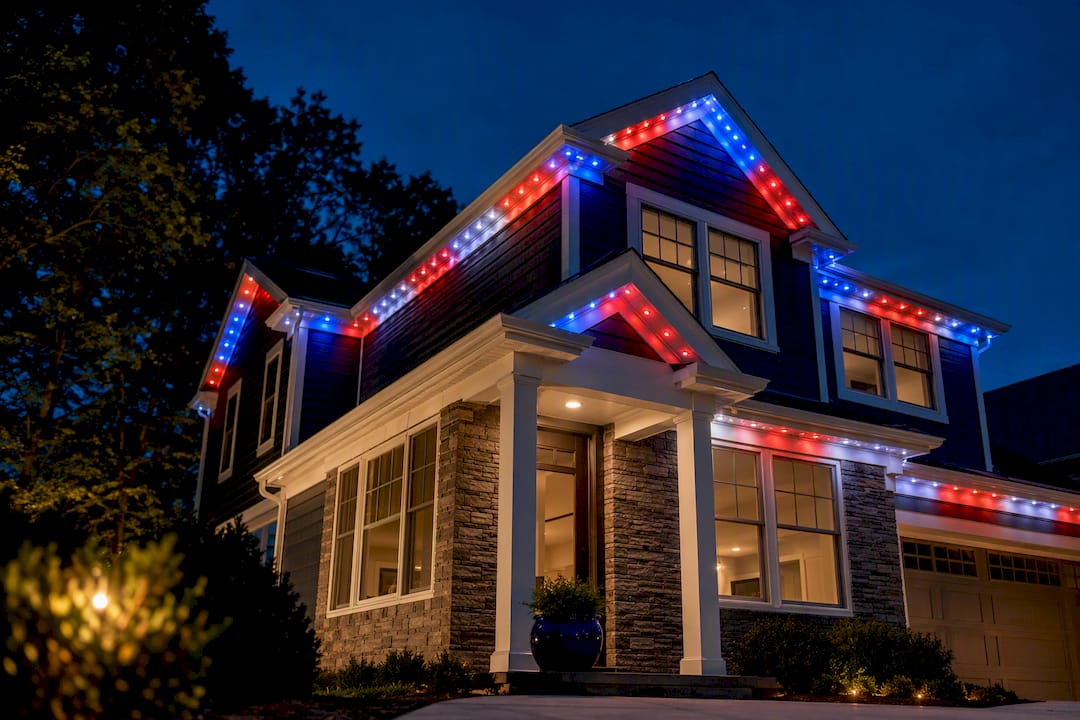
For a display that looks sharp and stays within Flag Code, illuminate a properly mounted flag with a dedicated spotlight and pair it with red, white, and blue string or roofline RGB lighting. Under 4 U.S.C. § 6, the flag can fly around the clock, but only if it’s lit after dark. Budget shoppers can grab string lights for one holiday. Anyone who wants the display up for months should look at a permanent programmable roofline system instead.
TL;DR:
- Proper illumination of the flag requires fixtures with enough brightness to be clearly visible from a normal distance after dark; solar flagpole lights typically last 8 to 12 hours.
- Aiming downward-mounted fixtures or ground spotlights ensures even coverage and better visibility, especially for taller flagpoles, while avoiding shadowing or washed-out colors.
- Permanent programmable roofline systems have a higher initial cost but offer app-controlled color changes and cleaner mounting, eliminating yearly restringing and color fade issues.
- When choosing outdoor lights, prioritize fixtures with high lumen output, good color-rendering quality, weatherproof ratings of IP65 or higher, and proper voltage handling for long runs to prevent dimming.
- Indoor patriotic displays should focus on safe, UL-listed LED fixtures, avoiding high-heat bulbs near fabrics, and ensuring cords are properly managed to prevent hazards.
Top Patriotic House Lighting Ideas and Where to Use Them
The best patriotic displays mix a few fixture types rather than leaning on one. Here’s what actually works, organized by where it goes on your property.
- Roofline RGB strips: run along the fascia for a bold red, white, and blue wash visible from the street; best left to a pro for clean mounting.
- Porch column wraps: red and blue mini lights spiraled up columns frame the entryway without much wiring hassle. Easy weekend DIY.
- Star silhouette stakes: metal star cutouts with warm white LEDs work well lining a front walkway. Cheap, fast, and beginner-friendly.
- Flagpole spotlights: ground-mounted or pole-top fixtures aimed at the flag itself, covered in detail below.
- Window candlelights: red, white, and blue LED candles in every front-facing window add symmetry with almost zero effort.
- Eave-mounted rope lights: a budget alternative to full roofline systems, good for renters or short-term displays.
- Tree wrap lighting: red and blue LED strands wrapped up a trunk and through low branches extend the palette beyond the house itself.
- Solar path lights: mixed red and blue lenses along a driveway or garden bed, no wiring required.
Roofline strips, flag spotlights aimed correctly, and anything requiring electrical modification are worth hiring out. Stars, window candles, and solar stakes are solid DIY territory for a Saturday afternoon.
If your display needs to shift from Independence Day colors to another palette later, a color-changing system saves you from re-stringing lights every season.
Pro Tip: Test your color palette after dark before Independence Day arrives. Many “patriotic” LED strands skew purple instead of true blue once the sun goes down.
Flag and Flagpole Lighting: Etiquette and Best Fixtures
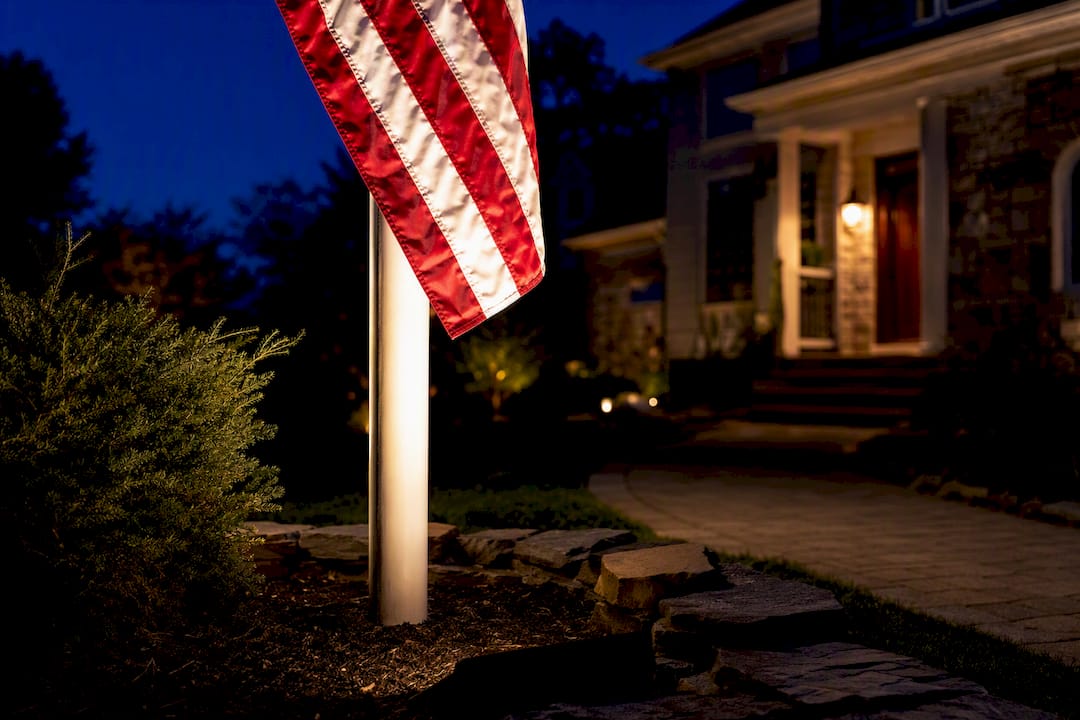
The U.S. Flag Code makes the rule simple: fly the flag at night only if it’s “properly illuminated during the hours of darkness,” per 4 U.S. Code § 6. In practice, that means the flag needs enough direct light to be visibly identifiable from a normal viewing distance, not just a porch light glow reaching it by accident.
Three fixture types handle this job:
- Pole-top solar rings: circle the pole below the flag, no wiring needed, though performance depends on battery capacity and sun exposure.
- Top-mounted downward lights: aim down the pole and across the flag for even coverage on taller installations.
- Ground spotlights: aimed upward from the base, often the simplest retrofit for existing poles.
Consumer testing on solar flagpole lights shows runtimes typically land in the 8 to 12 hour range with IP65 weather protection, and lumen output varies enough between models that it’s worth checking specs rather than assuming any solar ring will do. For full coverage without shadowing, lighting professionals generally recommend narrow beam spreads and fixture placement scaled to pole height and flag width. The red stripes and blue field absorb more light than the white, so a dim fixture leaves a flag looking washed out rather than vibrant.
Outdoor House Displays: Temporary Versus Permanent Roofline Lighting
Clip-on string lights and rope lights make sense when you’re decorating for one holiday and don’t want a long-term commitment. They’re inexpensive, available at most hardware stores, and easy to take down in a weekend. The trade-off is the annual ladder climb, the tangled storage bin, and colors that fade a season or two in.
Permanent programmable roofline lighting solves the recurring hassle. Instead of restringing lights every summer, you flip the palette on a phone app and switch from red, white, and blue back to daily white or holiday colors whenever you want. The fixtures mount into a track system, which gives a cleaner line along the roof edge than clipped strings ever manage, and the color output stays consistent because the LEDs aren’t degrading in a storage bin all year.
- Temporary strings: lowest upfront cost, best for occasional use, shortest lifespan.
- Permanent roofline systems: higher upfront investment, app-based color control, no annual installation labor.
One technical detail matters on longer runs: LED circuits over roughly 100 feet can suffer voltage drop, which dims the far end of the run and shifts color accuracy. Installers typically add power-injection points partway through the run to keep brightness and color even from one end to the other.
Pro Tip: If you’re comparing quotes for a permanent install, ask specifically how the installer handles voltage drop on long rooflines. It’s a detail that separates a clean install from one with a dim, uneven stretch by the garage.
Indoor Patriotic Lighting Ideas and Safety Considerations
Indoor displays can be just as bold as anything outside. A mantel arrangement with small string lights woven through garland, a tabletop lantern in red glass, or a color-wash uplight aimed at a wall behind a flag display all read well in photos and in person. Window-mounted star silhouettes backlit with LED puck lights create a strong look visible from the street after dark.
Keep safety in the mix indoors:
- Use UL-listed fixtures rated for indoor use only where labeled.
- Choose low-heat LEDs, especially near fabric bunting or paper decorations.
- Keep cords away from foot traffic and never run them under rugs.
- If displaying a flag indoors, avoid draping it in a way that lets it touch the floor.
How to Choose Lights: Brightness, Color, and Power Source
Picking the right fixture comes down to four factors, and getting any one wrong shows up immediately after dark.
- Match lumens to the job. Pathway lights need modest output, accent lighting on columns or trim needs moderate brightness, and flag or roofline fixtures need the highest lumen counts to stay visible against ambient light.
- Check color quality, not just color name. Cheap LEDs often render “red” as orange-pink and “blue” as purple once it’s dark. Look for fixtures with a color-rendering spec listed, and favor brands that show real product photos taken at night.
- Weigh your power source. Solar fixtures need no wiring but depend on sun exposure and battery health; low-voltage systems need a transformer but run more reliably; line-voltage systems power the biggest roofline installs but need professional wiring.
- Run the checklist before buying: IP65 or higher for anything exposed to rain, a UL listing, mounting hardware that fits your surface, and a warranty that covers more than 90 days. ENERGY STAR offers general guidance on efficient LED selection if you’re comparing wattage against brightness.
Maintenance, Safety, and Seasonal Care
A quick seasonal check keeps a display looking sharp and prevents shorts or fire risk.
- Inspect seals and connectors for cracking before each display season.
- Check solar panels and batteries for corrosion or reduced runtime.
- Store temporary strings coiled loosely, not wound tight, to avoid wire fatigue.
- Call a licensed installer for any electrical splicing, long roofline runs, or complex layouts involving multiple rooflines or power sources, especially to ensure proper outdoor lighting durability and weather protection.
Why Permanent Programmable Roofline Lighting Is a Leading Option
A permanent, app-controlled system removes the seasonal hassle entirely. Instead of climbing a ladder every Independence Day, you switch the roofline to red, white, and blue from your phone and switch it back whenever you want.
Capital Pro Lighting has installed these systems around the Capital Region for over 10 years, and a few details tend to matter most to homeowners comparing quotes:
- Phone-based color control for instant seasonal or holiday changes.
- Custom 3D-printed brackets for a track that sits flush against trim, not a bulky retrofit.
- A lifetime parts warranty on the track installation itself.
When you’re getting quotes, ask about bracket customization for your roofline, how voltage drop is handled on longer runs, and what the site visit covers before a quote is finalized.
Pro Tip: Ask any installer to show you a completed roofline job in person, not just a video. Bracket fit and wire concealment are easiest to judge up close.
When DIY Makes Sense and When a Pro Is Worth It
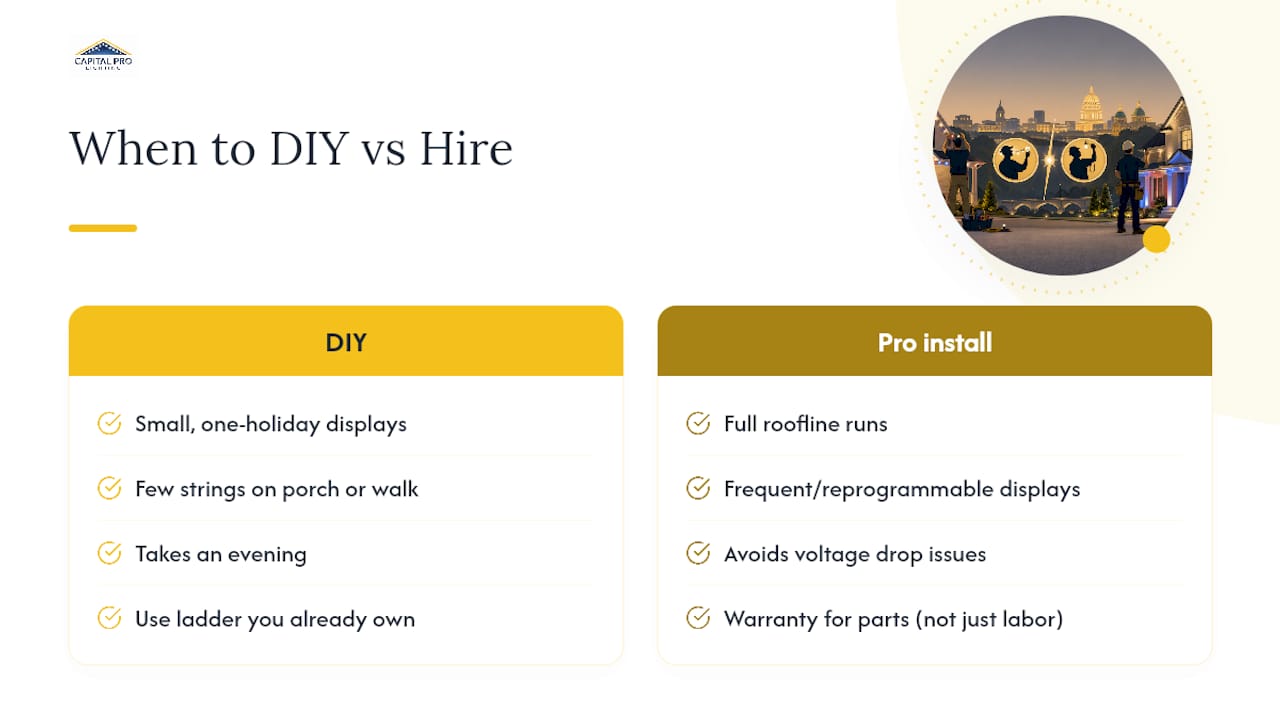
Small, one-holiday displays are genuinely good DIY projects. A few strings of lights on a porch column or stars along the front walk don’t need much more than an evening and a ladder you already own.
Where I’d draw the line is scale and frequency. A full roofline run, or a display you want to reprogram for every holiday from Independence Day through the winter, starts running into voltage drop, mounting durability, and warranty questions that a retail light strand was never built to answer. That’s where paying for an install earns its cost, particularly if the warranty covers the parts and not just the labor.
— Luis T
Get a Permanent, App-Controlled Patriotic Lighting Setup
There’s a real gap between a string of lights you restring every July and a system you control from your couch. Permanent roofline installations built for the Capital Region offer a color palette controlled via phone instead of stored in a bin. No ladder, no tangled strands, no faded reds by August.
A typical project starts with a site visit to map your roofline and discuss bracket placement, followed by a quote and an install that comes with a lifetime parts warranty on the track. If you’re in Delmar, Troy, or elsewhere in the Capital Region, check out permanent lighting options in your area or head to the main Capital Pro Lighting page to request a quote for your home.
Sources
- 4 U.S. Code § 6 - Time and occasions for display | LII / Legal Information Institute
- Best solar flagpole light | BobVila
- How to light up a flagpole | VOLT Lighting
- Best LED light for flagpole | SolarPanelCrew
FAQ
Is it appropriate to illuminate the American flag at night?
Yes, and it’s more than appropriate. Under 4 U.S.C. § 6, the flag may be displayed 24 hours a day specifically when it is properly illuminated during darkness.
What is the best type of outdoor light for a flagpole?
Pole-top solar rings work well for smaller poles with good sun exposure, while ground spotlights or top-mounted downward lights give more even coverage on taller poles, according to flagpole lighting guidance from VOLT Lighting.
How many lumens does a flagpole light need?
It depends on flag size and pole height, but consumer testing shows solar flagpole lights typically run 8 to 12 hour cycles with IP65 protection, and higher-lumen models perform better on larger flags.
What are some American-made outdoor light fixtures?
Look for fixture brands that list UL certification and country-of-origin details on their packaging or spec sheets; availability varies by retailer, so check current listings rather than relying on brand reputation alone.
Should I choose solar or wired lighting for a permanent patriotic display?
Solar works fine for smaller accents like path lights or a flagpole ring, but wired low-voltage or line-voltage systems handle full roofline installs more reliably, especially for color-changing displays used across multiple seasons.
Recommended
Ready for a Brighter Home?
Free, no-pressure quotes across the Capital Region.
No obligation. Local installer. Same-day callback.
Reviewed by Capital Pro Lighting
Capital Pro Lighting installs permanent outdoor lighting, architectural lighting, and holiday lighting across Albany and New York's Capital Region. We install UL listed permanent lighting systems and have 10 years in business. More about our team.


