
Financing vs Cash for Homeowners: Use Six Months 0% to Protect Savings

Financing vs Cash for Homeowners: Use Six Months 0% to Protect Savings
Finance when your loan’s after-tax cost sits meaningfully below what your cash could earn elsewhere, or when paying cash would empty your emergency fund. Pay cash when the rate is high, the item depreciates fast, and your reserves can absorb the hit without strain. The main exceptions: genuine 0% promotions, low, locked-in rates, and any situation where writing a check leaves you without a safety net.
TL;DR:
- Financing is advisable when your loan’s actual APR is lower than what your cash could earn through investments or savings, especially if paying cash would reduce your emergency fund below three months of expenses.
- Always check the true APR, origination fees, and prepayment penalties before choosing a loan to avoid hidden costs, particularly with promotional 0% offers.
- Paying cash is better when the loan rate is high, the asset depreciates quickly, and paying cash won’t deplete your safety net or reduce your emergency reserves below your comfort level.
- Keep three to six months of expenses in reserve to protect against emergencies, as draining your liquidity to avoid interest costs often leads to higher borrowing costs later.
- When financing for home improvements or big purchases, ensure all costs are clear, prepayment penalties are minimal, and the financing term matches how long you’ll use the asset to maximize benefits.
Financing vs Cash: A Quick Decision Checklist
Run these checks before you sign anything or transfer a dollar.
- Compare the real APR to your cash’s return. Include origination fees and any add-ons in the loan’s true cost, then weigh that against a conservative after-tax return you could earn by keeping the money invested or in savings.
- Protect your emergency fund. If paying cash drops your reserves below three months of expenses, finance instead, even if the loan carries some interest.
- Factor in the asset type. A depreciating asset (most vehicles, electronics) tilts toward financing since you’re not tying up capital in something losing value. An appreciating or income-generating asset can make cash the smarter play.
- Check the fine print on 0% offers. Confirm there’s no prepayment penalty and that you can genuinely pay it off inside the promo window.
What Financing Actually Costs You (And Where It Pays Off)
Financing keeps cash in your pocket now, but you’re renting that convenience. The FTC’s credit guidance is blunt about reading the fine print before you borrow. Here’s the tradeoff broken down.
The upside:
- Preserves liquidity for emergencies or better opportunities
- Spreads a large cost into predictable monthly payments
- Can create arbitrage if your cash earns more than the loan’s APR
- Builds installment credit history when you pay on time
- Unlocks access to big purchases you couldn’t otherwise make immediately
The downside:
- Interest and origination fees add real dollars to the total cost
- Lenders often require insurance coverage you might not otherwise buy
- Depreciating assets can leave you owing more than the item is worth
- Missed payments damage your credit score fast
Pro Tip: Before you sign, check three numbers: the actual APR (not the “starting at” rate), any origination fee, and whether early payoff triggers a penalty. Those three details separate a good loan from a bad one.
Why Paying Cash Isn’t Always the Safer Choice
Paying cash feels simple: no interest, no lender rules, no monthly reminder. That simplicity has a cost most people underestimate.
The upside:
- Zero interest and no loan fees
- No lender-imposed insurance or usage restrictions
- Full ownership from day one
- Almost always cheaper in total when the loan APR is high
The downside:
- Ties up capital you might need elsewhere
- Can drain your emergency fund faster than you’d like
- Does nothing for your credit history
- May forfeit manufacturer rebates or promotional financing designed to reward buyers who finance
The rule that matters most here: never pay cash if it pushes your liquid reserves below your personal safety cushion. Experian’s comparison of financing and cash purchases makes the same point. A cheaper total cost on paper isn’t a win if it leaves you exposed to an emergency with no buffer.
How to Run the Math Before You Decide
You don’t need a finance degree to figure this out. You need five inputs and a calculator.
- List your inputs: purchase price, APR, fees, loan term, expected after-tax return on cash, and your emergency-fund buffer.
- Calculate total interest owed over the loan term using the actual APR, not the advertised teaser rate.
- Calculate the opportunity cost of paying cash: your buffer amount times your expected after-tax return, over the same time period.
- Compare the two totals. Whichever number is smaller tells you which option costs less in dollars. Then weigh liquidity separately.
- Find your break-even APR: the rate at which the loan’s interest cost equals what your cash could have earned elsewhere. Below that rate, financing usually wins financially; above it, cash usually wins.
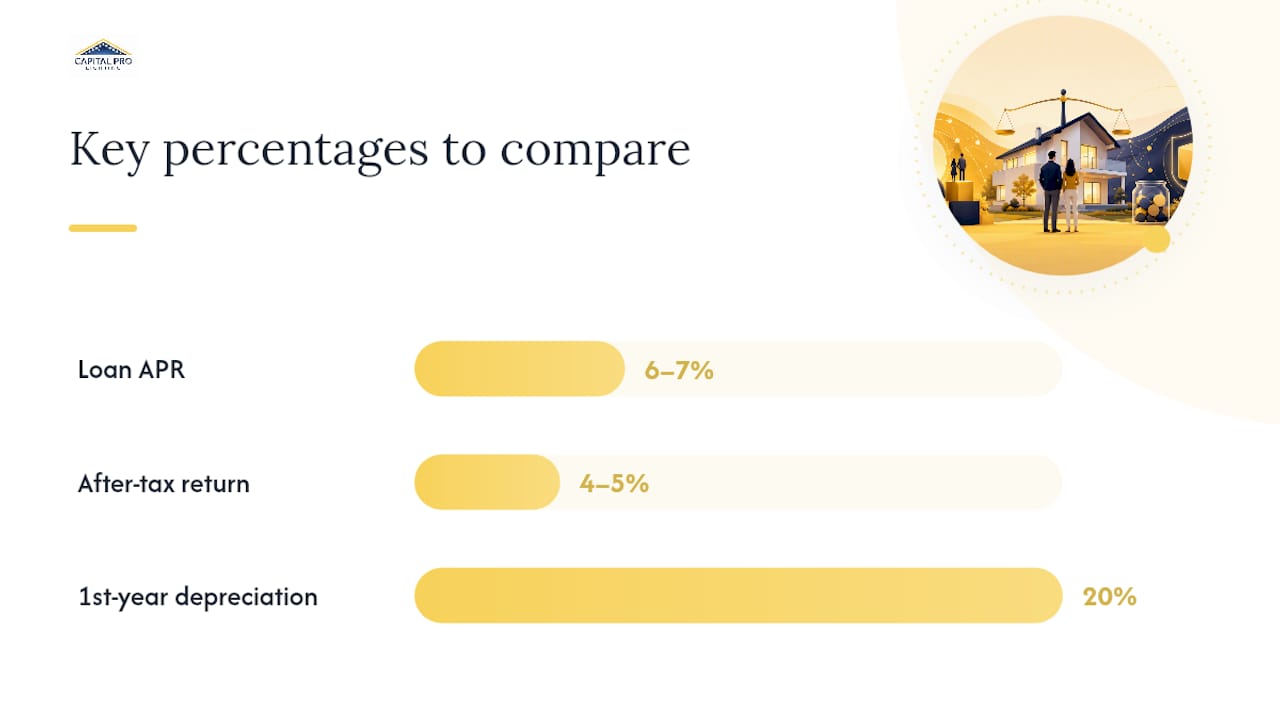
Here’s a worked example. Say you’re financing $30,000 for a vehicle. Guides that break down car loan versus cash math show that a 60-month loan around 6% to 7% APR generates several thousand dollars in interest over the loan’s life. Now compare that to keeping the $30,000 invested at a conservative 4% to 5% after-tax return, a range used by financial calculators modeling this exact decision. If your loan rate sits below that expected return, financing can leave you ahead even after accounting for interest. If your rate runs higher, cash wins on pure math.
Numbers aside, weigh how long you’ll keep the item, whether the loan has a prepayment penalty, whether the lender forces added insurance, and how fast the asset depreciates. A vehicle losing 20% of its value in year one changes the calculation more than a percentage point of APR ever will.
Dealer Incentives and the Negotiation Games You Need to Know
You typically pick one. KBB’s guidance on incentives explains that manufacturers use these offers to steer buyers toward financing, since dealers often earn commission on financed deals.
- Negotiate the price first, before mentioning whether you’re paying cash or financing.
- Compare the total cost of the 0% offer against taking the rebate and financing elsewhere at a low rate.
- Watch for add-on fees: documentation charges, forced gap insurance, and extended warranties dealers bundle into financed deals.
Revealing your payment method early gives the salesperson leverage. Keep it to yourself until the price is locked.
Liquidity, Credit, and Insurance Factors You Can’t Ignore
Most consumer finance guidance points to keeping three to six months of expenses in reserve, and for good reason: draining that cushion to avoid a modest interest rate often forces you into higher-cost borrowing later when an emergency hits. A tiny interest rate spread rarely justifies that risk.

Installment loans, when paid on time, build credit history in a way cash purchases simply don’t. Miss payments or run credit utilization high, though, and the damage outweighs the benefit fast. If you’re financing a vehicle, expect the lender to require comprehensive and collision coverage, an added annual cost that can rival or exceed the loan’s interest over time, according to LegalClarity’s breakdown of financing versus paying in full. For most consumer purchases, tax implications are minimal. Interest on personal loans and auto loans generally isn’t deductible, unlike mortgage interest, so don’t count on a tax break to tip the math.
Applying This to Home Installations Like Permanent Lighting
The same framework applies when you’re paying for a home improvement project, not just a vehicle. A homeowner installing permanent outdoor lighting faces the identical question: pay the full cost upfront, or spread it out and keep cash available for the unexpected?
A short, genuine no-interest financing window changes the math in the buyer’s favor, since you preserve your emergency fund without paying a premium for the privilege, as long as you pay it off before interest kicks in.
When comparing quotes for a home lighting project, ask these questions regardless of who you hire:
- What’s covered under the warranty, and for how long?
- Is the total installed cost, including brackets, controllers, and labor, spelled out upfront?
- Are there prepayment penalties if you pay off the financed balance early?
- Does the financing term match how long you expect to enjoy the system?
Get Permanent Lighting Installed Without Draining Your Savings
Capital Pro Lighting installs permanent outdoor roofline lighting that you control from your phone, switching colors for holidays, game days, or just a Tuesday night, without ever touching a ladder again. For homeowners who’d rather keep cash on hand than pay the full installed cost upfront, Capital Pro Lighting offers six months of no-interest financing, letting you spread the cost while your emergency fund stays intact.

Every installation includes a lifetime parts warranty on the track system and custom 3D-printed brackets for a clean, factory-finished look, details worth comparing against any other quote you collect. If you’re weighing cash against financing for your own home, the smartest first step is seeing the real numbers side by side. Request a quote from Capital Pro Lighting and ask about the financing terms directly.
What I’d Tell a Friend Before They Sign Anything
Run the math before you decide anything else. Most people skip this step and regret it later, either by paying cash they needed for an emergency or by financing at a rate that quietly cost them more than they realized. Two rules I’d stick to: keep your emergency fund untouched no matter how good the cash discount looks, and only take financing when the rate is genuinely low or the promo window is real and manageable.
— Luis T
This article is general information, not a substitute for advice from a qualified financial advisor. Consult a qualified financial professional about your own circumstances before acting on anything here.
Sources
FAQ
Is Financing Better Than Cash?
Neither is universally better. Financing tends to win when the loan’s APR sits below what your cash would otherwise earn or when paying cash would drain your emergency fund; cash tends to win when the rate is high and your reserves can absorb the cost.
What Is the Difference Between Cash and Financing?
Paying cash means you own the item outright immediately and never pay interest, while financing means a lender fronts the money and you repay it over time with interest and fees added to the total cost.
Do Dealerships Prefer You to Finance or Pay Cash?
Most dealerships prefer financing because they often earn a commission on the loan, which is why KBB recommends negotiating the price before revealing how you plan to pay.
What Is the $3,000 Rule for Cars?
This isn’t a standard, universally recognized rule in auto financing; if you’ve seen it referenced, it likely refers to a specific dealer promotion or rebate threshold rather than an industry-wide guideline, so verify the exact terms with the dealer offering it.
Recommended
Ready for a Brighter Home?
Free, no-pressure quotes across the Capital Region.
No obligation. Local installer. Same-day callback.
Reviewed by Capital Pro Lighting
Capital Pro Lighting installs permanent outdoor lighting, architectural lighting, and holiday lighting across Albany and New York's Capital Region. We install UL listed permanent lighting systems and have 10 years in business. More about our team.


