
The Right Way to Light a Restaurant Patio for Guests and Revenue
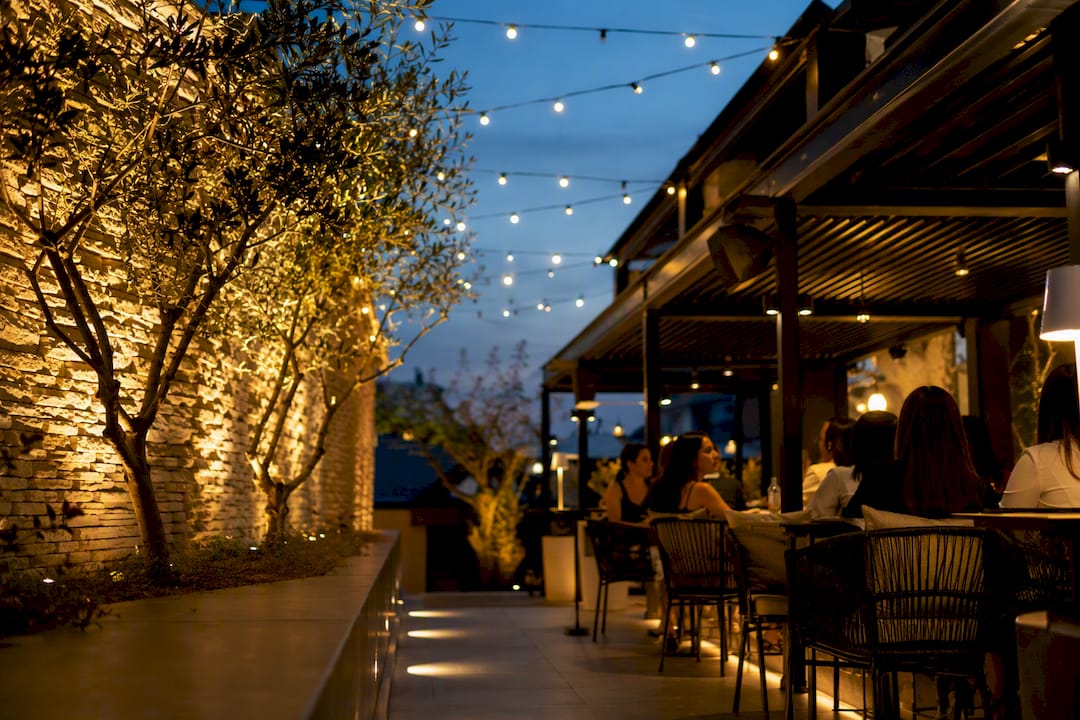
The Right Way to Light a Restaurant Patio for Guests and Revenue
The fastest way to improve your patio’s revenue and guest experience is a layered lighting system: warm, dimmable LEDs (2700K to 3000K), CRI of 90 or higher, and weatherproof fixtures with scene controls. Skip any single-source overhead solution. Guests linger longer under layered light, and they order more when they can actually read the menu without squinting.
Use this checklist when you’re comparing bids or sketching out a patio refresh:
- Layer three types of light: ambient (overall glow), task (menu and table visibility), accent (drama on walls, trees, stairs)
- Require CRI ≥90 and 2700K to 3000K color temperature so food and skin tones look appetizing, not sickly
- Specify IP65 for any fixture exposed to rain or snow, IP44 minimum under a covered structure
- Before signing anything, confirm dimming and scene controls are part of the install, or bring in a licensed electrician for a permanent system
Key Takeaways
Restaurant exterior lighting works best as a layered system of warm, high-CRI, weatherproof LEDs with dimming controls specified before installation, not added afterward.
| Point | Details |
|---|---|
| Layer three light types | Combine ambient, task, and accent lighting instead of relying on a single overhead source. |
| Hit the right footcandle target | Aim for 5 to 10 footcandles at table height for comfortable, glare-free dining. |
| Specify Kelvin and CRI | Demand 2700K to 3000K color temperature and CRI of 90 or higher in every bid. |
| Match IP rating to exposure | Use IP44 under cover, IP65 for open patios, and IP67/68 for in-ground or water fixtures. |
| Consider a permanent system | Capital Pro Lighting installs phone-controlled permanent LED systems with a lifetime parts warranty on track installs. |
Why Layered Restaurant Exterior Lighting Changes the Guest Experience
Ambient light fills the space and sets the emotional temperature of the patio. Task light lets guests read a menu or a check without pulling out a phone flashlight. Accent light adds depth, drawing the eye to a tree, a stone wall, or an entrance without flooding the whole area in brightness.
Professional hospitality lighting guidance generally targets 5 to 10 footcandles at table height for dining ambiance, a range that feels intimate without leaving anyone straining to see their plate. A single string of overhead bulbs can’t hit that target evenly. It creates hot spots directly under each bulb and dead zones in between, which is why patios lit this way often feel harsher than restaurants that build in layers.
Three things happen when you layer correctly, especially if you consider incorporating features like contemporary pizza ovens for UK outdoor use that may impact your patio layout and lighting needs:
- Glare drops because no single fixture has to do all the work
- Dwell time increases because the space feels considered rather than functional
- Menu and check readability improves without adding cold, clinical light
Pro Tip: Walk your patio at dusk with a phone light meter app before finalizing any fixture order. It’s a rough tool, but it will show you exactly where the dark pockets are.
Which Fixtures Create Each Lighting Layer
Ambient light usually comes from overhead sources spread across the whole patio. Tensioned stainless-steel cables strung with commercial-grade LED string lights remain the standard here, and they hold their line far better than the plastic hooks and rope-light setups sold for backyard parties. Soffit-recessed cans and pendants hung under a pergola also work well when you want a cleaner architectural look instead of visible cable runs.
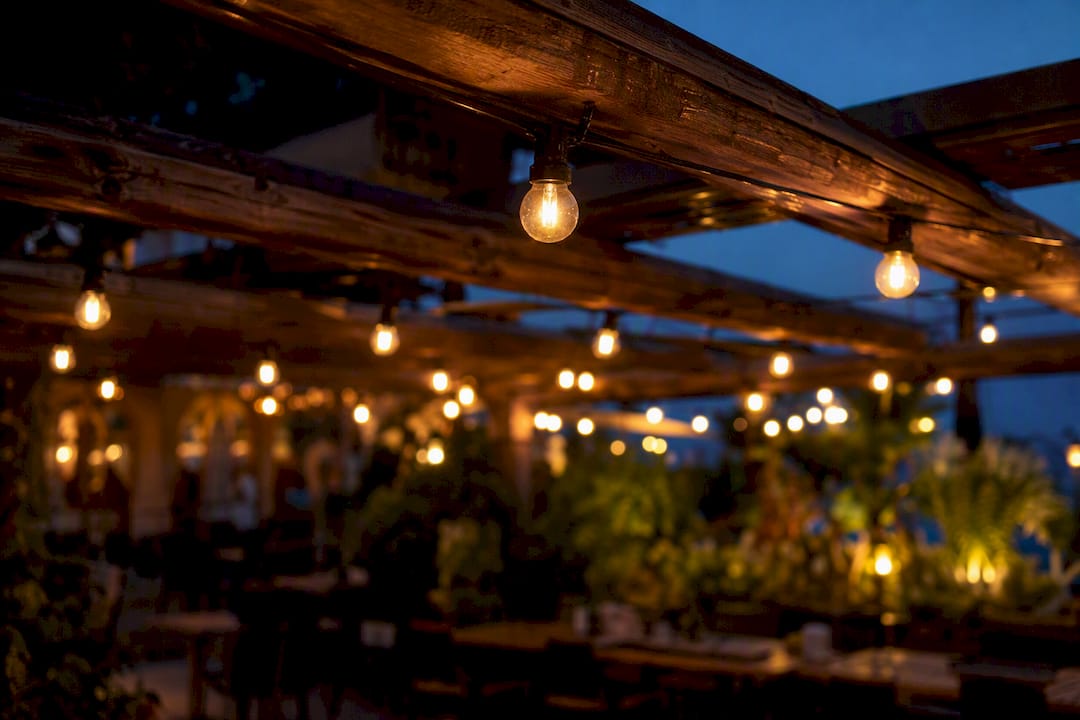
Task light needs to reach the table without hitting anyone in the eyes. Battery-powered table lamps solve this at low cost and let you rearrange seating freely. Low-hung pendants and directional downlights work too, but only if they’re aimed carefully. A downlight pointed straight down onto a four-top can throw shadows across faces; angle it slightly off-vertical and shield the lens.
Accent light is where a patio gets its personality. Consider:
- Narrow-beam uplights (15° to 25° beam angle) aimed at trees or a stone façade, which emphasizes texture without washing out the whole space
- Linear wall washers along a fence or building edge for a soft glow line
- Integrated stair lights for both safety and visual interest
- Concealed undercap masonry lighting tucked beneath a bar top or planter ledge
Mount ambient string lights at least 8 to 9 feet high to avoid guests brushing against them, and always shield any accent fixture positioned below seated eye level. Glare is the fastest way to undo a good lighting plan, and it’s almost always caused by an unshielded fixture aimed at the wrong angle rather than a fixture that’s simply too bright.
What Specs Should You Demand in a Lighting Bid?
Any contractor quoting your patio should be able to answer these questions without hesitation. If they can’t, that’s worth noting before you sign.
- Color temperature: 2700K to 3000K for dining patios. Warmer light in this range renders food more appetizingly and flatters skin tones, which matters for photos as much as for how a couple feels on a date night. Color-temperature strategies for hospitality often push fine dining toward the warmer end (2200K to 2700K) and casual dining slightly cooler (2700K to 3000K)
- CRI: Specify 90 or higher across every fixture. Restaurants leaning on social-media photography should push for 95, since high CRI is what keeps food looking natural under camera flash rather than washed out or oddly tinted
- IP rating: IP44 is the floor for anything under a covered patio roof. Fully exposed fixtures need IP65. Anything in-ground or near a water feature should be IP67 or IP68
- Dimmability: Non-negotiable. Ask specifically whether the system supports tunable white, not just brightness dimming
- Code check: Confirm wet or damp location listings under the National Electrical Code and check your municipality for dark-sky ordinances
Many towns and historic districts cap lumen output, restrict color temperature, or set curfew hours for exterior lighting, so verify local rules before finalizing your layout. A contractor familiar with your specific municipality will already know these limits, which is one reason a generic online fixture order rarely matches what a local pro delivers.
How Do Controls and Scenes Lower Your Operating Cost?
A patio lit the same way at 5 p.m. and 11 p.m. is a missed opportunity. Scene programming lets you shift from a bright, casual look during early dinner service to a moodier, dimmer setting later, and that shift alone can nudge guests to stay for a second round instead of drifting toward the door.
- Line-voltage dimming works for simpler setups; low-voltage LED drivers with wireless control (app-based scheduling) give you far more flexibility for scenes
- LEDs use a fraction of the energy legacy incandescent or halogen string lights draw, and they last dramatically longer under nightly outdoor use
- Surge protection and proper commissioning should be written into the install scope, not treated as an afterthought
Pro Tip: Ask your installer to program at least three scenes before they leave the job site: full brightness for setup and cleaning, a dinner-service scene, and a late-night dim. You’ll actually use all three.
How Durable Should Outdoor Restaurant Fixtures Be?
Outdoor patio fixtures take a beating from rain, salt air, temperature swings, and the occasional errant server cart. Sealed LED modules and marine-grade finishes resist corrosion far better than consumer-grade fixtures built for a backyard.
- Ask whether the warranty covers the sealed module itself or just a replaceable bulb inside a cheaper housing
- Budget for seasonal seal checks, lens cleaning, and connector inspections
- Temporary string setups cost the least upfront but need yearly replacement; permanent low-voltage LED systems and full architectural installs cost more initially but save money over several seasons of use
Fast Lighting Recipes You Can Brief in a Quote
If you want a shortcut past the spec sheet, hand your contractor one of these three recipes and let them fill in the fixture count.
- Fine dining: 2700K pendants over each table, small battery-powered table lamps, warm façade uplighting on the building exterior. Avoid unshielded bulbs and anything above 3000K. It reads as cold and clinical in this context
- All-day casual: 3000K string lighting overhead plus pendants, with tunable-white fixtures at any service counter that needs brighter light during lunch and a softer glow at dinner. Avoid over-lighting the whole space at one flat brightness all day
- Bar and terrace: Layered accent uplights on walls or plantings, targeted task spots at the bar rail, and color-changing accents used sparingly for events rather than as a nightly default. Avoid leaving accent lighting at full brightness, since that flattens the mood you’re trying to build
How a Professional Installer Approaches a Permanent Patio System
A professional installer starts with a site survey and photometric targets rather than guessing at fixture counts. Capital Pro Lighting designs permanent, phone-controlled systems using tensioned stainless-steel cabling and sealed LED modules, backed by a lifetime parts warranty on track installations.
- Site survey measures existing structures, power access, and sightlines before any fixture is ordered
- Photometric targets set expected footcandles at table height, not just a fixture count
- Controls commissioning validates every scene and dim ratio after install, not before
- Warranty paperwork spells out what’s covered on tracks and parts long after the crew leaves
Seasonal and Event-Based Lighting Options for Your Patio
A patio lighting system that only does one thing, year round, leaves revenue on the table during your busiest calendar moments. Holiday dinners, summer patio events, and slow winter weeknights all call for different looks, and a system built with that flexibility in mind pays for itself faster than a static one.
Warm white ambient and task lighting should stay constant as your baseline. That’s the layer guests expect every night, and changing it constantly would make the space feel inconsistent. Accent lighting is where seasonal flexibility belongs. Color-changing LED tracks let you shift façade uplighting to red and green for December, pastel tones for a spring brunch promotion, or a deep blue for a private event, all without touching a single physical fixture.
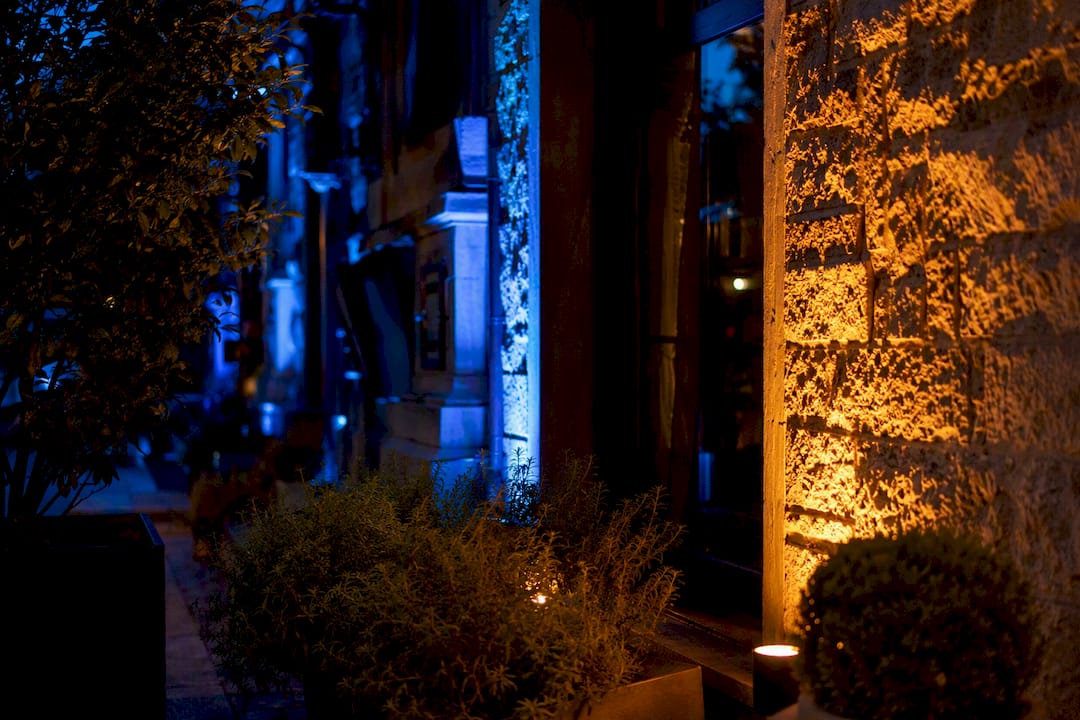
App-based scene control makes this practical rather than a hassle. Instead of climbing a ladder to swap bulbs before every holiday or hosted event, a manager switches a preset scene from a phone. That convenience matters most for restaurants that host private parties, seasonal menus, or recurring themed nights, since the lighting can match the occasion without a maintenance callout each time.
Temporary string lights bought seasonally seem cheaper at first, but the labor cost of hanging and taking them down every year adds up fast, and the fixtures themselves rarely survive more than one or two seasons outdoors. A permanent system with programmable color removes that yearly cycle entirely. The upfront cost buys flexibility for every season and event on your calendar going forward, not just the one you installed it for.
When Should You DIY vs. Hire a Professional for Patio Lighting?
Short-term pop-ups tolerate DIY string lights just fine. But a permanent system rewards professional installation: fewer callbacks, code compliance built in, and commissioning that actually validates your scenes. Budget for that upfront, and ask about warranty terms before you sign.
— Luis T
Get a Permanent, Programmable Lighting System for Your Patio
Everything above works whether you DIY a seasonal string light setup or hire an electrician for a one-off install. But if you’re tired of climbing ladders every November and April, or tired of replacing corroded string lights every couple of seasons, a permanent system solves that problem for good. Capital Pro Lighting installs permanent LED lighting systems across the Capital Region that you control entirely from your phone, with scenes for dinner service, holidays, and private events built in from day one.
Every track install comes with a lifetime parts warranty, weatherproof commercial-grade hardware, and professional commissioning so your scenes and dim ratios work correctly the first night you flip them on. That means no more guessing whether a contractor set your dimmer curve right, and no more seasonal labor cost hanging temporary lights. If your patio is ready for a system built once and controlled forever, request a site survey and quote to see what a permanent installation looks like for your space.
Sources
FAQ
What Color Temperature Is Best for Restaurant Exterior Lighting?
Most dining patios look best between 2700K and 3000K, with fine dining trending toward the warmer end and casual venues slightly cooler.
What CRI Rating Should Patio Lighting Have?
Specify a CRI of 90 or higher, and push for 95 if your restaurant relies heavily on food photography for marketing.
What IP Rating Do Outdoor Restaurant Fixtures Need?
Covered patios need at least IP44, fully exposed fixtures need IP65, and anything in-ground or near water should carry IP67 or IP68.
Is a Permanent Lighting System Worth It Over String Lights?
For restaurants investing in a long-term patio identity, yes: permanent systems from installers like Capital Pro Lighting eliminate yearly labor costs and offer programmable scenes that seasonal string lights can’t match.
Do I Need to Check Local Codes Before Installing Patio Lighting?
Yes. Many municipalities and historic districts set limits on lumen output, color temperature, and curfew hours, so confirm local ordinances before finalizing your design.
Recommended
Ready for a Brighter Home?
Free, no-pressure quotes across the Capital Region.
No obligation. Local installer. Same-day callback.
Reviewed by Capital Pro Lighting
Capital Pro Lighting installs permanent outdoor lighting, architectural lighting, and holiday lighting across Albany and New York's Capital Region. We install UL listed permanent lighting systems and have 10 years in business. More about our team.


