
Power Outage Lighting: Permanent, Phone-Controlled Roofline Systems
Power Outage Lighting: Permanent, Phone-Controlled Roofline Systems
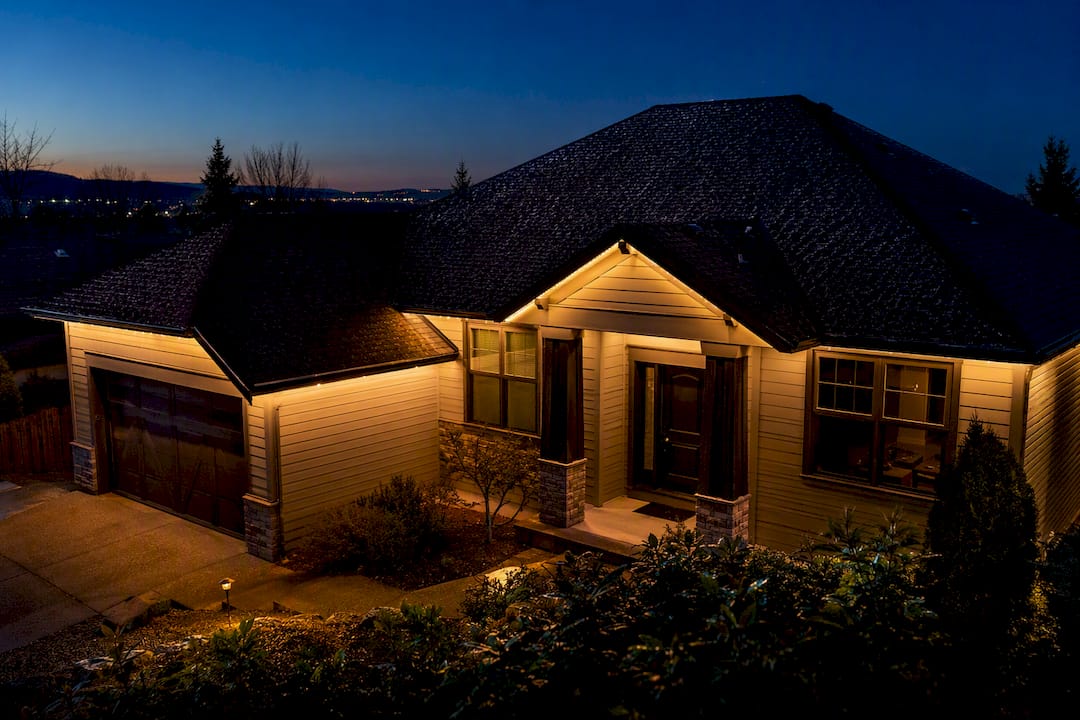
In this article, “power outage lighting” means something specific: permanent LED roofline lighting you control from your phone, running every night of the year, not a drawer full of flashlights for when the grid goes down. If you’re comparing options for year-round exterior lighting, the recommended move is hiring a professional installer rather than tackling a low-voltage transformer and weather-rated wiring yourself. Capital Pro Lighting, based in the Albany and Capital Region, builds these systems with a lifetime parts warranty on track installations and full smartphone control over color, timing, and zones.
- Permanent LED track mounted along the roofline, invisible by day
- Controlled entirely through a phone app, no ladders required
- Backed by a lifetime parts warranty on the track system itself
Key Takeaways
Permanent, phone-controlled roofline lighting delivers year-round curb appeal and holiday flexibility without ladders, and professional installation with a written CAD plan and warranty terms is what separates a durable system from a recurring repair headache.
| Point | Details |
|---|---|
| Get a CAD plan first | Insist on a written layout showing zones, transformer sizing, and wiring before signing any contract. |
| Confirm warranty scope | Separate parts, labor, and lifetime parts warranty terms in writing, since these are different promises. |
| Budget by complexity | Roofline length, zone count, and custom mounting drive cost more than any flat national price. |
| Keep battery lighting separate | Flashlights, lanterns, and headlamps still matter for actual outages; permanent systems don’t replace them. |
| Capital Pro Lighting fits this category | Offers CAD design, lifetime parts warranty on track installs, and over a decade of local Capital Region experience. |
Why Choose Permanent, Phone-Controlled Roofline Lighting?
The appeal is simple: you set it once and forget it. Smartphone scheduling lets you program sunset-to-sunrise timing, switch colors for a holiday or a home game, and manage separate zones (porch, peak, garage line) without touching a single wire after installation. During the day, the permanent linear lighting sits flush in a low-profile track, so your roofline looks clean and unchanged until dusk, when it becomes an architectural accent that highlights gables, columns, or a storefront sign.
There’s a real efficiency argument here too. The Department of Energy notes that LEDs use at least 75% less energy than incandescent bulbs and last dramatically longer, which matters when a system runs every night for years.
- No annual untangling, hanging, or storage of string lights
- Lower energy draw than incandescent holiday lighting run on the same schedule
- Workmanship backed by warranty terms you can actually verify in writing
This category fits homeowners who want the holiday-lights look without the ladder risk, and business owners who want a storefront that reads as intentional, not seasonal.
What Does a Professional Installation Look Like?
A good installer follows a sequence you can hold them to, not a vague “we’ll figure it out on site” promise.
- Consultation and goal setting. You walk the roofline together, talk zones, and decide what colors and schedules matter to you.
- CAD design. The installer produces a CAD layout and itemized proposal covering fixture placement, transformer size, wiring routes, and zone groupings, so you approve the plan before anyone touches your roof.
- Utility locates and scheduling. Before any trenching for the transformer or low-voltage lines, a reputable crew requests locates and books your install date.
- On-site work. Track mounting, transformer placement, and wiring happen in a single coordinated visit, with connections protected against moisture.
- Nighttime tuning and walkthrough. After dark, the crew fine-tunes brightness and zoning, then walks you through the app so you know how to change colors and schedules yourself.
Most on-site installs, per that same installation research, wrap up in 1 to 2 days depending on roofline length and zone complexity.
Pro Tip: Ask to see the CAD plan before you sign anything. A written layout with transformer sizing and wiring routes tells you the installer is measuring twice, not eyeballing your roofline from the driveway.
What Technical Details Should You Confirm Before You Sign?
A few line items on a proposal separate a system that lasts a decade from one that flickers out in two seasons. Run through this list on the phone or during the site visit, before you commit to anything.
- Weather rating. Confirm the track and LED nodes carry a real outdoor IP rating, not just “outdoor safe” marketing language, and ask what finish options exist for the track itself.
- Transformer capacity. Get the transformer sized with spare capacity, not maxed out at install, so you can add a zone later without swapping hardware.
- Controller and app. Check whether the app supports scheduling, zoning, and remote alerts, or just basic on/off. Smart controllers that report wattage draw can flag a failing fixture before you ever notice it’s dark.
- Wire routing and connections. Ask how connections are waterproofed. Gel caps and planned, accessible transformer placement are the standard Natural Accents points to verify.
- Mounting hardware. Custom brackets, including 3D-printed options for a clean fit against your specific trim, matter more for daytime appearance than most homeowners expect.
How Much Maintenance and Warranty Coverage Should You Expect?
Permanent systems are genuinely low-maintenance, which is a large part of the pitch. Most owners need only a seasonal visual check, no annual rehang, no bulb replacement cycle.
- A quick seasonal walk-around catches loose brackets or a shaded fixture before it becomes a repair call.
- Smart controllers that monitor wattage draw can alert you to a failing zone before it’s visible at night.
- Warranty language matters: distinguish parts coverage, labor coverage, and any lifetime parts warranty specifically tied to the track system, since these are not the same promise.
- Many firms also offer optional annual service plans covering inspections and adjustments beyond the base warranty.
Get every one of these terms in writing before the crew leaves your driveway.
What Determines Cost and Installation Timeline?
There’s no single national price tag for permanent roofline lighting, because the variables genuinely change the bid. Roofline length is the biggest driver, followed by the number of zones you want independently controlled, the complexity of app features, and whether you need custom mounting for unusual trim or masonry.
- Roofline length and complexity scale the amount of track, wiring, and labor needed.
- Zone count adds controller complexity; three zones cost more to program and wire than one continuous run.
- Custom mounting, including brackets shaped for specific fascia or trim, adds design and fabrication time.
- Financing or phased installation lets you cover the full roofline this year and add a second zone next season, spreading the cost.
Expect a design and parts lead time before your install date gets booked, then a 1 to 2 day on-site install for most residential rooflines. Larger commercial storefronts or multi-zone estates run longer.
How Do You Choose the Right Installer?
Ask the right questions upfront and you’ll filter out the crews who show up with a ladder and a guess.
- Will you provide a CAD layout before installation begins? A written plan, not a verbal estimate, is the professional standard.
- How is the transformer sized, and is there room to expand later? Vague answers here predict problems in year two.
- Can you demo the app before I sign? You should see scheduling, zoning, and color control firsthand.
- What exactly does the warranty cover, and for how long? Get parts, labor, and any lifetime coverage spelled out separately.
- Can I see local references or completed installations? Long-standing local experience, ten-plus years in the region in Capital Pro Lighting’s case, is a trust signal you can verify.
Red flags: no written scope, no warranty terms, or a crew that skips the nighttime walkthrough entirely. A CAD-led design process tends to produce a more even wash of light with fewer hot spots than an installer working from memory.
Pro Tip: Insist on a final nighttime walkthrough before you sign off on the job. Daytime looks can hide uneven brightness or gaps between zones that only show up after dark.
What Are Your Options for Short-Term Blackout Lighting?
Permanent roofline systems handle your everyday and holiday lighting, but they’re not designed as blackout backup. For the hours or days when the grid actually fails, most households still rely on a separate, portable category of lighting entirely.
Flashlights remain the fastest grab-and-go option, cheap and battery-efficient for short bursts of task lighting. Lanterns, especially LED lantern-style units, spread light across a room and work well for shared spaces like a kitchen table during dinner. Headlamps free up your hands for anything that requires two, like checking a breaker panel or refilling a generator. Battery-powered puck lights or stick-on LEDs placed around stairwells and hallways add a layer of passive safety lighting that doesn’t require anyone to hold anything.
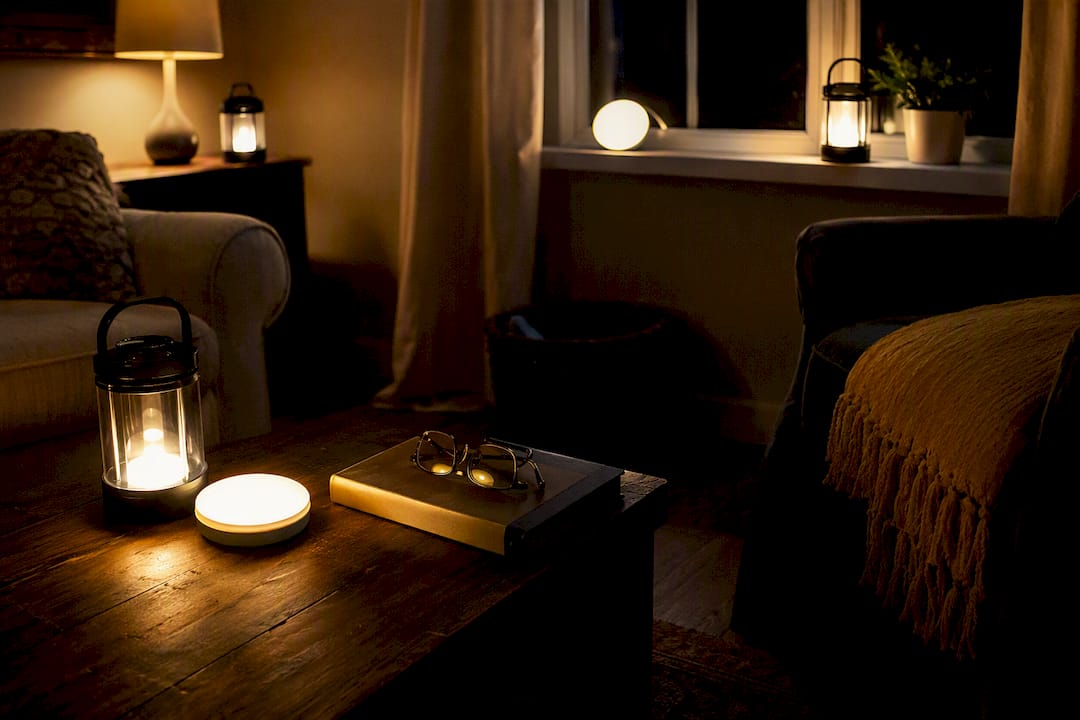
None of these substitute for your permanent exterior system, and that’s by design. One is built for nightly curb appeal and runs on your home’s wiring. The other is a stopgap kit for the rare hours the power actually drops. Keeping both makes sense: a phone-controlled roofline system for daily use, and a basic battery kit stashed somewhere accessible for the occasional outage.
What Safety Habits Matter When the Power Actually Goes Out?
Temporary lighting during a blackout carries its own risks that a permanent, hardwired system simply doesn’t. Candles remain a leading cause of home fires during outages, so battery and LED sources are the safer default whenever they’re available.
Keep flashlights and lanterns away from flammable materials, and never leave an open flame unattended in a room with pets or kids moving around in the dark. Check batteries seasonally rather than discovering they’re dead mid-outage. If you’re running a portable generator for backup power, keep it outdoors and away from windows; carbon monoxide from generators running too close to a house is a documented cause of injury during extended outages.
Position emergency lighting at floor level near stairs and exits rather than only on tabletops, since low light helps prevent falls in a dark hallway. Keep a charged phone or headlamp within reach of the bed, not buried in a closet you’ll be feeling around for in the dark. These are small habits, but they’re the ones that actually prevent the trip to urgent care that follows a bad blackout night.
How Do Different Emergency Lighting Types Compare on Runtime?
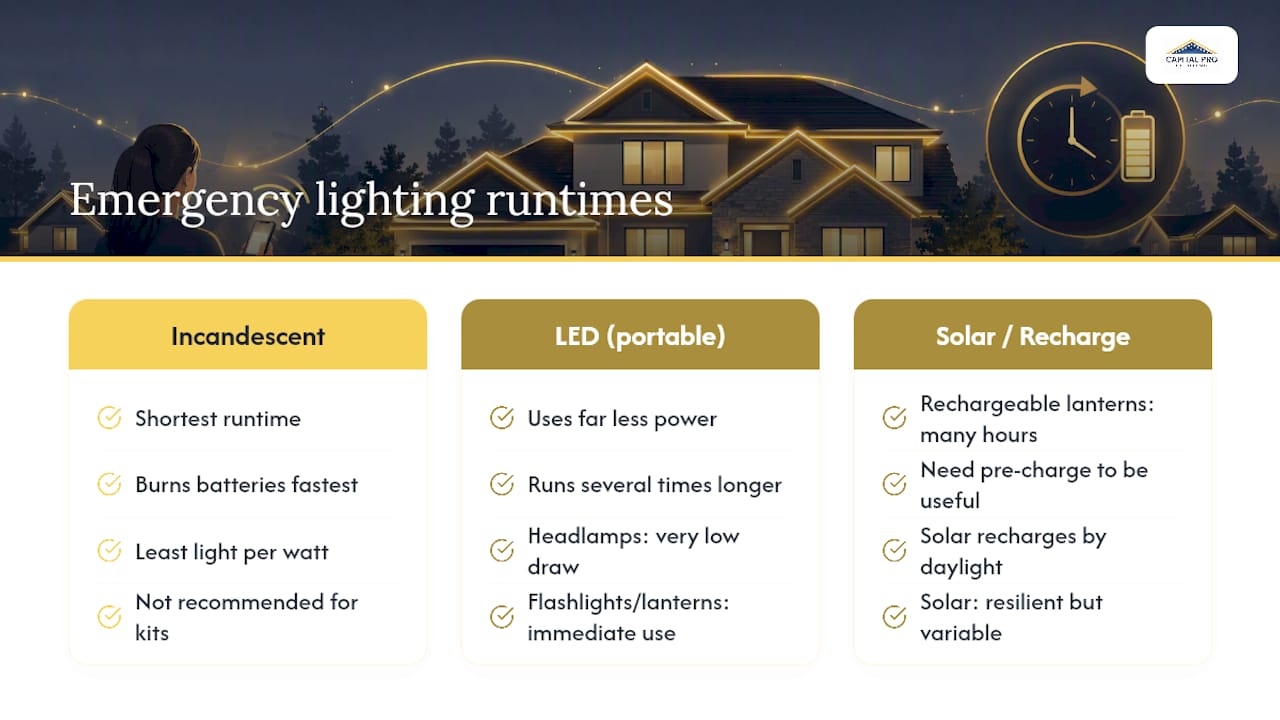
Battery-powered options vary enormously in how long they actually last, and that variation should drive what you keep on hand. Basic incandescent flashlights burn through batteries fastest and produce the least light per watt, which is why most emergency kits have shifted to LED variants over the past decade.
LED flashlights and lanterns draw a fraction of the power incandescent bulbs need for comparable brightness, often stretching a set of batteries several times longer. Rechargeable lantern units with built-in battery packs can run for many hours on a single charge, useful for a multi-day outage, but they need to be charged ahead of time to be useful at all. Headlamps with LED bulbs tend to sip power slowly since the light output needed for close-range tasks is modest compared to lighting an entire room.
Solar-powered options add a layer of resilience for outages that stretch beyond a day or two, since they recharge during daylight hours without needing outlet access at all. The tradeoff is inconsistent output on cloudy days and a slower recharge cycle than a wall outlet provides. For most households, the practical answer is layering: fast LED flashlights for immediate needs, a rechargeable lantern for shared spaces, and a solar unit as a longer-duration backstop if outages in your area tend to run past a day.
How Should You Set Up Temporary Lighting During an Outage?
Placement matters as much as the light source itself. Put a lantern or LED puck light in every room you’ll actually use, kitchen, bathroom, and any bedroom with someone who might need to move around at night. Stairwells deserve dedicated lighting since falls are one of the more common outage-related injuries.
Keep a flashlight or headlamp in a fixed, memorized spot, a nightstand drawer or a hook by the back door, so you’re not searching blind when the power drops. Battery-operated motion-sensor lights are worth placing near exits and bathrooms since they turn on automatically without anyone fumbling for a switch. Avoid running extension cords from portable lighting across walkways where someone could trip in the dark.
If you’re setting up for an extended outage, group your battery lighting near your backup power source (more on that below) so you’re not hunting through the house room by room. A simple bin near the door with flashlights, a lantern, and spare batteries beats a drawer-by-drawer search every time the power actually fails.
Can You Run Lighting Off a Generator or UPS During an Outage?
Backup power sources extend what temporary lighting can do, but they come with their own rules. A portable generator can run higher-draw lighting, floor lamps, work lights, or a string of LED shop lights, far longer than batteries alone, but it needs to run outdoors, away from windows and doors, to avoid carbon monoxide buildup indoors.
A UPS (uninterruptible power supply), more common in home offices or for medical equipment, can also keep a small lamp or charging station running for the short window between a power failure and switching to a generator or waiting out a brief outage. It won’t power a whole house, but it bridges the gap so you’re not fumbling for a flashlight the second the lights cut out.
If your home has a whole-house or standby generator wired into the electrical panel, some circuits, including select lighting circuits, can be pre-designated to stay powered automatically during an outage. That’s a conversation for an electrician, not a lighting installer, since it involves your home’s panel and transfer switch rather than your roofline system. The takeaway for most households: treat generators and UPS units as bridges for essential temporary lighting and devices, not as a reason to skip stocking basic battery lighting as your first line of defense.
What Codes Apply to Permanent Outdoor Lighting Installations?
Permanent lighting installations, unlike a string of holiday lights, typically involve low-voltage wiring, a transformer, and sometimes minor electrical work tied to your home’s exterior. Most jurisdictions require that low-voltage transformers and any line-voltage connections meet local electrical code, and a professional installer should already know the permit requirements in your specific municipality.
Utility locates before any digging or trenching for wiring runs are standard practice, and a competent crew will request them as a matter of course rather than waiting for you to ask. This protects both the installer and your property from hitting a buried utility line during transformer placement or wire routing. Homeowners’ associations in some neighborhoods also have their own rules about visible lighting hardware, brightness at night, or color changes for holidays, so it’s worth checking your HOA covenant before scheduling an install if you live in a managed community.
None of this should scare you off the project. It’s simply why hiring a professional who handles locates, code compliance, and permitting as part of the job, rather than leaving it to you, is the safer and less stressful route.
Why Permanent, Phone-Controlled Systems Beat the Alternatives
Homeowners underestimate how often a “temporary” holiday lighting setup becomes a permanent fixture out of sheer exhaustion with the annual ladder routine. The real case for permanent, phone-controlled roofline systems isn’t novelty. It’s that they remove a recurring physical risk (ladders, freezing hands, untangling cords) and replace it with a five-second app tap. What gets underrated is the CAD design step: a plan that maps zones and transformer capacity before installation prevents the uneven, hot-spotted look that gives permanent lighting a bad reputation in the first place. Skip that step, and you get a worse version of string lights that costs more.
— Luis T
Ready to Switch to Permanent, Phone-Controlled Lighting?
If you’re tired of the annual ladder routine and want lighting that looks intentional every night of the year, Capital Pro Lighting is built for exactly that shift. Every project starts with a walk-through and a written CAD design, so you know your zones, transformer sizing, and fixture placement before any crew touches your roofline. The installation includes a lifetime parts warranty on the track system and custom 3D-printed brackets for a clean daytime look, backed by more than a decade of local installation work across the Capital Region.
Getting started is straightforward: schedule a consultation, review your CAD plan, and pick an install date that works for your schedule. Explore permanent outdoor lighting options for your home or business, or head straight to Capital Pro Lighting to book your consultation today.
Sources
- Permanent Linear Lighting Explained | Year-Round Trim Lights
- What to Expect During a Professional Outdoor Lighting Installation - TLC Incorporated
- Landscape Lighting Design & Installation Process - Natural Accents Outdoor Lighting
FAQ
How Long Does a Permanent Lighting Install Take?
Most residential on-site installations take 1 to 2 days depending on roofline length and the number of zones being wired.
Can I Control the Lights Without Being Home?
Yes. Smartphone app control lets you schedule, dim, or change colors remotely, and smart controllers can alert you to fixture issues without a manual check.
Does Capital Pro Lighting Offer a Warranty?
Capital Pro Lighting backs its track installations with a lifetime parts warranty, separate from standard labor coverage, so ask any installer to define both terms clearly.
Do I Still Need Flashlights if I Install Permanent Lighting?
Yes. Permanent roofline systems run on your home’s wiring and aren’t designed as blackout backup, so a separate battery lighting kit still matters for actual power outages.
What Should I Check Before Digging for Transformer Placement?
Request utility locates before any trenching, and confirm your installer plans for waterproof connections and accessible transformer placement as standard practice.
Recommended
Ready for a Brighter Home?
Free, no-pressure quotes across the Capital Region.
No obligation. Local installer. Same-day callback.
Reviewed by Capital Pro Lighting
Capital Pro Lighting installs permanent outdoor lighting, architectural lighting, and holiday lighting across Albany and New York's Capital Region. We install UL listed permanent lighting systems and have 10 years in business. More about our team.


