No Ladder, Safe Hanukkah House Lights for Capital Region Homeowners
No Ladder, Safe Hanukkah House Lights for Capital Region Homeowners
For reliable, visible Hanukkah house lighting, use weatherproof LED displays, pair a window menorah with roofline or lawn accents in blue and white, and run everything on timers. If you want to skip the ladder every winter, a permanent programmable roofline installation gives you the same festive glow with zero setup or teardown.
TL;DR:
- LED and rope lights are more durable and weather-resistant options, with IP65 or higher ratings critical for roofline and ground-level displays.
- Permanent programmable roofline systems provide year-round flexibility, easy color changes, and reduce setup time compared to seasonal decorations.
- Public menorah displays in windows or on lawns should face the street for visibility, with safety tips including outdoor-rated cords and stable fixtures.
- Coordinating neighborhood decorations with shared color schemes enhances visibility and community engagement without needing identical setups.
Hanukkah House Lights: Decor Ideas for Every Budget
Chanukah house lights work best when they do two jobs at once: signal the holiday to anyone walking or driving by, and hold up through eight nights of whatever weather shows up. The good news is you don’t need a professional crew to pull off a display people notice. You do need a plan, because “figure it out as I string lights in the cold” is how most tangled-cord disasters happen.
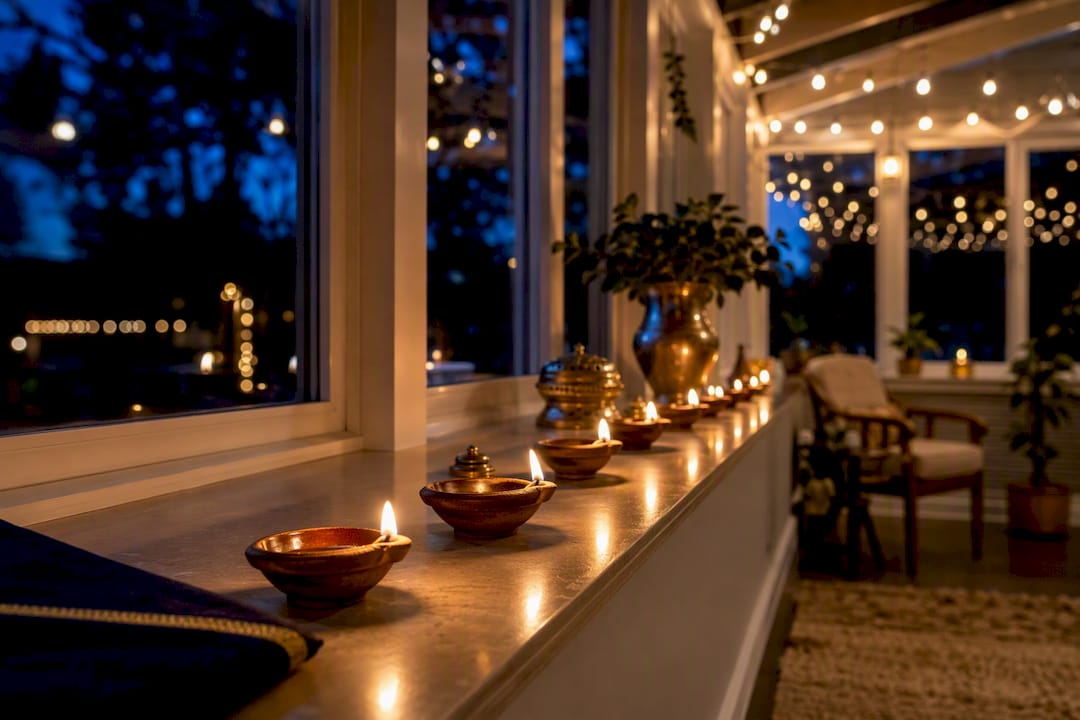
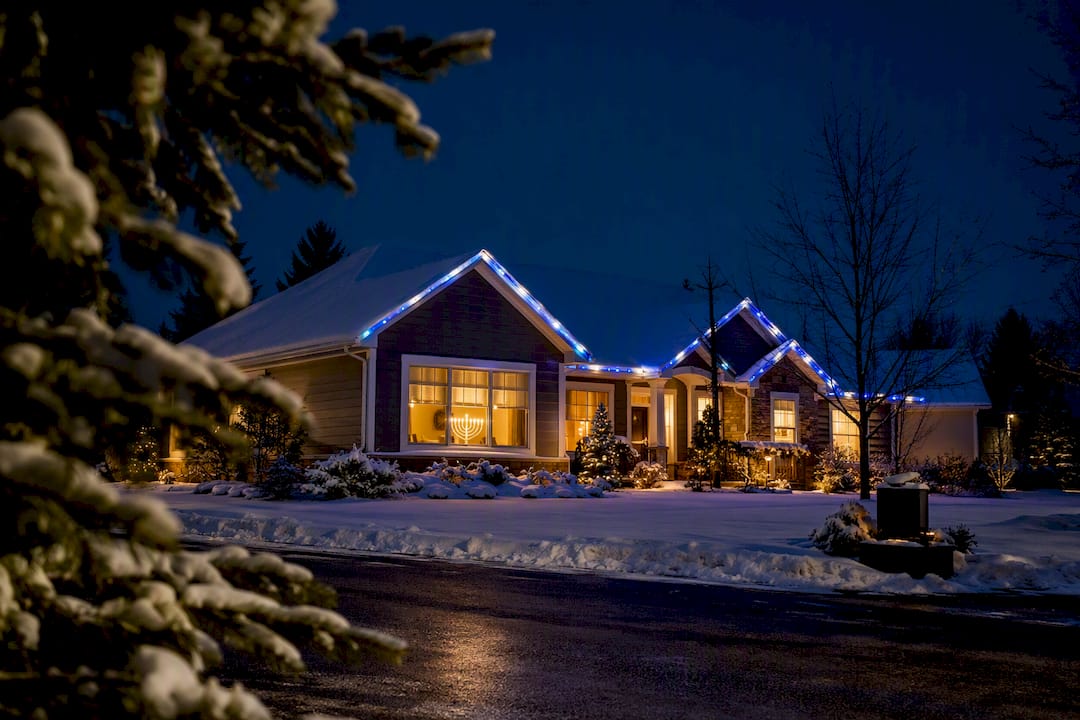
Start with the window. A lit menorah in a front-facing window is the oldest and most recognizable form of Hanukkah outdoor decorations, and it’s also the easiest to get right. Electric and LED menorahs are widely recommended for outdoor or window use because they skip the fire risk of open flame near curtains or drafts, and most plug-in models include a photocell that turns them on automatically at dusk.
From there, work outward. Rooflines, lawns, and trees each offer a different kind of visual impact, and combining two or three creates the layered look you see on the best-decorated blocks.
Window and porch displays
- A single electric menorah per window reads as intentional; scattering random blue lights does not.
- Battery-operated flameless candles in a window box work for renters who can’t run cords through a frame.
- Static window clings or projector-style Star of David silhouettes add visual interest without extra wiring.
Roofline and eave ideas
Outlining the roofline in blue and white rope lights turns your whole house into the display, not just one window; see the Custom homes exterior gallery — Bayfair Custom Homes for inspiration on cohesive home exterior lighting and design. Rope lights and LED string lights rank among the most popular choices for outdoor Hanukkah decorations because they handle wind and moisture better than incandescent strands and use a fraction of the electricity.
Color-changing LED profiles are worth a look if you want to mark each night of the holiday differently. Some smart-light systems let you add one new color segment per night, which mimics the traditional practice of lighting one additional candle each evening. It’s a small touch, but it’s the kind of detail neighbors actually notice and ask about.
Lawn and yard displays
- A freestanding lit menorah anchored on the lawn is the centerpiece move. Wind is the enemy here, so weight the base or stake it into the ground rather than trusting it to stand on its own.
- Illuminated Star of David yard stakes on either side of the walkway frame the entrance without competing with the menorah.
- Dreidel-shaped path lights along the driveway or front walk add a playful layer that works well for households with kids.
- A cluster of blue and white spotlights aimed up at a tree does double duty as both a Hanukkah light display and general landscape lighting you can leave up past the holiday.
Projection and motion lighting
If you want maximum visual payoff for minimum installation effort, a projector is hard to beat. A single unit staked in the lawn or mounted near the garage can throw a rotating pattern of dreidels, Stars of David, or “Happy Hanukkah” text across your entire facade. No ladder, no cords along the roofline, no risk of a strand blowing loose in a January wind. The tradeoff is that projections read best after full dark and lose impact in well-lit neighborhoods, so they work better as a supplement to a window menorah than a replacement for one.
Rental-friendly and low-commitment options
Not everyone can staple lights to a roofline or drill into siding. Clip-on LED strands with gutter hooks, magnetic light strips for metal siding or garage doors, and battery-powered candles for windowsills all give renters and apartment-adjacent homes a real display without a single tool. Blue-and-white color schemes with string lights along trees and rooflines remain the most common styling choice across all of these formats, which makes it easy to build a cohesive look even with mismatched, low-commitment pieces.
Budget breakdown by tier
| Tier | What you get | Typical setup |
|---|---|---|
| DIY / budget | Battery candles, clip-on rope lights, one yard stake | An afternoon, basic hand tools, no electrician |
| Midrange plug-in | Roofline rope lights, electric menorah, timer, projector | A weekend, outdoor extension cords, a GFCI outlet |
| Premium / permanent | Programmable roofline system, app control, custom brackets | Professional installation, one-time setup, reused every year |
What Kind of Lights Actually Hold Up Outdoors?
Not every string of lights sold for “holiday decor” is built to sit on your roof through an ice storm. Picking the right hardware matters more than picking the prettiest one.
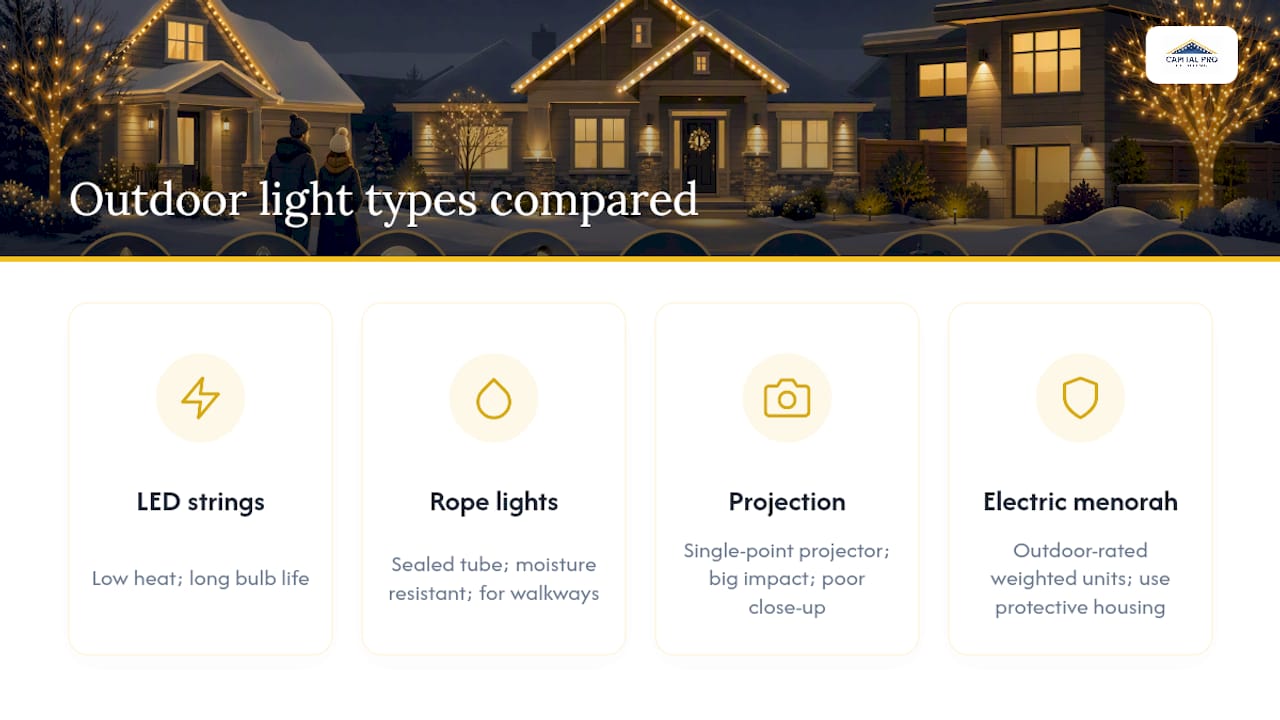
LED string lights are the default for a reason: low heat output, long bulb life, and enough variety in bulb shape and spacing to fit almost any layout. They’re the best all-around choice for window frames, shrubs, and short roofline runs.
Rope lights (sometimes sold as rope-lite) are sealed tubes of LEDs, which makes them more resistant to moisture intrusion than open string lights. They’re the better pick for ground-level runs along a walkway or garden bed where snow and slush pile up.
Projection lights skip wiring entirely and throw patterns from a single fixed point. Great for big visual impact on a budget, weaker for close-up detail.
Electric menorahs range from simple plug-in units with plastic “flame” bulbs to weighted outdoor models rated for direct exposure. Outdoor menorah use benefits from protective housings or fully enclosed electric designs, especially in regions that see real wind and snow during the holiday.
Weatherproofing: IP ratings actually matter here
Every outdoor-rated light should carry an IP (Ingress Protection) rating on the packaging. The first digit covers dust and debris; the second covers water.
- IP44: Splash-resistant. Fine for a covered porch, risky for open roofline exposure.
- IP65: Protected against water jets from any direction. A solid minimum for most climates.
- IP67: Can handle temporary submersion, which matters if your gutters back up during a thaw.
If you live somewhere that gets real snow accumulation, don’t settle for anything under IP65 on roofline or ground-level runs.
Power options compared
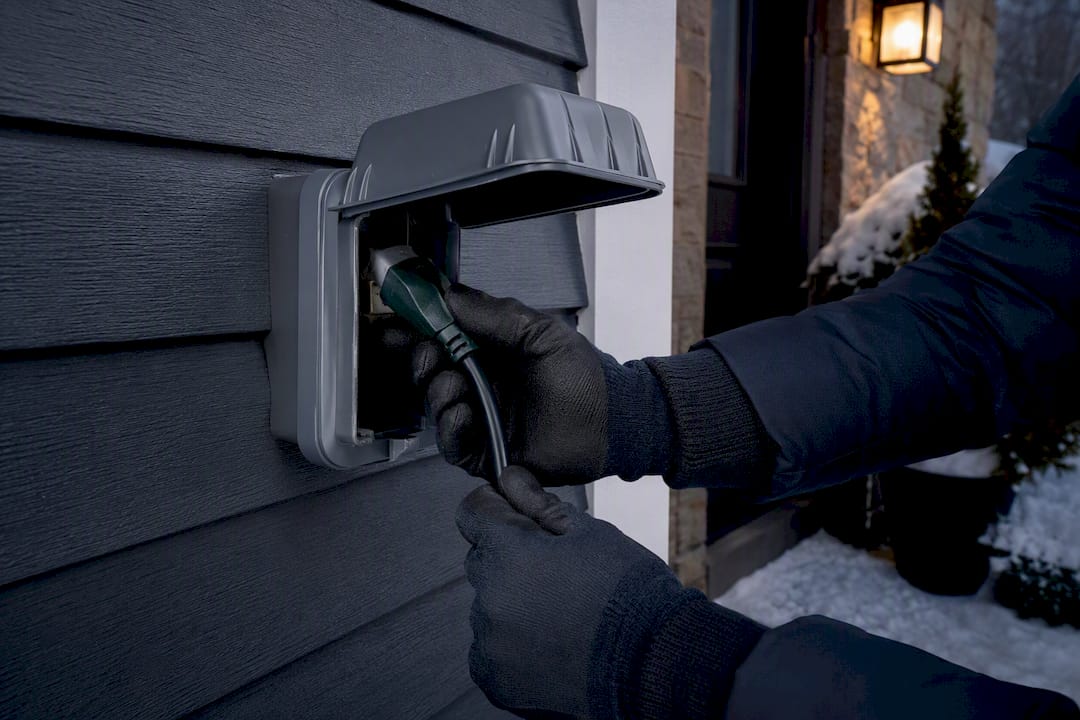
- Plug-in (AC): Most reliable output and easiest to run on a timer, but requires a GFCI-protected outdoor outlet and weatherproof extension cords.
- Battery-operated: Best for windowsills and small accents where running a cord isn’t practical; expect to swap batteries at least once during the eight nights.
- Solar: Fine for supplemental path lighting, but December’s short days rarely deliver enough charge for a full display, so don’t rely on it for your main light source.
- Hardwired/permanent: The highest upfront cost and the lowest ongoing effort. No cords, no batteries, no annual setup.
Color, brightness, and visibility
Blue and white remain the dominant Hanukkah color scheme for a reason: it’s instantly recognizable and reads clearly from the street after dark. For roofline runs meant to be seen from the road, look for higher lumen output per bulb rather than just more bulbs. A shorter run of brighter LEDs often reads better from a passing car than a longer run of dim ones.
Timers and smart controls
A timer isn’t optional if you want your display to actually align with nightfall. Lights are meant to burn for a minimum period after nightfall to fulfill the tradition properly, and a timer takes the guesswork out of remembering to flip a switch every evening at a slightly different sunset time. Smart plugs that adjust automatically as sunset shifts across the eight nights solve this without any manual tracking at all.
Pro Tip: Buy one IP65-rated extension cord rated for outdoor use and keep the connection point up off the ground, inside a covered junction box if you have one. Most winter light failures trace back to water pooling at a cord connection, not a bad bulb.
Installing and Maintaining Your Hanukkah Light Display
Getting a display up safely takes about the same effort as putting it away correctly. Skip either step and you’re looking at a fire hazard or a strand of lights that doesn’t work next year.
- Mount without damaging your house. Plastic gutter clips and shingle-tab clips let you outline a roofline without a single nail or screw. Save adhesive hooks for smooth trim, not textured siding, where they tend to fail in cold weather.
- Use outdoor-rated everything. That means outdoor-rated cords, outdoor-rated timers, and a GFCI outlet or adapter at the source. Indoor extension cords aren’t insulated for freeze-thaw cycles and can crack.
- Anchor anything freestanding. A lawn menorah or Star of David stake needs a wind-rated ground anchor or a weighted base, not just a stake pushed into soft dirt. A gust that topples a lit fixture into snow or leaves is the most avoidable failure mode in the whole setup.
- Hire an electrician for anything hardwired. If you’re running new outdoor outlets or tying into your home’s electrical panel for a permanent system, that’s a licensed-electrician job, not a weekend project.
- Set your automation before the first night. Program your timer or smart plug to activate at or slightly before nightfall and stay on for at least the traditional burn window, so you’re not manually managing lights every evening.
After the holiday: storage and maintenance
Whatever you put up needs somewhere to go once the eighth night is over. Wrap string lights around a scrap of cardboard or a dedicated spool rather than balling them up loose. That’s the single biggest reason tangled strands become non-functional strands by the following year. Store rope lights flat if possible, since tight coiling in cold storage can crack the outer tubing. Wipe down electric menorahs and projector lenses before boxing them, and check battery compartments for corrosion before you pack anything that ran on batteries all season.
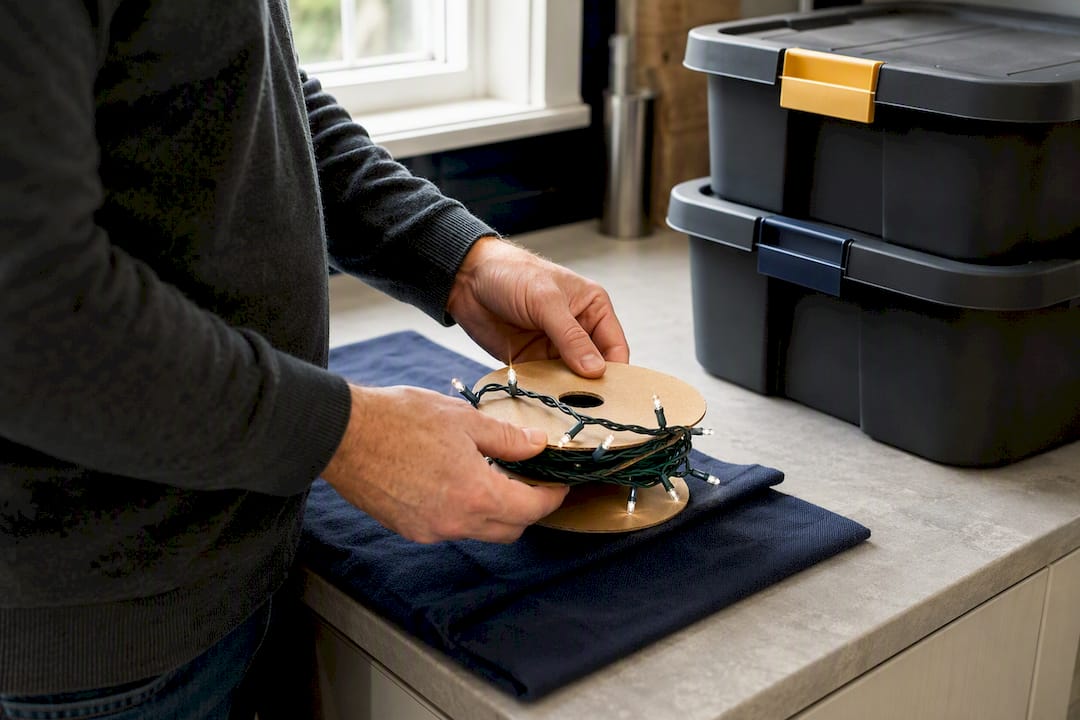
Pro Tip: Label your storage bins by display zone (window, roofline, lawn) rather than by light type. When you pull everything back out next year, you’ll set up by location instead of hunting through a pile of unlabeled strands.
Safety, Timing, and the Meaning Behind the Display
Hanukkah lighting isn’t just decoration. It’s rooted in a specific religious practice, and understanding the basics helps you set up a display that respects the custom instead of just borrowing its color palette.
Hanukkah runs eight nights starting on 25 Kislev, and the lit candles or lights are meant to burn for at least thirty minutes after nightfall, placed where they can be seen from the street. That thirty-minute window is the baseline most practical guides cite, and it’s worth building your timer schedule around it if your outdoor display includes an actual menorah lighting, not just decorative string lights.
The traditional hanukkiah holds nine lights: one for each of the eight nights, plus the shamash used to light the others. Standard practice places the candles right to left and lights them left to right, adding one each successive night.
The reason for visibility isn’t aesthetic. It’s the concept of pirsumei nissa, publicizing the miracle. Placing a menorah in a window or doorway facing the street, rather than tucked away inside, is the point of the ritual, not an optional styling choice. Public menorah displays on lawns and in shared community spaces follow the same logic on a larger scale.
That said, many halachic authorities limit the recitation of blessings to home or synagogue lightings, even though participating in and viewing a public lighting is welcomed. If you’re organizing or attending a public display, that distinction is worth knowing before you assume every public menorah lighting includes a blessing ceremony.
Electric and LED options exist alongside this tradition rather than against it. Many households use electric menorahs for windows specifically because they can burn safely for extended periods without supervision, which actually supports the visibility goal better than an open flame that needs to be watched.
- Keep any open-flame menorah away from curtains, dry branches, and anything that could catch a stray draft.
- If Hanukkah lighting falls on Friday night, timing shifts to accommodate Shabbat, so check with a local rabbi or your synagogue for the adjusted schedule that year.
- A non-Jew may assist with lighting but generally cannot light on a Jew’s behalf to fulfill the mitzvah, which matters if you’re coordinating a mixed household or shared display.
Finding and Hiring a Professional Installer
If climbing a ladder in December isn’t your idea of a good time, hiring an installer solves the safety and time problem in one move. Start by asking any prospective installer three things: what warranty covers the parts and labor, whether they carry liability insurance for roof and ladder work, and how they handle takedown after the season.
Costs vary widely depending on your roofline length, the complexity of the layout, and whether you’re renting seasonal lights or having a permanent system installed. A simple seasonal roofline outline typically costs less than a full programmable system with app control and custom brackets, since the permanent option includes the electrical work and hardware that seasonal rentals skip entirely.
Ask about takedown and storage, too. Some installers who do seasonal work will store your lights for you between seasons, which saves you the attic-bin shuffle every January. If you’re comparing quotes, get the scope in writing: number of feet covered, bulb type and IP rating, whether GFCI outlets are included, and what happens if a section fails mid-season.
For homeowners in the Capital Region considering a permanent, programmable roofline system instead of a seasonal rental, Capital Pro Lighting’s project pages for Niskayuna show what a finished custom-track installation actually looks like on a real house, which is a useful reference point before you request quotes elsewhere.
Making Your Block Part of the Display
A single house lit up is nice. A block where four or five houses coordinate their Hanukkah lights is the kind of display that actually gets people talking, and it multiplies the visibility that pirsumei nissa is built around. Public lighting displays have historically been used to spark interest and conversation about Jewish tradition beyond a single household, and a coordinated neighborhood effort extends that same idea street by street.
Coordinating doesn’t require identical setups. Agree on a shared color palette, blue and white is the natural default, and let each household pick its own format: one does a window menorah, another does a roofline outline, a third puts up a lawn display. The variety keeps it visually interesting while the shared color scheme ties the block together at a glance.
If your neighborhood or synagogue hosts a public menorah lighting, timing your home display to complement rather than compete with it extends the effect. Turn your lights on slightly before the public ceremony so arriving guests see a lit street, not just a lit lawn at the community site.
Community Facebook groups and neighborhood associations are usually where these efforts start. One person floats the idea, a few neighbors commit, and by the second year it becomes an expected part of the block’s holiday season. It costs nothing beyond coordination, and it turns individual effort into something with real visibility.
Permanent Roofline Lighting vs. Seasonal Decor: An Honest Take
Most homeowners default to seasonal decor because that’s what everyone else does, not because it’s actually the better option once you’ve done it three or four years running. The math on a permanent system changes once you factor in the time cost of climbing a ladder every winter, untangling strands that half-failed in storage, and replacing bulbs that didn’t survive the last freeze.
A permanent programmable roofline system flips that entirely. Custom color-matched tracks stay on the house year-round, and switching from daily white light to Hanukkah blue and white takes an app tap instead of an afternoon on a ladder. Capital Pro Lighting backs its track installations with a lifetime parts warranty, and the 3D-printed brackets mount flush and discreet instead of leaving visible clips and hardware along the roofline, which is the detail that separates a clean installation from an obviously decorated one.
That said, permanent isn’t automatically the right call for everyone. A renter, a household testing out a new display style, or someone who only wants lights up for a couple of weeks a year is better served by a solid seasonal setup. The permanent route earns its cost when you know you want lighting flexibility across Hanukkah, Christmas, and the other 350 days of the year, not just an eight-night display. With years of local installation experience in the Capital Region, and financing options available for homeowners wanting to spread the cost, the calculation usually comes down to how many winters you plan to keep doing this by hand.
— Luis T
Ready for a Roofline That Changes With You?
If you’re tired of the annual ladder routine, Permanent LED roofline systems can be installed, and you control them entirely from your phone, so your house can go from everyday white to Hanukkah blue and white in seconds, no cords, no climbing, no storage bins.
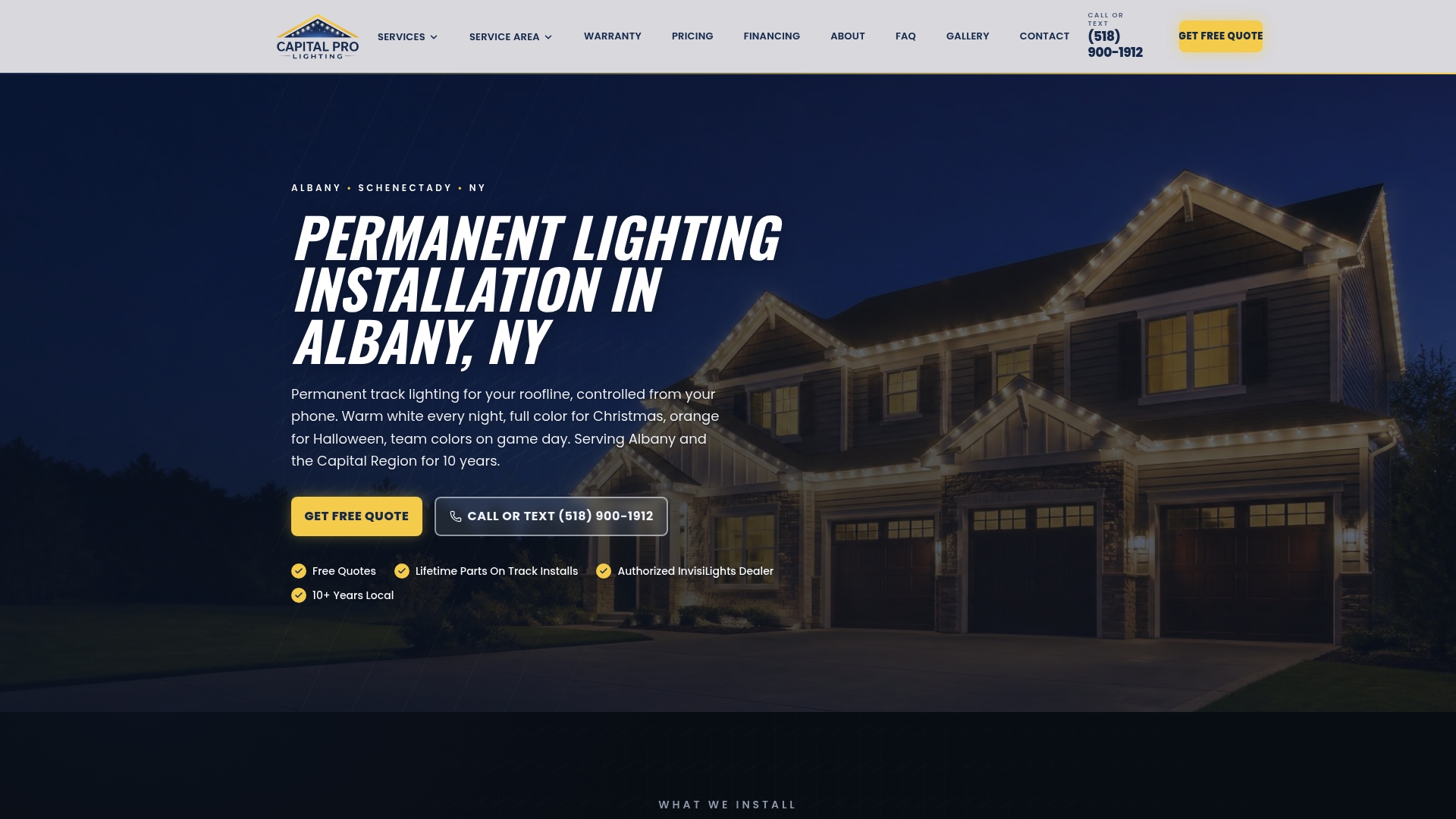
A consultation starts with a site visit to look at your roofline, siding, and existing outlets, followed by a proposal that lays out track placement, bracket style, and total cost. If spreading out the investment makes more sense for your household, financing options with no interest for six months are available so the switch to a permanent system doesn’t have to happen all at once.
Capital Pro Lighting serves homeowners across the Capital Region, including Albany, Schenectady, Troy, and the surrounding towns. If a permanent, programmable display sounds like the upgrade your house has been missing, start with a look at the permanent outdoor lighting options built for exactly this kind of year-round flexibility.
Sources
Exact lighting times and dates shift every year, so verify specifics against a dedicated calendar rather than guessing from last year’s schedule.
- Shul — and beyond? Chanukah lights in public places — DinOnline
- Chanukah 2026 - Hebcal
- Hanukkah 2026: The Complete Guide to the Festival of Lights - Hidabroot
FAQ
What are Hanukkah lights called?
The traditional candelabra used for Hanukkah is called a hanukkiah, a nine-branched menorah with eight lights for each night plus a shamash used to light the others.
When should I light the menorah in 2026?
Hanukkah begins at nightfall and runs eight nights, with lights meant to burn for at least thirty minutes after dark each night; check Hebcal’s calendar for the exact nightly candle-lighting times in your location.
Can a non-Jewish person light a menorah?
A non-Jew may assist with lighting but generally cannot light on behalf of a Jewish person to fulfill the mitzvah; participating in and enjoying a public display, however, is welcomed.
What is not allowed on Hanukkah?
Practices vary by community, but some guidance recommends pausing certain activities like eating a full meal right before candle lighting so the focus stays on the mitzvah; consult a rabbi for specifics that apply to your household.
Do I need professional installation for Hanukkah house lights?
No, plenty of homeowners set up seasonal displays themselves with plug-in string lights and window menorahs; professional installation is worth considering if you want a permanent, programmable system like Capital Pro Lighting’s roofline installs that eliminates annual setup entirely.
Recommended
Ready for a Brighter Home?
Free, no-pressure quotes across the Capital Region.
No obligation. Local installer. Same-day callback.
Reviewed by Capital Pro Lighting
Capital Pro Lighting installs permanent outdoor lighting, architectural lighting, and holiday lighting across Albany and New York's Capital Region. We install UL listed permanent lighting systems and have 10 years in business. More about our team.