
Skip the DIY Kit: Why Permanent Roofline Lighting Needs a Pro
Skip the DIY Kit: Why Permanent Roofline Lighting Needs a Pro
A professionally installed permanent, programmable roofline LED system is the right call for most homeowners and small business owners who want reliable, year-round architectural lighting instead of seasonal strip lights or dark sky outdoor lighting kits from a big-box shelf. The reasons come down to three things: the hardware lasts longer, the finish looks clean in daylight, and a real warranty backs the work. If you’re ready to move forward, the next step is simple: schedule a measurement and quote with a qualified installer before your next holiday season or backyard event sneaks up on you.
Key Takeaways
A permanent roofline system holds up because installers control voltage drop, seal every fastener, and back the work with a warranty that covers labor, not just parts.
| Point | Details |
|---|---|
| Hire a professional crew | DIY strips fail within a few winters; permanent puck systems and hat track are built for years, not seasons. |
| Require IP67 minimum | Confirm puck and connector IP ratings plus UL, cUL, or CSA control-box certification before signing. |
| Expect single-day installs | Most homes finish in one visit; bungalows run four to six hours, larger homes six to eight. |
| Compare warranty terms | Look for lifetime workmanship plus multi-year parts coverage, not a one-year product-only warranty. |
| Get a local quote | Capital Pro Lighting offers no-pressure measurement visits and financing across the Capital Region. |
Where to verify specs and best practices
Check manufacturer pages for exact IP ratings, review Capital Pro Lighting’s warranty terms, and browse regional project pages like Schenectady for real install examples before requesting a quote.
Why Professional Installation Beats DIY for Permanent Roofline Lighting
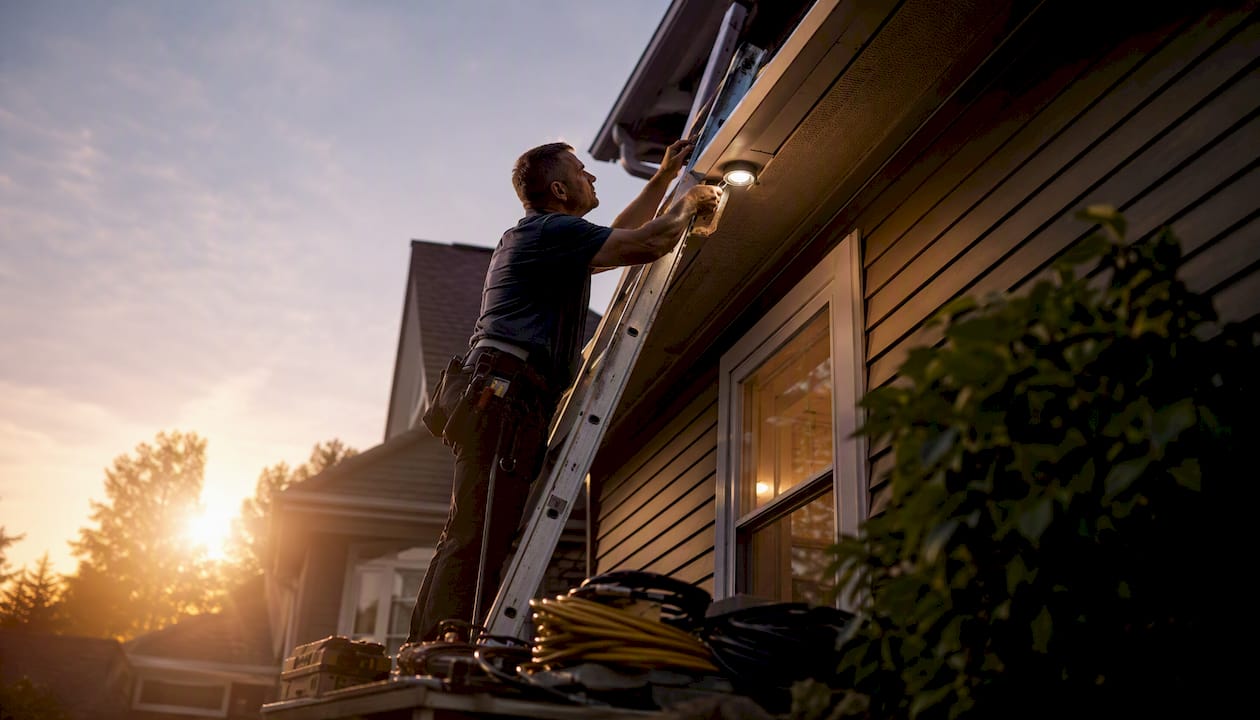
Consumer LED strips fail fast outdoors. Adhesive mounts give up in the cold, UV rays yellow the diffusers, and the color shifts within a season or two. Permanent puck systems and aluminum track are built for a different lifespan entirely, and professional installs run through a specific sequence that a weekend DIY project simply skips: precise measurement, track cut to exact length, sealed mounting, concealed wiring, and full zone testing before the crew leaves.
The gap shows up fastest in what breaks first.
- Adhesive failure vs. mechanical fasteners. Sticky-back strips peel in freeze-thaw cycles; pro installs use sealed stainless screws into fitted track.
- Uneven spacing vs. calibrated module placement. DIY runs often drift crooked by the third fascia board; hat-track systems keep pucks locked to spec.
- Exposed wiring vs. concealed runs. Visible cords are the giveaway of a DIY job from the street.
- Voided warranties vs. lifetime coverage. Retail kits carry a one-year product warranty at best; professional crews commonly back both parts and workmanship for life.
Look for IP67-rated pucks running on a 24V low-voltage system with a UL or cUL-listed control box. That combination, paired with a crew that finishes most homes in a single day, is what separates a lighting system from a lighting project you’ll be redoing in three years. Capital Pro Lighting builds every install around that standard.
Pro Tip: Ask any installer whether their pucks are wired in parallel. If one module ever fails, parallel wiring means you swap that single unit instead of tearing out an entire run.
What Hardware Specs Should You Require in a Proposal?
Require IP67 on every puck and IP67 or better on every connector, plus UL, cUL, or CSA certification on the control box itself. Anything less is asking for trouble the first time a hard rain hits at the wrong angle.
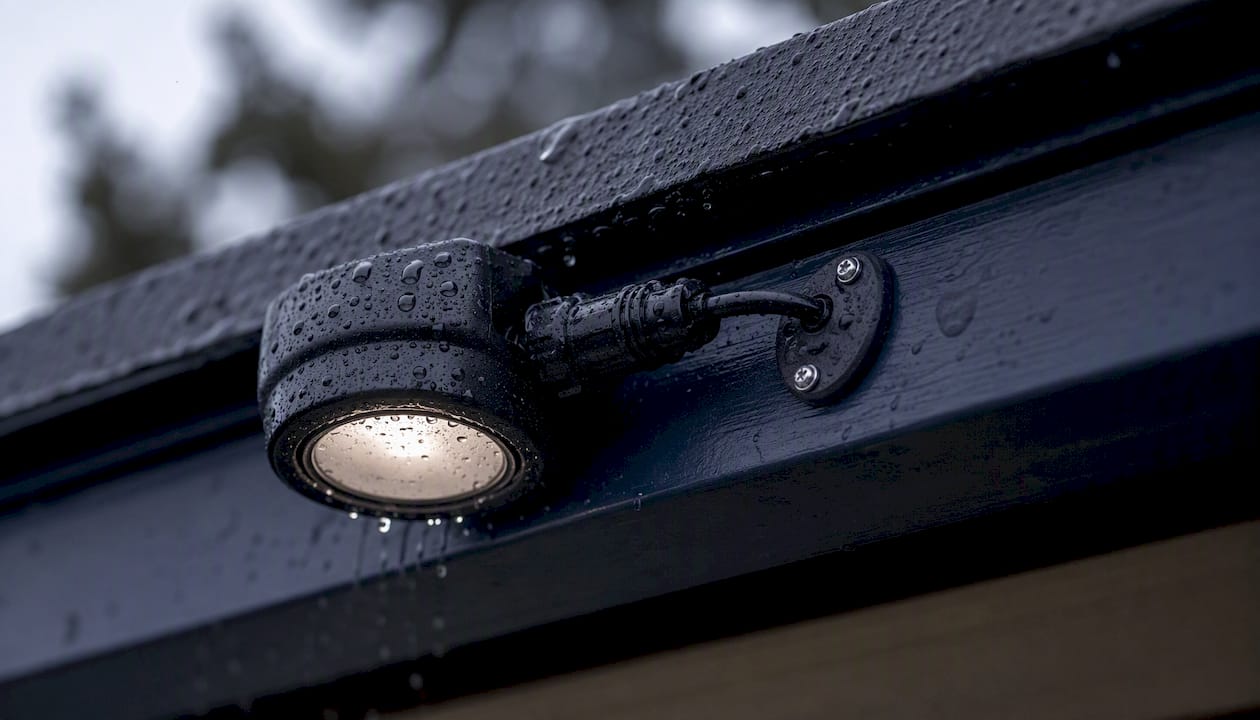
The track matters just as much as the light source. A quality aluminum hat track, mounted below the fascia and color-matched to your trim, hides the wiring completely and keeps module spacing consistent. That’s the difference between a roofline that looks intentional in the daytime and one that looks like a string of Christmas lights someone forgot to take down.
Before signing anything, confirm these five items appear in writing:
- Puck IP rating (IP67 minimum, IP68 preferred on connectors)
- Control-box certification (UL, cUL, or CSA listed)
- Track material and finish (aluminum, color-matched, mounted below fascia)
- Fastening method (mechanical stainless screws, not adhesive strips or staple clips)
- Warranty terms covering both parts and labor, not just the fixture
Vague answers on any of these five points are your cue to keep shopping.
What Does a Typical Installation Timeline and Cost Actually Look Like?
Most single-family homes go from consultation to finished, tested system in a single visit. The sequence runs in a predictable order:
- Site survey and measurement. The installer walks the roofline, measures every run, and notes corners, peaks, and valleys.
- Prefabrication. Track gets cut to exact lengths and pucks are pre-loaded, often before the crew arrives.
- Mounting the track. Sealed stainless fasteners go into the fascia, positioned below the roofline for a clean daytime look.
- Wiring and control-box placement. Low-voltage wiring runs concealed inside the track back to a weatherproof, UL-listed control box.
- Programming and commissioning. The installer sets up app control and tests each zone individually.
- Walkthrough. You see the system run through a few color scenes before the crew leaves.
Timelines vary with the house. Bungalows typically wrap in four to six hours; larger two-story homes run six to eight. Complex rooflines with multiple gables can stretch into a second day.
What actually moves the price:
- Total roofline length and number of corners, peaks, or valleys
- Puck density and any specialty color-changing features
- Access difficulty (steep pitches, multiple stories, obstructed eaves)
- Whether new outlet or electrical panel work is needed
- Warranty tier selected
On warranties, don’t assume all coverage is equal. A retail strip kit gives you a one-year product-only warranty, full stop. Professional installations frequently include lifetime workmanship coverage with multi-year parts protection, which matters more than it sounds like it should the first time a connector needs attention five years in.
How Do Installers Prevent Flicker, Leaks, and Uneven Brightness?
Pros design for long wire runs and real New York weather, not showroom conditions. That means calculating voltage drop before a single screw goes in, choosing wire gauge that matches the run length, and sealing every connection against moisture and thermal cycling.
The technical practices that separate a five-year system from a five-month one:
- Voltage-drop calculations. Incorrect gauge or distribution on long runs causes dimming or flicker at the far end of the roofline.
- Parallel wiring over series. Keeps brightness consistent and makes future service simple.
- Sealed fasteners at every mounting point. Unsealed screws let moisture behind the fascia, which causes damage no lighting warranty will cover.
- Concealed wiring through the hat track. Keeps the system invisible by day and protected from UV and physical damage.
- Grounding and surge protection at the control box. Standard practice on any electrical component tied to household power.
Pro Tip: During a walkaround, ask whether sections are pre-cut and bench-tested before installation day. Installers who test off-site catch defective modules before they’re on your roof, not after.
What Should You Ask Before Hiring an Installer?
Ask for proof on five things before you sign anything: warranty terms, control-box certification, photos of actual track installs, references, and a written scope of work. Anyone who can’t produce all five on request isn’t ready for your roofline.
A fuller vetting checklist:
- Credentials. Insured, and licensed where your municipality requires it.
- Warranty specifics. Length of parts coverage, length of workmanship coverage, and exactly what triggers a claim.
- Portfolio proof. Before/after photos of real installs, ideally in your region, plus customer references you can actually call.
- Control-box certification. UL, cUL, or CSA listing, in writing.
- IP ratings. Stated explicitly for both pucks and connectors, not just “waterproof.”
- Service and maintenance terms. What happens if a module fails in year four?
- Financing options. Whether payment plans are available for larger projects.
On the site visit, ask directly: Do you use color-matched hat track? How do you seal fasteners? Do you prewire and test sections off-site? What’s your approach to voltage drop on longer runs? A confident installer answers all four without hesitation.
Red flags worth walking away from: a vague scope of work, no photo portfolio, no clear IP rating or listing documentation, any pressure toward adhesive mounts or temporary clips, no written warranty, or no proof of insurance. Understanding how natural light raises home value and buyer appeal can further help you appreciate the impact of well-installed exterior fixtures. Capital Pro Lighting offers no-pressure quotes across the Albany and Capital Region and will walk through every one of these points before you commit to anything.
A publisher’s take on permanent roofline lighting
Permanent installs win on a boring but real metric: total cost of ownership. A system with lifetime workmanship and multi-year parts coverage stops being a project and becomes infrastructure. The proof isn’t in the pitch, it’s in the photo gallery, the warranty page, and years of regional installs across Albany, Schenectady, and Saratoga counties that homeowners never have to think about again.
Get a Roofline Lighting Quote From Capital Pro Lighting
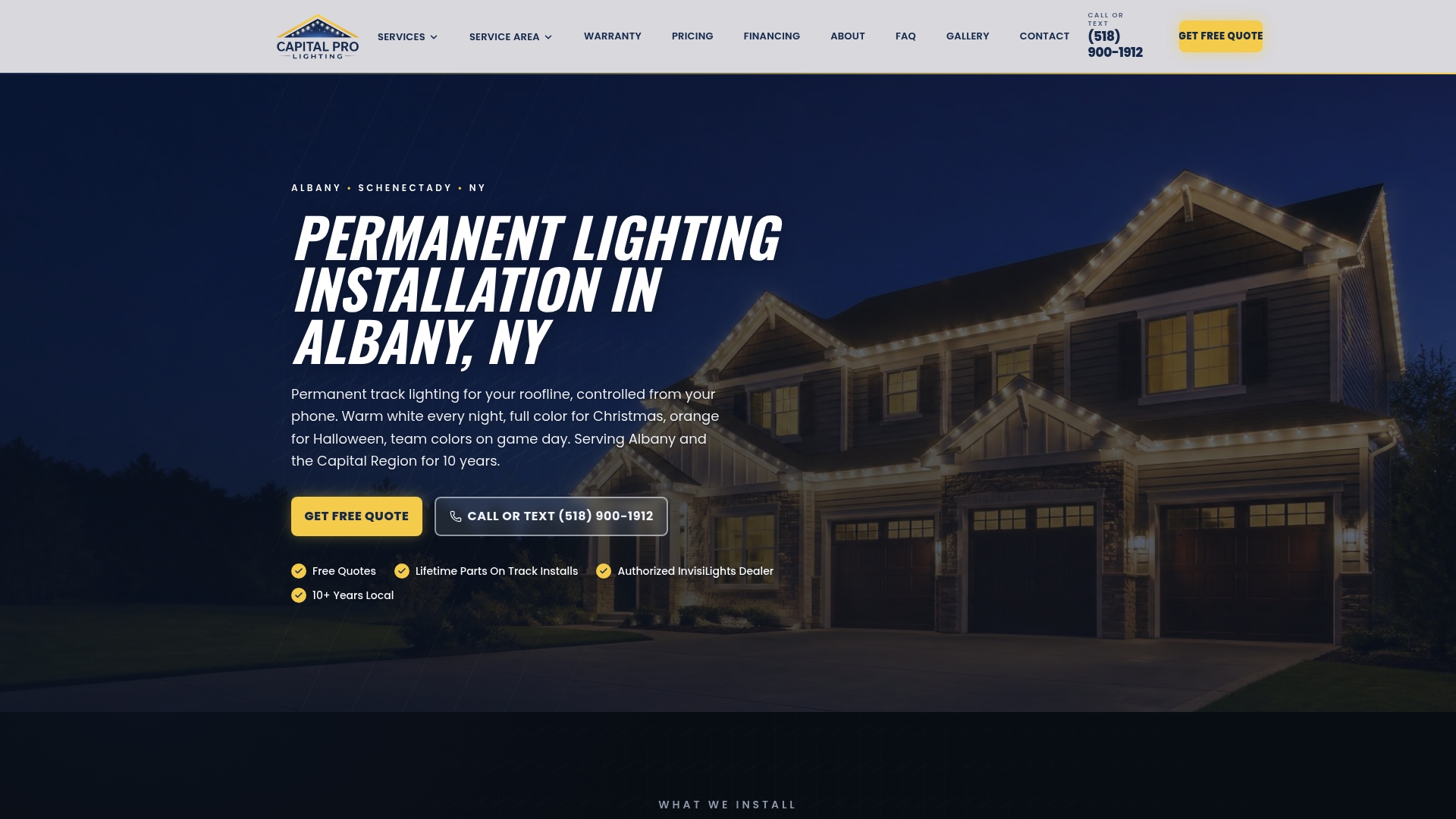
Capital Pro Lighting installs permanent, programmable roofline lighting built around color-matched aluminum hat track, UL-listed control boxes, and custom 3D-printed brackets that keep the whole system discreet against your fascia. Every install carries a lifetime warranty on parts and workmanship, and financing is available for homeowners who’d rather spread the cost over time.
Here’s why homeowners across the Capital Region choose Capital Pro Lighting over a retail kit or a general contractor:
- Local installers who know Albany-area rooflines, weather, and code requirements
- A published warranty you can read before you sign anything
- Real before/after project photos, not stock renderings
- Six months no-interest financing for qualifying projects
If you’re in Delmar, Ballston Spa, Schenectady, or anywhere else in the region, the next step is a quick measurement visit. Request a quote from Capital Pro Lighting and find out what a permanent, phone-controlled system would look like on your own roofline before the next holiday rush hits.
Frequently Asked Questions
Is professional installation worth it over a DIY roofline lighting kit?
What’s the difference between dark sky outdoor lighting from a retailer and a permanent professional system?
How long does a permanent roofline lighting install take?
Can permanent programmable lights change color for holidays and events?
What should I check on a lighting installer’s proposal before signing?
Sources
Recommended
Ready for a Brighter Home?
Free, no-pressure quotes across the Capital Region.
No obligation. Local installer. Same-day callback.
Reviewed by Capital Pro Lighting
Capital Pro Lighting installs permanent outdoor lighting, architectural lighting, and holiday lighting across Albany and New York's Capital Region. We install UL listed permanent lighting systems and have 10 years in business. More about our team.


