
Christmas Light Installation Cost: What You'll Actually Pay
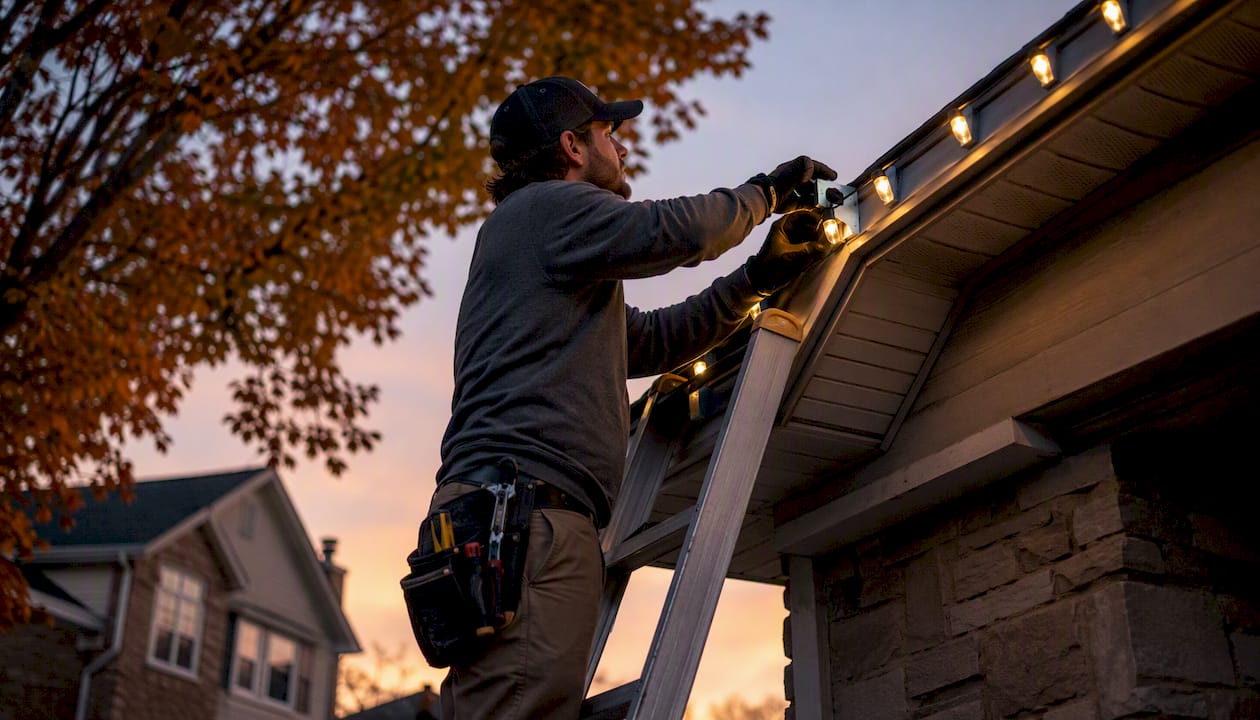
Christmas Light Installation Cost: What You’ll Actually Pay
Expect to pay $5 to $12 per linear foot for professional Christmas light installation, or roughly $800 to $3,500 for a full residential package depending on home size and features. Here’s how those numbers break down before you call anyone for a quote.
- Small ranch home: $800–$1,800 total
- Average two-story house: $1,500–$3,500 total
- Large or custom property: $3,500–$6,000+
Most homeowners underestimate one thing: the quote isn’t really pricing the lights. It’s pricing the ladder work, the insurance, and the guy who has to climb a wet roof in November. That’s why per-foot roofline installation runs $8–$12 when lights are included, even though a string of LEDs costs almost nothing at retail.
Key Takeaways
Professional Christmas light installation costs $5 to $12 per linear foot, with most residential packages totaling $800 to $3,500 depending on home size and complexity.
| Point | Details |
|---|---|
| Per-foot baseline | Expect $2–$5/ft for labor-only, $5–$10/ft for install-plus-lights, up to $12/ft in complex jobs. |
| Sample budgets | Small ranch runs $800–$1,800; two-story runs $1,500–$3,500; large custom runs $3,500–$6,000+. |
| Confirm the fine print | Get takedown, storage, insurance, and minimum ticket confirmed in writing before you sign. |
| Equipment adds up fast | Bucket trucks or lifts for steep, tall, or complex rooflines add $300–$800 per day. |
| Consider the long game | Capitalprolighting’s permanent programmable systems ($3,000–$8,000 upfront) can break even against 5+ years of seasonal installs while adding year-round color control and a lifetime parts warranty. |
What Does a Professional Christmas Light Installation Package Include?
A real quote isn’t just “hang some lights.” It should spell out labor, materials, and what happens after New Year’s Day.
Standard inclusions typically cover:
- Installation labor for roofline, eaves, windows, and columns
- Commercial-grade LED strands (or a rental option where the installer owns the lights)
- Mounting clips, hooks, and hardware sized for your roofline
- A timer or smart control for automatic on/off scheduling
- Takedown after the season, plus storage in some packages
Exclusions trip people up more than inclusions do. Electrical outlet work, repairs for storm damage mid-season, and storage fees often sit outside the base price unless you ask. Confirming takedown and storage in writing matters because some homeowners get hit with a $200–$400 removal bill in January they never saw coming.
Pro Tip: Before signing anything, ask three questions: What’s your minimum ticket? Are your crews insured? Is takedown scheduled automatically or do I need to call you again in January?
How Much Does Christmas Light Installation Cost by Home Size?
Pricing splits into two tiers. Labor-only installation, where you supply the lights, runs about $2–$5 per linear foot. Install-plus-lights packages, where the contractor supplies commercial-grade product, land closer to $5–$10 per linear foot, and higher-end metro markets can push toward $12.
| Home Type | Linear Feet | Material Cost | Labor Cost | Total Package |
|---|---|---|---|---|
| Small ranch | 100–150 ft | $300–$800 | $500–$1,800 | $800–$1,800 |
| Mid-size two-story | 150–250 ft | $600–$1,400 | $800–$1,800 | $1,500–$3,500 |
| Large/custom | 250–400+ ft | $1,500–$3,500 | $3,500–$6,000+ | $3,500–$6,000+ |
On a typical mid-range job, materials and labor split roughly 50/50. Beyond the roofline, most contractors price add-ons as flat rates rather than by the foot:
- Bush or shrub wrap: $50–$150 each
- Small to medium tree wrap: $100–$250 each
- Large tree wrap: $500 or more
- Wreath with lights: usually bundled into the flat-rate add-ons above
What Drives the Price of Holiday Lighting Installation?
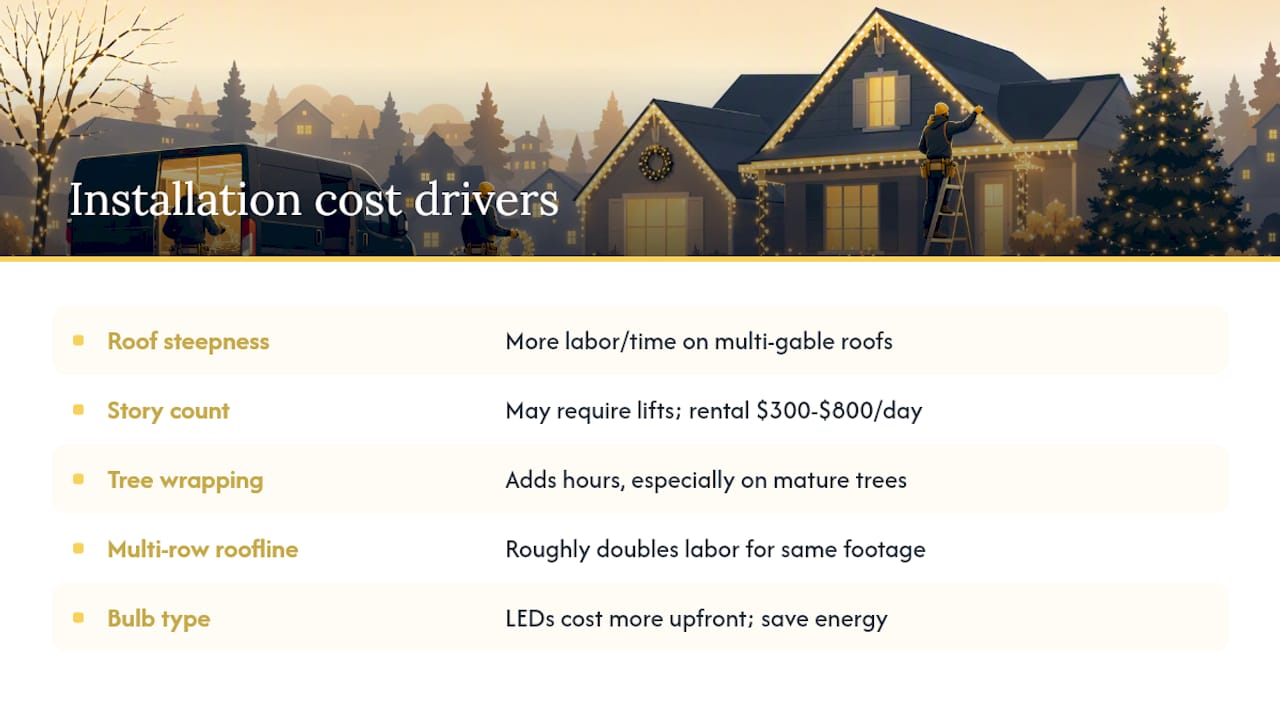
Two houses with the same square footage can get wildly different quotes, and it’s rarely about the lights themselves. Roof steepness and peak count matter enormously. A steep multi-gable roof takes longer to navigate safely than a simple single-story ranch, and that time shows up in labor cost.
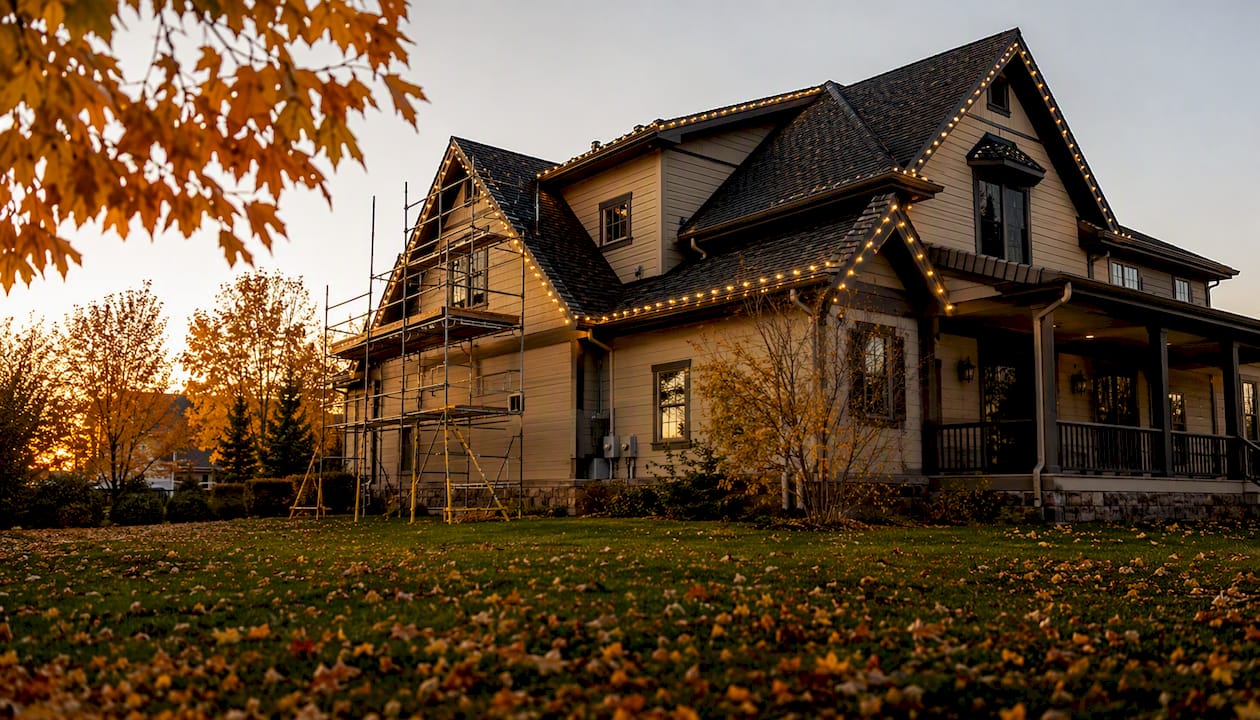
Story count is another multiplier. A two-story or three-story home often requires taller ladders or, in some cases, a bucket truck or boom lift. That equipment isn’t cheap: lift rental with an operator typically runs $300 to $800 per day, and it gets passed straight to the homeowner’s invoice.
Tree wrapping adds hours fast, especially on mature trees with heavy canopies. Double-stacked or multi-row roofline designs roughly double the labor for the same linear footage. And bulb type matters twice: LED strands cost more upfront but last longer and use a fraction of the electricity that incandescent strings burn through.
Pro Tip: Ask your installer to itemize equipment charges separately. A quote that lumps “$400 equipment fee” into the total without explanation is worth questioning.
Should You DIY Your Christmas Lights or Hire a Pro?
The honest answer depends less on your budget and more on your tolerance for ladders in freezing weather.
- Add up your real costs. Materials-only DIY might run $200–$600 for lights and clips, but factor in your time. A two-person professional crew often takes 3 to 8 hours depending on home size; a DIY homeowner working alone frequently doubles or triples that.
- Weigh the liability. A fall from a second-story roof is not a minor injury. Licensed installers carry insurance that covers accidents and property damage; your homeowner’s policy may not cover a ladder fall on your own roof the same way.
- Decide what you value. If storage space, ladder risk, and January takedown chores all sound unappealing, hiring out starts looking cheap by comparison.
| Factor | DIY | Professional |
|---|---|---|
| Upfront cost | $200–$600 (materials only) | $800–$3,500 (full package) |
| Time investment | 4–12+ hours, solo | 3–8 hours, two-person crew |
| Insurance/liability | On you | Covered by installer |
| Storage after season | Your garage | Often included |
How to Estimate Your Own Christmas Light Installation Cost
You don’t need a contractor on-site to get a working ballpark. Here’s the formula pros use in reverse.
- Measure your linear footage. Walk the roofline, eaves, windows, and any columns you want lit. Most single-family homes run 100 to 250 feet.
- Pick your rate tier. Use $2–$5/ft if you’re supplying lights, $5–$10/ft if the installer supplies commercial-grade LEDs.
- Add flat-rate features. Tack on $50–$150 per bush, $100–$500+ per tree, depending on size.
- Add equipment premiums if needed. A two-story-plus home with steep peaks may need a lift at $300–$800/day.
- Add takedown and storage if not bundled into the base quote.
Worked example: 200 feet of roofline at $7/ft ($1,400), plus two medium tree wraps at $200 each ($400), plus takedown at $150, lands around $1,950, squarely in the mid-size two-story range.
Pro Tip: Round up your linear footage estimate by 10%. Homeowners almost always undercount corners and vertical runs around dormers.
When Should You Book to Avoid Surge Pricing?
Installer calendars fill fast once Halloween passes. Booking in early to mid-October typically locks in standard rates; waiting until late November often means paying a rush premium or missing the season entirely, since crews cap how many jobs they can physically finish before December.
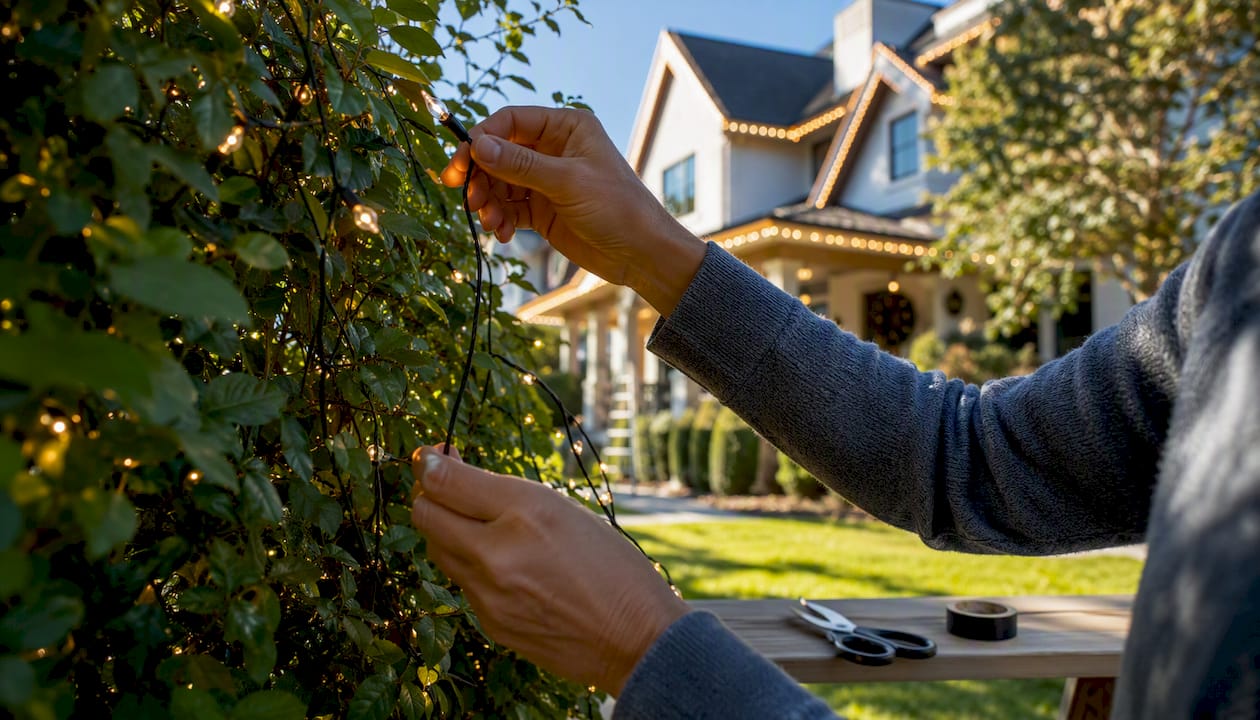
Running costs matter too. A modest LED display often costs just a few dollars for the entire season, while an equivalent incandescent display can run $15–$50 or more. Pair LEDs with a timer set for 5 to 6 hours nightly, and you’ll trim that number further without dimming your display.
Are Permanent Roofline Lights Worth It Instead?
Recurring seasonal installs add up faster than most homeowners realize. Pay $1,500–$3,500 every year for five years and you’ve spent $7,500–$17,500, with nothing left behind but a bill.
Permanent programmable LED systems typically cost $3,000–$8,000 upfront, which sounds steep until you run the break-even math against five or more seasons of annual installs. For a homeowner who wants lights up for Halloween, Christmas, a graduation party, and random Tuesday nights, that math tips fast.
- No annual install or takedown crew to schedule
- Full color control from your phone, year-round
- No storage tote taking up garage space every January
Capitalprolighting builds its permanent systems with custom 3D-printed brackets for a clean, discreet fit, UL listed lights, and a lifetime warranty on parts.
If you’re the type of household that strings up lights for every holiday and every home game, a permanent system stops being a luxury and starts being the cheaper long-term option.
Pro Tip: If you’re on the fence, ask any seasonal installer for a multi-year discount first. If the math still favors permanent, that’s your answer.
A Straight Answer From Someone Who’s Looked at a Lot of Quotes
Get two or three written quotes before you sign anything, and read past the total to the line items. A cheap bid missing takedown or insurance isn’t actually cheap. And if you’re the household that decorates for every occasion, do the break-even math on a permanent system before writing another seasonal check.
Get a Quote for Your Home’s Lighting
There’s a real gap between what a seasonal install costs every single year and what a one-time permanent system costs once. Capitalprolighting installs both, so you’re not locked into either path before you’ve seen the numbers for your own roofline. For homeowners who want traditional seasonal service, that means full installation, takedown, and storage handled for you. For homeowners tired of the annual cycle, Capitalprolighting’s permanent programmable roofline lighting comes with a lifetime warranty on parts, custom 3D-printed brackets for a clean fit, and full color control from your phone, no ladder required after installation day.
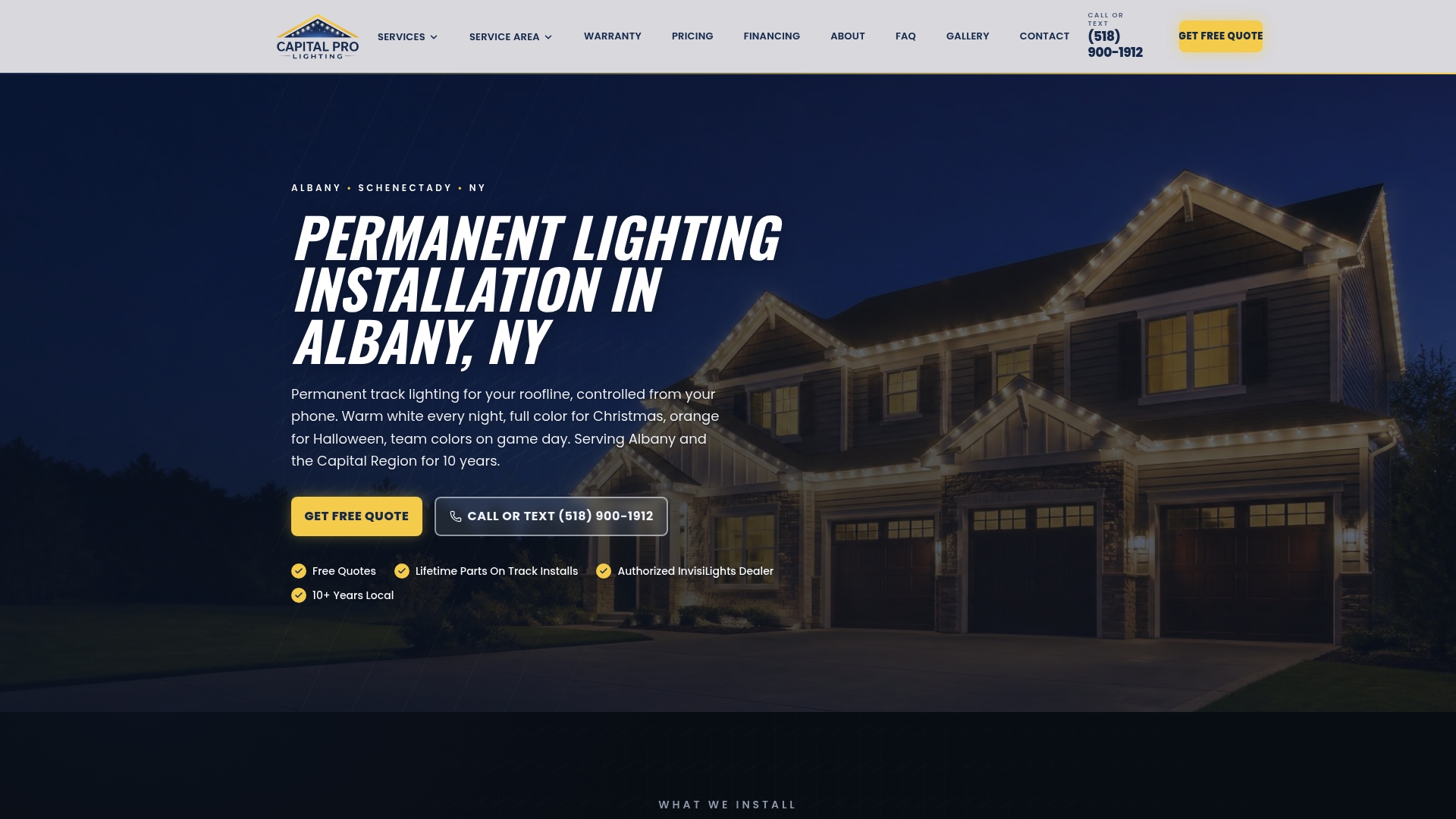
If you’re in the Capital Region, start with a free estimate for your Albany home and ask for both a seasonal quote and a permanent system break-even comparison side by side.
Frequently Asked Questions
How much for Christmas light installation on an average home?
Most two-story homes cost $1,500 to $3,500 for a full professional package, including labor, LED lights, clips, and a timer.
What’s the average cost for holiday lighting per linear foot?
Labor-only installs run $2–$5 per foot; install-plus-lights packages run $5–$10 per foot, and complex or high-end jobs can reach $12 per foot.
Does professional Christmas light installation cost include takedown?
It depends on the contract. Some packages bundle takedown and storage; others bill $200–$400 separately. Always confirm this in writing before booking.
Is a permanent lighting system cheaper than yearly installs long-term?
Often, yes. A $3,000–$8,000 permanent system can break even against five or more years of seasonal installs, while adding year-round color control and no annual takedown.
Why do installers charge a minimum fee even for small homes?
Insurance, travel, and crew mobilization cost the same whether a job is 80 feet or 300 feet, so most installers set a minimum ticket, commonly $800 to $1,000, to stay profitable on smaller jobs.
Sources
- Christmas Lights HQ — How Much Does Christmas Light Installation Cost? Real Pricing Breakdown
- HomeGuide — Christmas light installation cost
- Family Handyman — Christmas light installation cost
- Electric Choice — Electricity cost and consumption for Christmas lights
A written quote with itemized labor, materials, and takedown terms protects you more than any single price range ever will.
Recommended
Ready for a Brighter Home?
Free, no-pressure quotes across the Capital Region.
No obligation. Local installer. Same-day callback.
Reviewed by Capital Pro Lighting
Capital Pro Lighting installs permanent outdoor lighting, architectural lighting, and holiday lighting across Albany and New York's Capital Region. We install UL listed permanent lighting systems and have 10 years in business. More about our team.


