
Christmas Light Removal Service: Fast, Safe Post-Holiday Takedown
Christmas Light Removal Service: Fast, Safe Post-Holiday Takedown
Hiring a professional Christmas light removal service is the fastest, safest way to end the holiday season without spending a weekend on a frozen ladder. Most local crews can get you on the schedule within days, and the best ones handle everything from unclipping strands to boxing them for next year.
Before you book anything, run through this checklist:
- Schedule removal for early January, before ice buildup makes the job riskier and pricier.
- Ask for a written, flat-rate quote, not a vague estimate.
- Confirm the crew carries insurance and stands behind its work with some form of warranty.
- Decide upfront whether you want your lights stored, or whether this is the year you switch to permanent lighting instead.
Key Takeaways
Hiring an insured professional for Christmas light removal costs less in risk and hassle than DIY takedown, especially when the service includes testing, repair, and labeled storage.
| Point | Details |
|---|---|
| Book in the January window | Schedule removal between January 2 and mid-January to avoid ice damage and neglected-yard optics. |
| Confirm quote terms upfront | Get a flat-rate written estimate covering labor, repairs, storage, and disposal before booking. |
| Verify insurance and warranty | Ask for proof of liability coverage, worker’s comp, and a satisfaction guarantee before hiring. |
| Skip curbside recycling for lights | Use e-waste programs, retailer drop-offs, or municipal events instead of the recycling bin. |
| Label and box for next season | Coil, tag, and photograph each section so reinstallation next year takes an afternoon, not a weekend. |
| Consider permanent lighting | Capitalprolighting’s programmable roofline systems carry a lifetime parts warranty and end the annual takedown cycle. |
What Does a Professional Christmas Light Removal Service Actually Do?
A quote for “light removal” can mean very different things depending on the company. Some crews show up, unclip everything, and leave you a pile of tangled cords in the driveway. Others run a full-service process that includes testing, repair, and labeled storage. Knowing the difference before you book saves you a second phone call in February.
A solid removal visit typically includes:
- Powering down and disconnecting all strands and controllers safely.
- Top-down takedown, starting at the roofline and working toward the ground.
- Careful clip removal to avoid cracking frozen plastic housing.
- On-site testing of each strand to flag which ones are dead or damaged.
- Minor repairs, like replacing a fuse or reseating a bulb, done on the spot.
- Coiling and labeling strands by location for easy reinstallation.
- Either boxing everything into storage bins or handing coiled strands back to you.
- A final clean sweep of the yard for dropped clips, zip ties, and hardware.
Some companies only offer bare-bones takedown. Others bundle takedown with storage, or takedown plus repair and inspection so your lights are ready to rehang without surprises next November. Before signing anything, confirm the provider is insured, uses UL-listed lights if replacements are needed, gives you a flat-rate estimate in writing, and backs the job with some kind of satisfaction guarantee. Those four signals separate a reliable operator from a side hustle with a truck and a ladder.
When Should You Book Removal, and What Will It Cost?
Booking is simple: most companies just need your home’s size, roof height, an approximate strand count, whether you want storage, and any access quirks (steep pitch, tall trees, a locked gate). Give a crew that information over the phone or through an online form, and you can usually get a flat quote back same-day.
Timing matters more than people think. Industry guidance points to a window between January 2 and mid-January as the sweet spot for removal, early enough to avoid ice damage to clips and wiring, late enough that you’re not the house that looked done with Christmas on December 26. Local crews typically respond within 24 to 72 hours during this stretch, though the first two weeks of January are peak season, so booking early in the month beats waiting until the 20th.
Statistic callout: Holiday-related waste volume jumps roughly 25 to 30 percent in the two weeks after Christmas. That surge doesn’t just clog disposal sites, it also means the crews handling both removal and disposal get busiest right when you need them most.
What actually moves the price:
- Number of stories and roof steepness (a single-story ranch costs less than a steep-pitched colonial).
- Whether the job needs a lift or harness system versus a standard extension ladder.
- On-site repairs to strands, controllers, or timers.
- Storage fees if you want everything boxed and kept off-site.
- Distance from the provider’s service area.
- Disposal or recycling charges for strands you don’t want back.
Before you accept a quote, ask a few direct questions: Is this price flat rate or itemized? Are gutters and siding covered if something gets damaged during removal? Is disposal of old lights included? What’s the cancellation or rescheduling policy if weather pushes the date? And can they show proof of insurance?
Is DIY Removal Actually Riskier Than It Sounds?
Yes, and it’s not just about falling. Cold weather makes plastic clips brittle, which means a hard yank to free a frozen strand can crack the clip or tear the shingle underneath it. Add ice on the ladder rungs and a roofline you’ve never walked before, and you’ve got a genuinely dangerous combination. Consumer Reports has flagged DIY holiday takedown as one of the more overlooked home safety risks each winter, not because the task looks hard, but because people underestimate it until they’re on the roof.
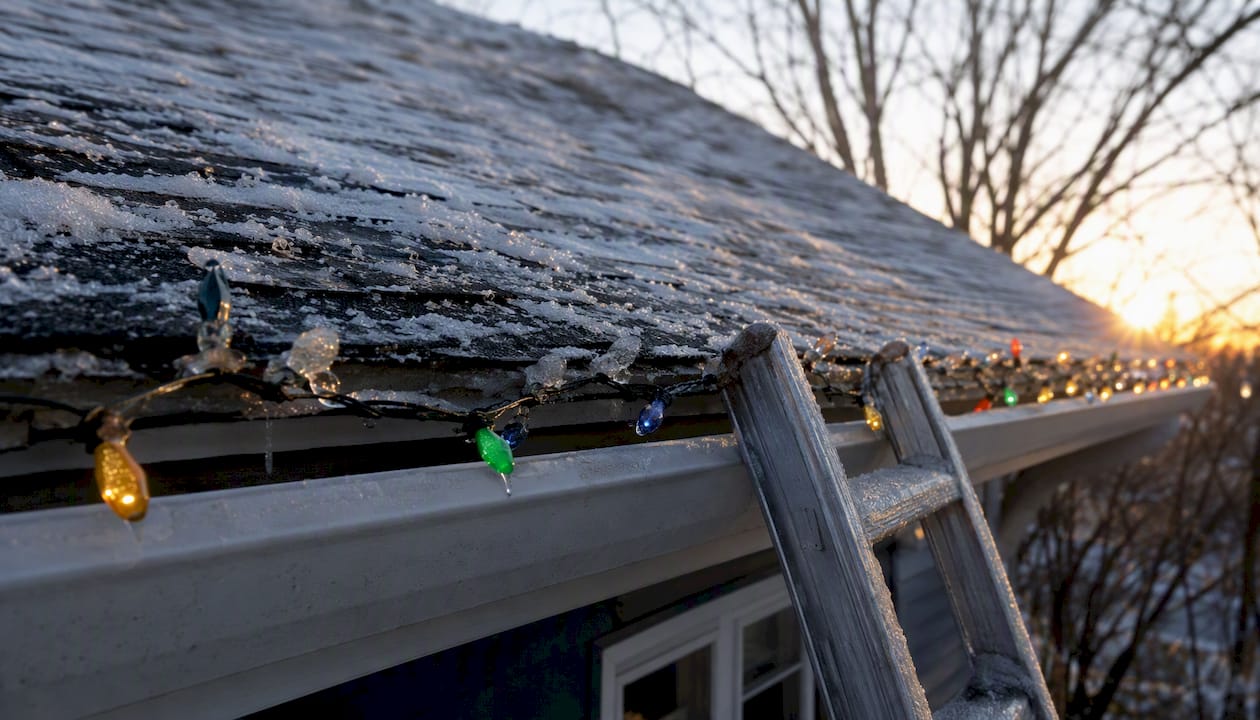
Professional crews handle multi-story homes with safety harnesses, rigging systems, and boom lifts instead of leaning a ladder against an icy gutter. They also use hand tools built specifically for gentle clip removal, which is why pros rarely crack the plastic housing you’ll shatter with a gloved hand.
Before hiring anyone, ask for proof of liability insurance and worker’s compensation coverage, a written safety policy, and recent references or reviews.
Pro Tip: If a company hesitates to send proof of insurance by email, treat that as your answer. A legitimate crew has this document ready before you even ask.
Where Do Old or Broken Christmas Lights Go?
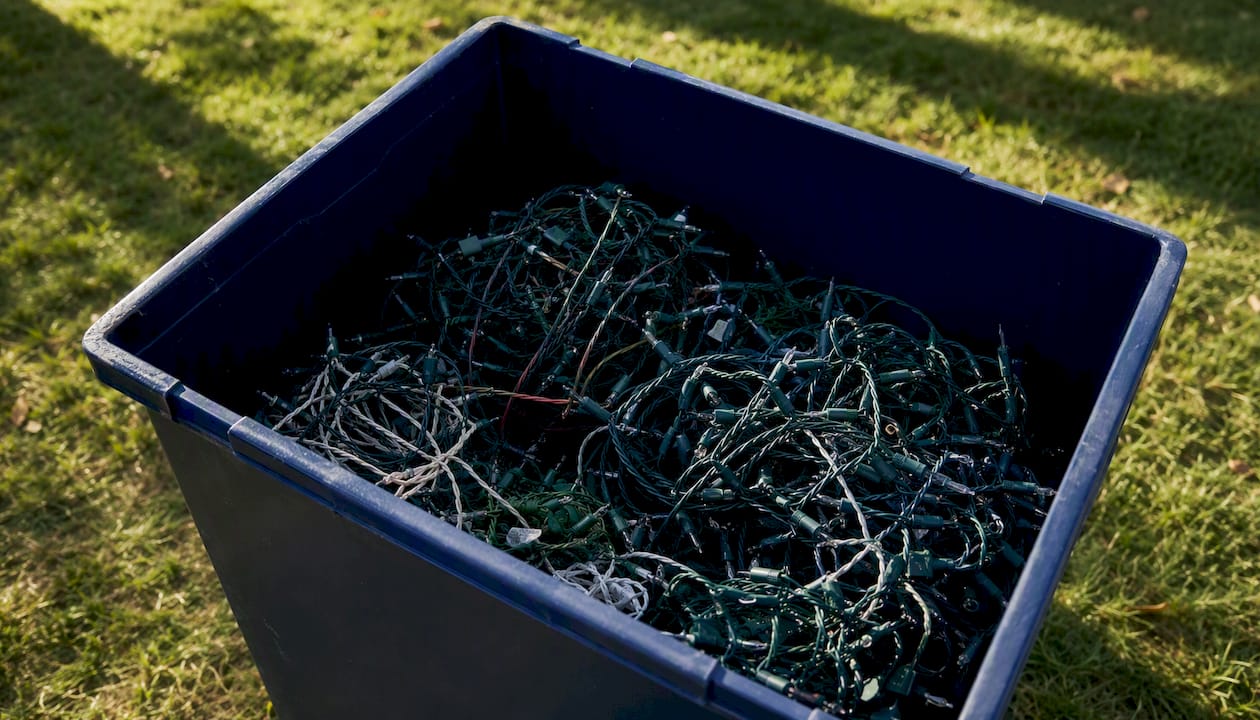
Do not toss long light strings into curbside recycling. The cords tangle sorting equipment at recycling facilities, which means the whole batch often gets pulled and landfilled anyway. Instead, use dedicated e-waste programs, seasonal drop-off bins at retailers like Home Depot or Lowe’s where available, municipal household hazardous waste events, mail-in recycling services, or scrap metal yards if you’re dealing with a large volume from a business property.
Statistic callout: That post-holiday waste spike of 25 to 30 percent is exactly why timing your drop-off matters. Municipal programs get flooded in early January, and some seasonal collection events run only through late January, so check dates before you assume there’s still time.
Most seasonal drop-off programs run November through January, though some cities extend collection into early February. Availability changes year to year, so check your local waste management site before hauling a box of dead lights to a bin that’s already closed for the season.
How Do Pros Pack and Label Lights for Next Year?
Professionals work top-down, and they never yank a frozen clip. If a connection doesn’t budge, they’ll let it warm up rather than force it and risk snapping the wire.
- Test each strand before it goes into storage, so you’re not discovering dead sections next November.
- Coil each strand individually and secure it with a zip tie instead of one giant tangled ball.
- Tag each coil with its location (“front gable,” “porch rail”) so reinstallation takes minutes, not an afternoon of trial and error.
- Photograph the finished display before takedown begins, creating a simple map for next season.
Store coils in rigid bins rather than plastic bags, which crush bulbs and invite moisture. Keep spare bulbs and clips in the same labeled bin as their matching strand, and store everything somewhere temperature-stable and dry, not a damp garage corner.
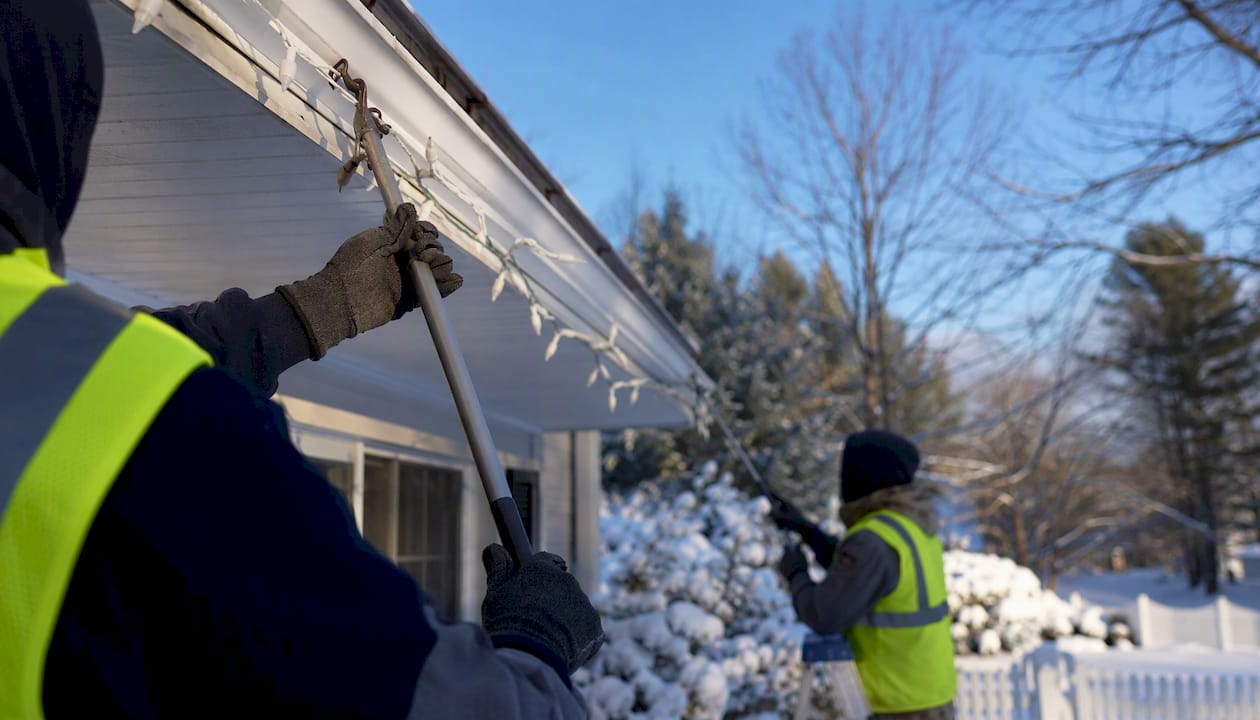
Pro Tip: Use a hooked pole to unclip gutter-mounted lights from the ground instead of climbing for every section. It’s the single fastest way pros clear a roofline without repositioning a ladder twenty times.
Is Permanent Roofline Lighting Worth Skipping Takedown Entirely?
If you’re tired of this cycle every January, permanent programmable lighting is worth a real look. No annual takedown, no storage bins taking up garage space, and app control that switches your roofline from red and green in December to school colors in October.
The tradeoffs are real too: higher upfront cost, a proper installation appointment, and rooflines or gutters need to be suited to a permanent track system. Capital Pro Lighting’s permanent systems come with a lifetime parts warranty and UL-listed components, which is the kind of long-term coverage that makes the upfront cost easier to justify if you’re planning to stay in the house a while.
Get Your Lights Down (or Never Take Them Down Again)
Once the tree’s in the compost pile and the last cookie’s gone stale, the last thing you want is another weekend on a ladder. Capitalprolighting handles the whole post-holiday cycle for Capital Region homeowners: professional takedown, on-site strand testing and repair, and labeled storage so next year’s reinstall takes an afternoon instead of a weekend.

Every job comes with an insured, licensed crew, UL-listed lights, and a flat-rate written quote before anyone touches a ladder. If you’d rather stop the annual cycle entirely, Capitalprolighting also installs permanent programmable roofline lighting backed by a lifetime parts warranty on parts, controlled entirely from your phone, and ready for any color scheme from Halloween through the Fourth of July. Homeowners across Albany, Troy, Clifton Park, and Saratoga Springs already use it to skip the ladder altogether.
Request a removal quote or a permanent lighting consultation at Capitalprolighting and get a date on the calendar before peak January booking fills up.
Frequently Asked Questions
How much does a Christmas light removal service typically cost?
Pricing depends on home size, roof steepness, strand count, and whether storage is included. Ask for a flat-rate written quote so labor, repairs, and disposal are all spelled out before the crew shows up.
When is the best time to schedule holiday light removal?
Industry guidance points to early January through mid-January, which reduces the odds of ice damage while avoiding a yard that looks abandoned mid-season.
Do professional services store the lights for me?
Many do, offering labeled bin storage as an add-on to takedown. Confirm this upfront since some providers only handle removal and hand the coiled strands back to you.
Can I recycle broken Christmas lights curbside?
No. Long strands tangle sorting machinery at recycling facilities. Use e-waste drop-off programs, seasonal retailer bins, or municipal hazardous waste events instead.
Is permanent lighting cheaper than paying for takedown every year?
It costs more upfront, but it eliminates the recurring labor and storage costs of annual installation and removal, which is why some homeowners see it pay off over several seasons.
Sources
- Can you recycle Christmas lights? (includes safety and service guidance)
- Holiday recycling resources (Indiana Department of Environmental Management)
Recommended
Ready for a Brighter Home?
Free, no-pressure quotes across the Capital Region.
No obligation. Local installer. Same-day callback.
Reviewed by Capital Pro Lighting
Capital Pro Lighting installs permanent outdoor lighting, architectural lighting, and holiday lighting across Albany and New York's Capital Region. We install UL listed permanent lighting systems and have 10 years in business. More about our team.


