Skip the Ladder: Capital Region Backyard LED Roofline Checklist
Skip the Ladder: Capital Region Backyard LED Roofline Checklist
For most homeowners who want year-round backyard roofline lighting, a professionally installed permanent LED track system is the best option. It cuts out the ladder work that sends thousands of people to the emergency room every winter, and it gives you app-controlled color changes for any holiday, game day, or random Tuesday. Capital Pro Lighting installs these systems locally across the Capital Region, with a lifetime parts warranty backing the track itself.
TL;DR:
- These systems require a professional installer when roofs are steep, multi-story, or have complex architecture, while confident DIYers may manage simple single-story, straight roofs.
- A well-installed permanent track should be nearly invisible during the day, with low-profile brackets and matched color tones; safety practices demand UL or ETL testing and GFCI outlets.
- Weatherproof lighting tracks with sealed connectors and UV-stabilized housing resist harsh climates better than seasonal string lights, reducing failure risk over time.
- Homeowners should confirm that warranties cover parts and labor, app support is long-term, and local rules permit visible, color-changing lighting before installation.
Permanent Roofline Lighting vs. Seasonal Strings vs. DIY Fixtures
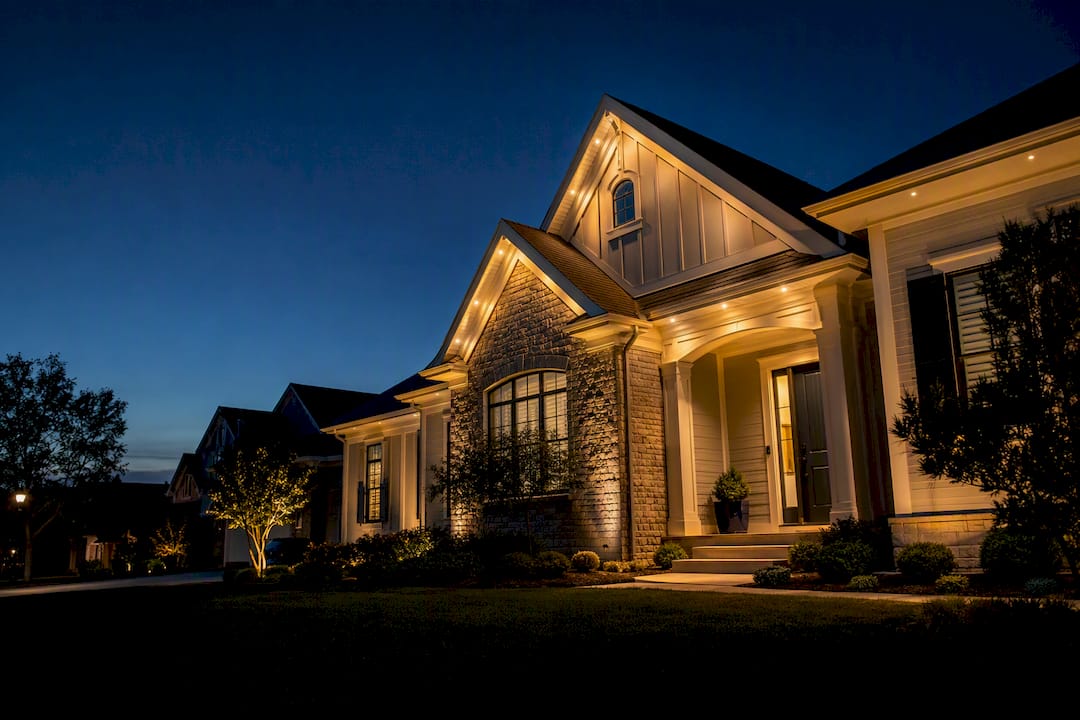
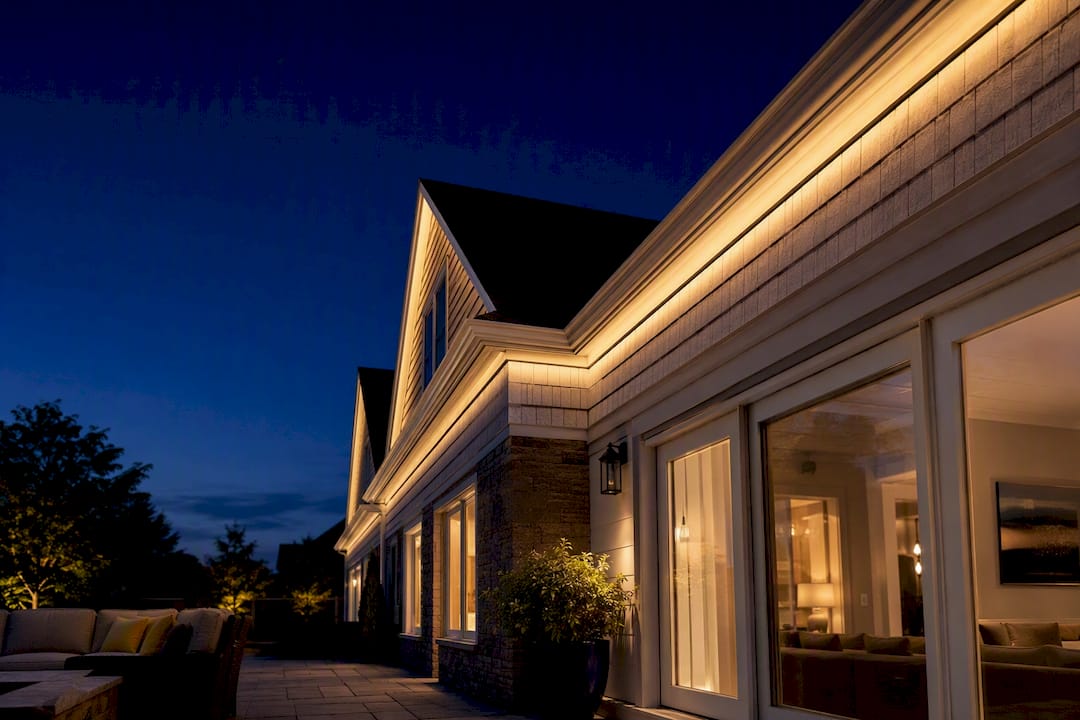
Three real categories exist here, and they solve different problems. Permanent track systems, often built with RGB or RGBIC LEDs, mount discreetly along the fascia or gutter line and stay there year-round. During the day, a well-installed track should nearly disappear against the roofline, which is why the color of the housing matters as much as the light output.
Seasonal string lights are the option most people already know: hang them in November, take them down in January, store them somewhere they’ll get tangled again by next year. They cost less upfront but carry recurring installation and removal expenses every season, plus the annual risk of a ladder mishap.
DIY smart floodlights or adhesive LED strips sit in between. They’re reasonable for renters, small patios, or anyone testing the idea before committing to a full install.
- Permanent track systems: best for homeowners who want year-round color control and are done with annual ladder duty.
- Seasonal strings: best for renters or anyone unsure they’ll want lighting past this holiday season.
- DIY smart fixtures: best for small budgets, apartments, or a trial run before a bigger investment.
What Does Backyard Roofline Lighting Cost?
Pricing swings widely depending on what you’re actually buying. Entry-level trackless clip systems tend to start lower, while full pixel-based permanent installs with zone control climb higher based on linear footage and roof complexity.
Pro Tip: Ask any installer to break the quote into linear feet, power injection points, and controller hardware. A vague lump-sum number usually means someone is guessing at your roof.
Several factors move the price up or down:
- Total linear feet of track around the roofline
- Roof height, pitch, and how many corners or dormers the crew has to navigate
- Whether you’re buying static warm-white output or full pixel/animated capability
- Controller and app features, including how many independent zones you want
- Power injection needs on long runs, which prevent color fade at the far end of a track
The long-term math favors permanent systems for anyone who decorates for multiple occasions a year. Vendor cost comparisons show permanent projects often starting in the low thousands and scaling with home size, while seasonal service is cheaper per event but repeats annually. LED hardware itself uses at least 75% less energy and lasts roughly 25 times longer than incandescent bulbs, which chips away at the gap over a few seasons of use.
How Do You Choose Between DIY and a Professional Installer?
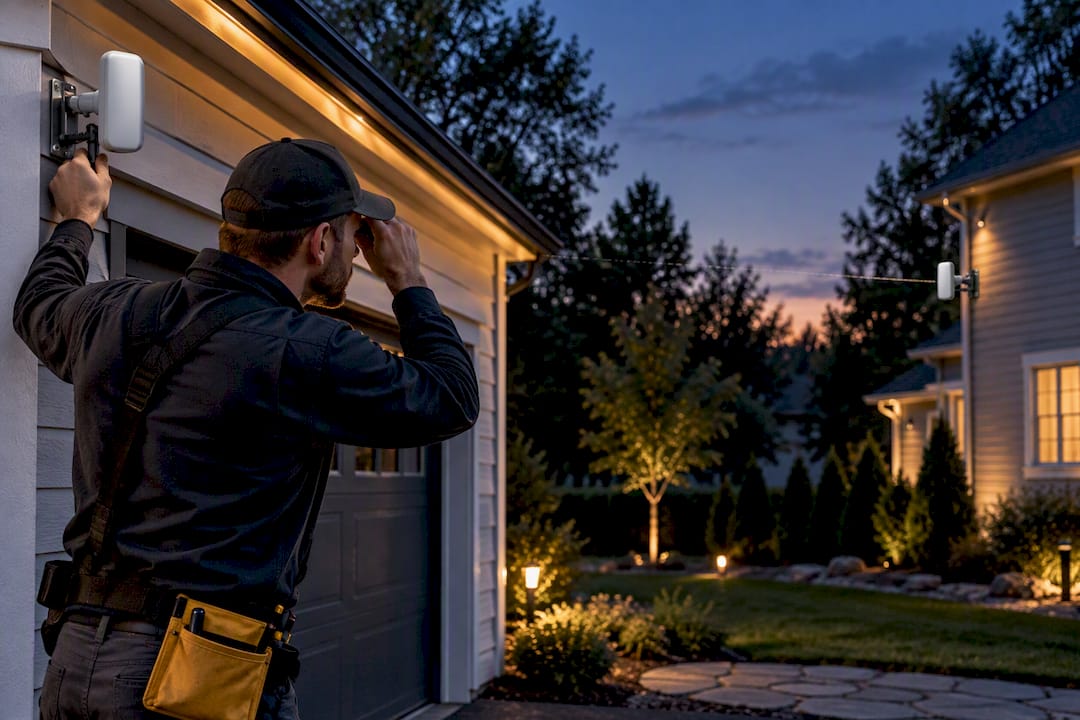
Hire a professional when your roof has more than one story, a steep pitch, long continuous runs, or you want a pixel-based system with genuine daytime discretion. A single-story ranch with a short, straight roofline is more forgiving for a confident DIYer; a Colonial with dormers and a detached garage is not.
Before signing anything, ask the installer these questions:
- What’s covered under warranty, and for how long, on parts versus labor?
- Does the controller and app get ongoing software support, or just a hardware guarantee?
- Can you show daytime photos of the track color against a roofline similar to mine?
- Are you insured, and can I see proof?
- What’s your response time if a section fails after install?
Watch for red flags: no written warranty, vague answers about power planning, no mention of UL or ETL testing on the fixtures, no daytime photos offered, or a pushy insistence on drilling into roofing material that didn’t need it.
A typical install runs one to two days for an average single-family home, depending on linear footage and roof access. Before the crew arrives, confirm your exterior outlets are GFCI-protected and clear any landscaping or ladders blocking the roofline.
Controls, Energy Use, and Safety Practices
App control is the actual daily value of a permanent system. Zones let you run warm white on the main house and a different scene over the patio. Scheduled scenes turn lights on at dusk without you touching your phone, and music sync features turn a static roofline into something a lot more fun for a backyard party.
The safety case is just as real as the convenience case. The CPSC estimated more than 14,000 holiday decorating injuries treated in emergency rooms during November and December in one recent count, with ladder falls a leading cause. A permanent track eliminates the annual climb entirely.
Non-negotiable safety practices for any roofline lighting:
- Use only outdoor-rated fixtures tested by UL or ETL, not indoor lights repurposed outside
- Plug into GFCI-protected outdoor receptacles, never a standard interior circuit
- Never pinch cords through closed windows or doors
- Check any exposed wiring for cracking or fraying before each season
Confirm your outdoor outlets are GFCI-protected before an installer shows up. It’s a five-minute check that saves a return trip.
What Maintenance and Warranty Terms Should You Expect?
“Permanent” doesn’t mean “maintenance-free.” Tracks need an occasional wipe-down, controllers occasionally need firmware updates, and any exposed connector should get a visual check once or twice a year. Budget for a light inspection call every couple of seasons, not a full re-install.
Daytime appearance is where a lot of homeowners get surprised after the fact. A track that glows beautifully at night but reads as a chunky black stripe on a cream-colored fascia during the day undermines the whole point. Insist on seeing matched track colors and low-profile brackets before you approve a design, not after installation.
When you review a contract, check for:
- Length of parts warranty versus labor warranty, since these are often different
- Whether controller firmware and app support are covered long-term or only the physical hardware
- Whether the warranty transfers if you sell the house
- Stated response time for repairs
Some vendors warrant the hardware but not future app compatibility, so ask that question directly rather than assuming.
Will Backyard Roofline Lighting Work With My Roof and Gutters?
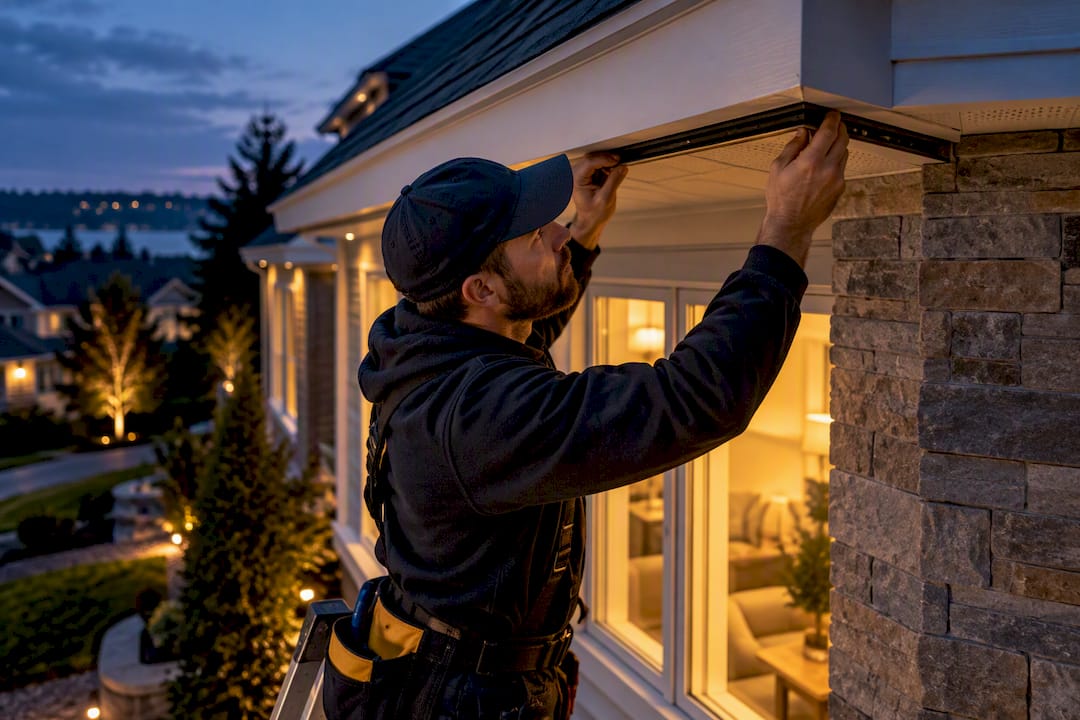
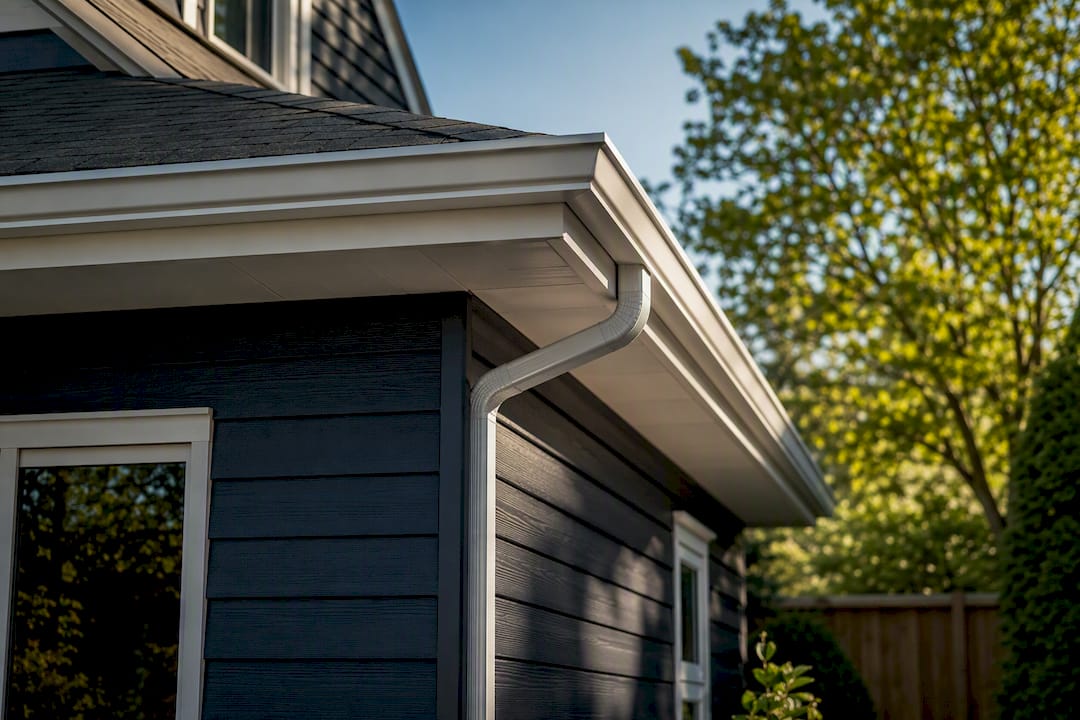
Most permanent systems attach along the fascia board, under the drip edge, or directly to gutter hardware, and a good installer adapts the mounting method to what’s already on your house rather than forcing a one-size approach. Asphalt shingle roofs with standard fascia boards are the easiest case: brackets clip on without any new penetration into the roofing material itself.
Metal roofs, slate, and homes with no fascia board (some modern builds run the roofline flush) need a different bracket strategy, often a gutter-clip or channel system instead of a fascia-mounted track. Homes with K-style gutters generally have more clip options than homes with half-round gutters, which sit slightly differently and can require custom spacing.
If your gutters are old, sagging, or due for replacement soon, that’s worth mentioning during the site visit. Mounting a lighting track to gutter hardware that’s already failing just transfers the problem. A reasonable installer will flag this before quoting rather than after the crew shows up. Custom brackets, including 3D-printed options designed for a specific roofline profile, solve a lot of the fit problems that generic clip kits run into on older or unusually shaped homes.
Does Roofline Lighting Affect Home Insurance or Local Rules?
Permanent electrical additions to your exterior can occasionally draw a homeowner’s insurance question, mostly around whether the work was done by a licensed, insured contractor and whether it meets local electrical code for outdoor wiring. Insurers care less about the lighting itself and more about how it was installed. Ask any installer for proof of insurance before work starts, since a poorly wired addition is the kind of thing that complicates a claim later, not the string lights themselves.
Local rules vary more than most homeowners expect. Some municipalities and homeowners associations have language around exterior lighting brightness, color changes visible from the street, or hours of operation, especially for anything that could be considered a nuisance to neighbors. Historic districts sometimes have stricter guidance on visible hardware during the day.
None of this makes permanent lighting risky, but it does mean a quick call to your HOA or a look at your local municipal code is worth doing before installation, not after. A reputable local installer who has worked in your town before will usually already know the relevant rules and can flag anything unusual during the site visit.
Lighting Design Principles That Make a Roofline Pop
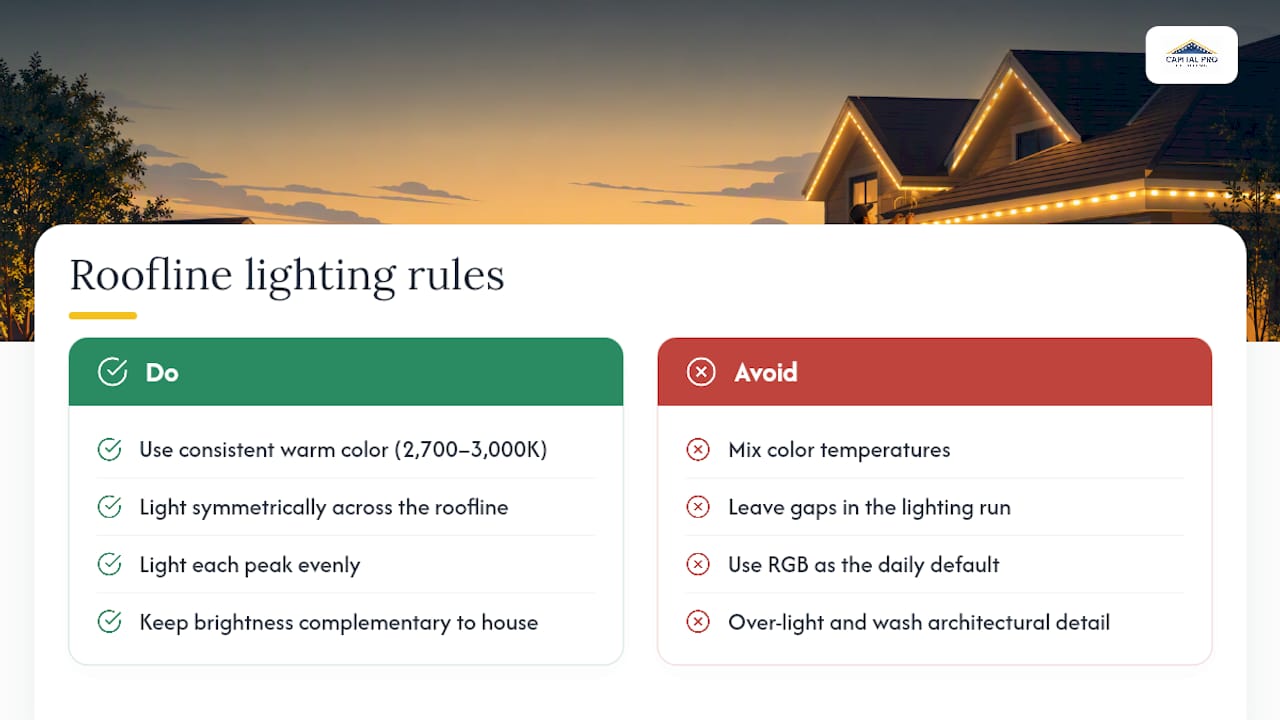
Good roofline lighting design starts with a simple rule: consistency beats intensity. A single warm color temperature run cleanly along the entire roofline almost always looks better than mixed color temperatures or gaps where a bracket count ran short.
Symmetry matters more on a roofline than almost anywhere else on a house. Uneven lighting, brighter on one side than the other, draws the eye to the mismatch instead of the architecture. If your home has a peaked roof or multiple gables, lighting each peak evenly creates a rhythm that a flat run along a single eave doesn’t achieve.
Color temperature choice changes the whole feel of a house. Warm white in the 2,700 to 3,000 Kelvin range reads as classic and architectural; full RGB color makes more sense for holidays and events than as a daily default. Many homeowners settle on warm white for everyday use and switch to color scenes through the app for specific occasions.
Brightness should complement the house, not compete with it. Rooflines that are over-lit tend to wash out architectural detail rather than highlight it. A tasteful, well-matched lighting upgrade is exactly the kind of exterior improvement that contributes to a home’s perceived value, the same way a well-chosen front door or updated exterior trim does.
How Durable Are Different Roofline Lighting Materials?
Weather resistance varies a lot between lighting types, and this is where cheap seasonal strings tend to fail fastest. Basic incandescent or entry-level LED string lights use PVC insulation that gets brittle in freeze-thaw cycles, cracking after a couple of winters of exposure.
Permanent track systems are built differently. The channel itself is typically a UV-stabilized polymer or aluminum housing rated for continuous outdoor exposure, and the LED diodes sit inside a sealed, weatherproof track rather than an exposed bulb socket. That sealed design matters more in a climate with real winters than in a mild one, since ice and snow load stress connection points that open-air string lights simply don’t have.
Connector quality is the detail most homeowners never think to ask about. A track with exposed or poorly sealed connectors will let moisture in eventually, corroding contacts and causing flickering sections years before the LEDs themselves would fail. This is also where custom, properly fitted brackets earn their keep: a bracket designed for your exact fascia profile keeps water from pooling against the track in a way that a generic clip sometimes doesn’t.
Can Roofline Lighting Work With My Existing Landscape Lighting?
Most app-based roofline systems support multiple zones, which means your roofline can run on its own schedule while path lights, uplights on trees, or deck lighting run on theirs. The practical benefit shows up at dusk: your landscape lights can come on at a lower, ambient level while the roofline holds a brighter accent color, or the whole yard can shift into a single coordinated scene for a party.
The catch is protocol compatibility. Not every landscape lighting brand talks to every roofline app, so if you already have a smart landscape system installed, ask a prospective roofline installer directly whether their controller can integrate with it or whether the two systems will run as separate apps on your phone. Running two separate systems isn’t a dealbreaker, just a scheduling inconvenience worth knowing about upfront.
For homeowners installing both from scratch, choosing one ecosystem for roofline and landscape lighting from the start avoids the app-juggling problem entirely and usually gives you cleaner scene design, since sunset-to-sunrise timing can sync across the whole property instead of two separate schedules.
What Local Installers Actually See on the Job
After years of climbing roofs across the Capital Region, a few patterns repeat on almost every job. Homeowners care far more about the daytime look than they expect to going in. They’ll spend weeks picking a color scene for New Year’s Eve and then realize, mid-install, that they also have to live with how the track looks at 2 p.m. on a Tuesday in July.
The second pattern is warranty anxiety, and it’s justified. Plenty of installers will happily sell hardware while staying vague about whether that hardware still works with next year’s app update. Ask that question directly and expect a straight answer.
The homeowners who end up happiest are the ones who treat the app scenes as a feature to actually use, not a gimmick they set once and forget.
— Luis T
Get a Backyard Roofline Lighting Quote From Capital Pro Lighting
If you’ve read this far and landed where most homeowners do, on a permanent LED track system, Capital Pro Lighting installs exactly that across the Capital Region, with a lifetime parts warranty on the track itself and custom 3D-printed brackets built for a clean daytime finish instead of a generic clip look. Reaching out gets you a site visit, a written quote broken down by linear footage and features, an install timeline, and full disclosure of what the warranty covers before you sign anything.
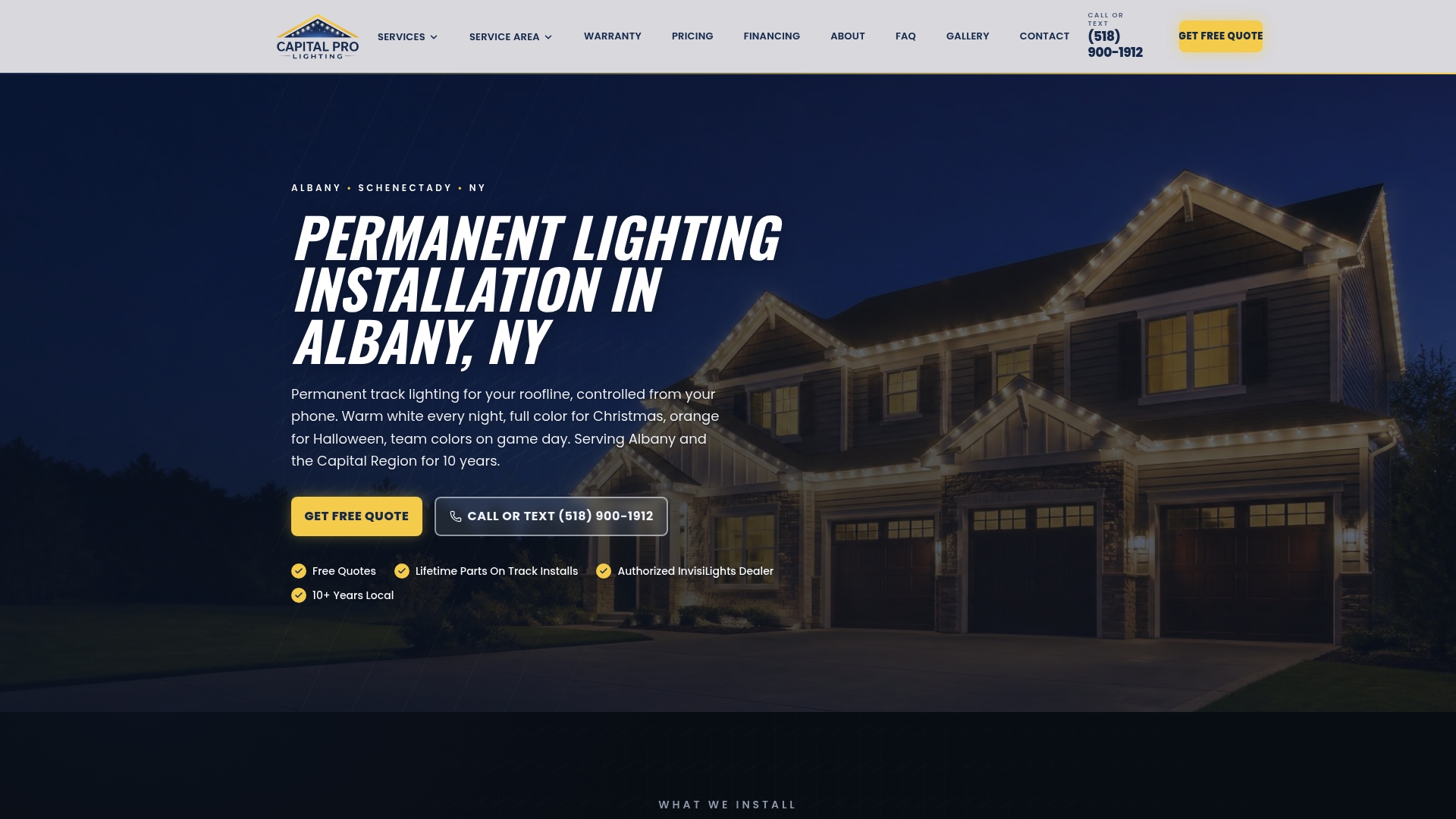
Prefer to keep things seasonal instead? Capital Pro Lighting also handles full-service Christmas light installation, including takedown and storage, if a permanent system isn’t the right fit yet. But for anyone ready to stop climbing ladders every November, check current pricing on InvisiLights Track Mounted and InvisiClips systems, or visit the permanent outdoor lighting page to see what a full install includes before you book a consultation.
Sources
- CPSC estimates more than 15,000 holiday decorating injuries during November and December
- Permanent vs. Seasonal Christmas Lights | Brightify
FAQ
How Much Does Permanent Roofline Lighting Cost?
Pricing depends on linear footage, roof complexity, and whether you choose static or pixel-based color. Capital Pro Lighting’s InvisiLights Track Mounted starts from 2500 USD one-off, and its InvisiClips trackless option starts from 2000 USD one-off, both one-time installation costs.
What Are the Best Lights for a Roofline?
Permanent LED track systems, either static warm-white or full pixel/RGBIC color, are the best fit for a roofline that needs to hold up year-round and look clean during the day. They avoid the annual teardown of string lights and give you app-based scene control instead of a single fixed look.
What Lights Are Best for a Backyard?
For a backyard specifically, look for outdoor-rated LED fixtures with app-controlled zones so the roofline, patio, and landscape beds can each run their own schedule and color. Warm white in the 2,700 to 3,000 Kelvin range tends to suit everyday use, with color scenes reserved for events.
What Are the Trends for Outdoor Lighting in 2026?
App-controlled permanent systems with zone-based scheduling continue to replace one-time seasonal displays, driven partly by the energy efficiency and lifespan advantage of LEDs over incandescent bulbs. Integration between roofline and landscape lighting under a single app is also becoming a standard expectation rather than a premium feature.
Recommended
Ready for a Brighter Home?
Free, no-pressure quotes across the Capital Region.
No obligation. Local installer. Same-day callback.
Reviewed by Capital Pro Lighting
Capital Pro Lighting installs permanent outdoor lighting, architectural lighting, and holiday lighting across Albany and New York's Capital Region. We install UL listed permanent lighting systems and have 10 years in business. More about our team.