Permanent Roofline Lighting Ideas That Look Custom, $20–$40/ft

Permanent Roofline Lighting Ideas That Look Custom, $20–$40/ft
The best roofline lighting approach for most homes is a warm-white, low-profile system split into independent zones, with saturated color reserved for holidays and events. This layout boosts curb appeal year-round, keeps hardware nearly invisible in daylight, and cuts the yearly ladder-and-tangled-string routine that seasonal strings demand. Below you’ll find design ideas, hardware options, technical checkpoints, and cost ranges to help you plan or evaluate a quote.
TL;DR:
- Use low-profile, weatherproof fixtures supporting independent zones to maximize control and versatility for year-round roofline lighting.
- Prioritize zoning and dimming capabilities over color range, as well-controlled white lighting provides greater everyday appeal.
- Install fixtures in strategic locations such as fascia, soffit, or walls, matching hardware to roof shape and avoiding awkward transitions at corners.
- Keep the color temperature between 2700K and 3000K, and shield fixtures downward to minimize glare and light pollution.
- Budget typically ranges from $20 to $40 per linear foot, with roof complexity, electrical scope, and controller features being the main cost drivers.
1. Top roofline lighting ideas homeowners can copy
A good roofline scheme reads as intentional day and night. Start with a continuous warm-white run along the fascia to outline the home’s architecture, then layer in secondary effects only where they add contrast rather than clutter.
- Warm-white fascia outline: Run a continuous low-profile line along the fascia board to trace the roof’s shape, the base layer for almost every successful scheme.
- Peak and gable accents: Highlight steep gables or dormers with a low-saturation color for holidays, then dim them back to white for the rest of the year.
- Soffit downlighting: Add small downlights under porch soffits and eaves to wash the entryway in light, spaced roughly 12 to 18 inches apart for even coverage.
- Roofline plus wall grazing: Pair the roofline outline with a grazing light against textured siding or stone to add depth without extra brightness.
- Pixel accents for festive scenes: Use point-controllable fixtures sparingly, reserved for scalloped holiday patterns or music-synced displays during short seasonal windows.
- Daytime disappearing act: Choose slim, color-matched track or channel systems so the hardware reads as a trim detail, not a string of bulbs, when the lights are off.
Pro Tip: Test any color scene at dusk before committing. Colors that look bold on a phone screen often wash out against a light-colored roofline.
2. Types and placement: match an idea to the right hardware
Not every idea calls for the same hardware. Matching the mounting style to your roofline’s geometry avoids awkward transitions at corners and valleys.
- Permanent recessed or track-mounted systems: Best for homeowners who want a fixture that stays hidden year-round and supports scheduling and color changes without reinstallation.
- Clip-on seasonal systems: Lower upfront cost and simple to remove, but visible clips and cords show in daylight and require reinstalling every season.
- Soffit-mounted downlights: Suit porches, covered patios, and eaves where you want a wash of light rather than an outline.
- Fascia-mounted channels: The standard choice for tracing rooflines, with corner pieces needed at hips and valleys for a clean transition.
- Recessed, walkable profiles: Appropriate near pool decks, terraces, or step edges where a fixture needs to sit flush and handle foot traffic.
3. Design principles for responsible, high-end-looking roofline lighting
Good roofline lighting borrows from architectural and landscape lighting practice rather than holiday-string habits. The Five Principles for Responsible Outdoor Lighting (useful, targeted, low levels, controlled, warm-colored) give a practical checklist for any exterior fixture, roofline included.
- Keep color temperature in the 2700K to 3000K range for everyday use, since warmer light reads as upscale and produces less glare than cooler white.
- Split the roofline into zones so the front elevation, garage, and backyard can run independently and dim on separate schedules.
- Dim to low output for most nights and reserve full brightness for specific events.
- Aim and shield fixtures downward or inward so light lands on the house, not on a neighbor’s window or the sky.
DarkSky’s Approved Luminaires guidelines cap approved fixtures at 3000K and recommend dimming to 10% output, a benchmark worth asking any installer about when comparing controller specs.
4. Materials, controllers, and installation tips homeowners should insist on
Before signing a contract, run through a short technical checklist so you’re comparing quotes on the same terms.
- Weatherproofing: Confirm the IP rating matches outdoor exposure, since roofline fixtures face rain, snow, and temperature swings all year.
- Controller capability: Prioritize independent zones, scheduling, dimming well below full brightness, and an app that has stayed reliable on typical home Wi-Fi.
- Power supply placement: Ask where the power supply lives. Placing it in a garage or basement behind an access panel keeps maintenance simple and hides hardware from the facade.
- Warranty terms: Get specifics on parts coverage, what triggers a replacement, and how quickly a technician can access the system if something fails.
Pro Tip: Ask an installer to show you the app’s zone map during the quote, not after installation. It tells you how granular the control really is.
5. Budget and cost expectations: per-foot ranges and main price drivers
Permanent roofline lighting is typically quoted by the linear foot, and the range moves with roof complexity more than with the brand of fixture. Installed permanent roofline lighting generally runs $20 to $40 per linear foot in 2026, with most contractors landing near $25 to $30 per foot.
- Linear footage and story count are the biggest single drivers, since taller homes need more scaffolding or lift time.
- Roof complexity, including dormers, gables, and multiple roof planes, adds labor for corner transitions and mounting.
- Electrical scope, such as adding a dedicated circuit or relocating a power supply, changes the quote independent of the fixture itself.
- Controller sophistication, including the number of zones and color capability, affects both hardware and programming cost.
A solid quote should always list measured linear footage, the exact product specification, controller features, and the electrical scope in writing before you compare it against another bid.
6. How to decide: permanent, seasonal, or hybrid approach
Your choice comes down to how you actually want the house to look most nights of the year, not just during the holidays.
- Choose permanent if you want warm-white architectural accent every night and the option to switch colors for a handful of events without touching a ladder.
- Choose seasonal-only if your budget is tight and you only care about a few weeks of holiday color each year.
- Choose a hybrid approach if you want everyday white lighting on a permanent system with a separate seasonal display, such as a decorated tree or yard display, layered on top.
- Ask yourself and any contractor how many zones you need, what the daytime appearance looks like, and how the warranty handles a failed section years down the line.
7. Professional installation benefits and Capital Pro Lighting proof points
A professional installer’s value shows up in details that are easy to overlook from a photo: zone planning that matches how you’ll actually use the lights, power supplies tucked into accessible spots rather than bolted to the fascia, and a daytime walk-through to confirm the hardware disappears when it’s off.

Capital Pro Lighting builds its permanent installations around app-controlled color changes, a lifetime parts warranty on track installs, and custom 3D-printed brackets designed for a clean, low-profile finish. The company has worked in the Albany and Capital Region for over 10 years.
During a consultation, ask to see daytime photos of a completed job, the exact product spec being quoted, and a live demo of the app’s zone and scheduling controls before you sign anything.
What most roofline lighting advice gets backward

Most guides treat color as the main event and warm-white as the boring default. That framing gets the priorities backward. The homes that actually look considered at night are built on a steady, warm architectural outline, with color treated as an occasional flourish rather than the point of the system.
The bigger mistake I see homeowners make is buying on brightness and color range instead of buying on zoning and dimming. A system with four independently dimmable zones and a dependable app will look better on more nights than one with unlimited colors and only two settings. If you take one thing from this article, prioritize control granularity over color options. Full-color capability is worth having for the handful of nights a year you’ll use it, but the everyday value of a roofline system comes from how well it handles warm white, low output, and reliable scheduling.
— Luis T
How Capital Pro Lighting can help
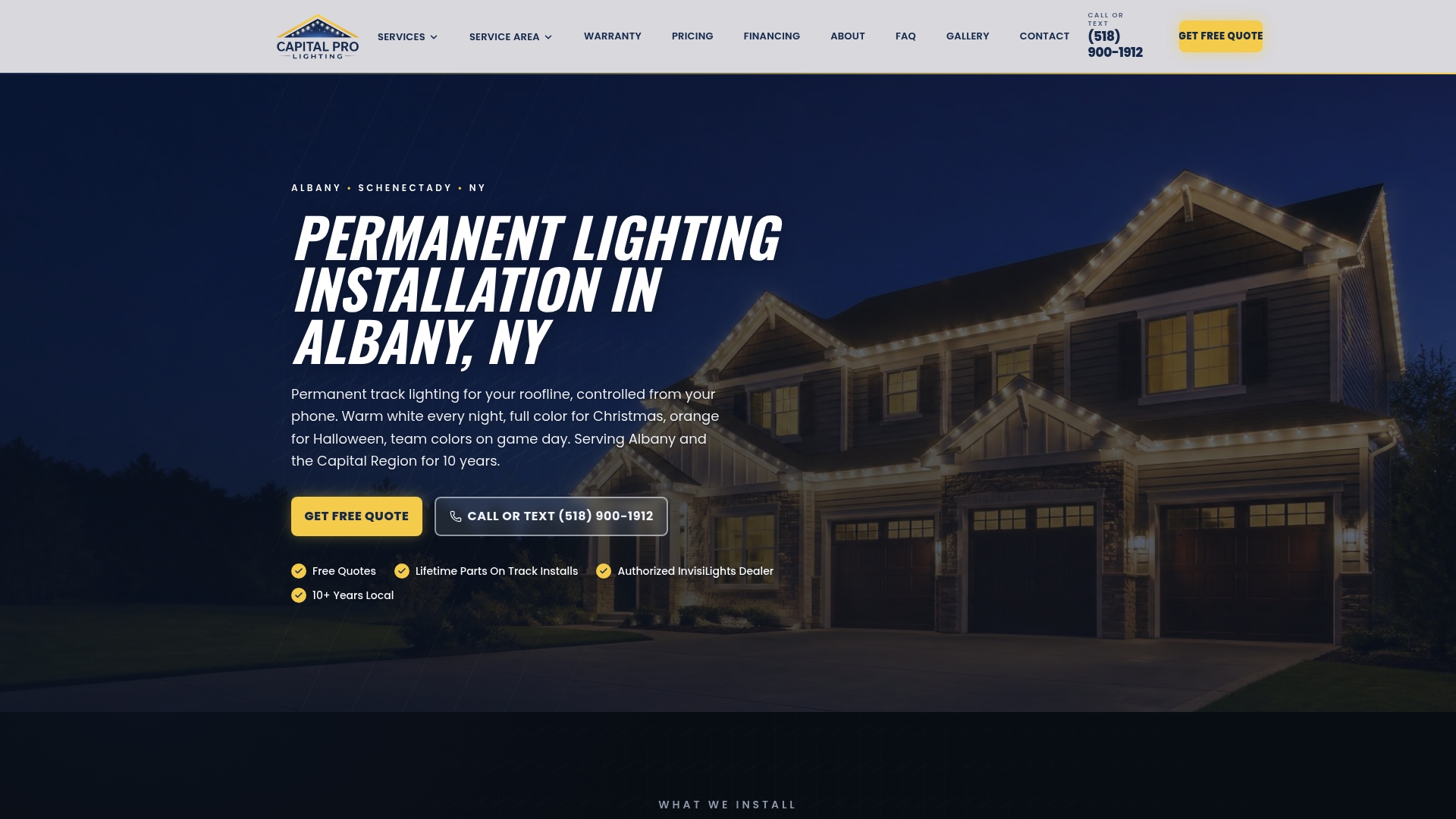
If the ideas above sound right for your home but the thought of another year of ladders and tangled strings does not, a permanent system solves that specific problem. Capital Pro Lighting installs both InvisiLights Track Mounted and InvisiClips / Trackless systems, each app-controlled for daily warm-white use and color scenes for events, backed by a lifetime parts warranty on track installs.
When you request a free estimate, ask for:
- Measured linear footage and a written product specification.
- A live demo of the zone and dimming controls in the app.
- Clear warranty terms covering parts and service access.
You can review InvisiLights and InvisiClips pricing or start with the permanent outdoor lighting service page to request a quote.
Sources
This article draws on DarkSky’s responsible lighting guidance, federal FEMP energy-efficiency recommendations, and current industry pricing and design guides linked throughout the sections above.
- Five Principles for Responsible Outdoor Lighting (DarkSky)
- Permanent Christmas Lights Cost: 2026 Pricing Guide (LightQuoter)
- Garden lightings: the architect’s 2026 design guide (Lightingline)
FAQ
What are the best lights for a roof line?
Low-profile, warm-white LED track or channel systems in the 2700K to 3000K range are the most versatile choice for a roofline, since they suit everyday architectural accenting and can shift to color for events. Look for fixtures with a weatherproof rating and a controller that supports independent zones and dimming.
What are the trends for outdoor lighting in 2026?
Layered, zoned lighting that separates circulation, accent, and ambient fill is replacing single bright outlines, with warm-white as the everyday base and saturated color reserved for events, according to the Lightingline design guide. This layered approach is also associated with lower overall energy use than an “all-on” scheme.
What is the rule of thumb for outdoor lighting?
A widely used guideline is to keep light useful, targeted, and at the lowest level that does the job, then control it with timers or zones and favor warm color temperatures, following the Five Principles for Responsible Outdoor Lighting. Applied to a roofline, that means warm-white as the default, shielded and aimed fixtures, and full brightness reserved for specific events.
Recommended
Ready for a Brighter Home?
Free, no-pressure quotes across the Capital Region.
No obligation. Local installer. Same-day callback.
Reviewed by Capital Pro Lighting
Capital Pro Lighting installs permanent outdoor lighting, architectural lighting, and holiday lighting across Albany and New York's Capital Region. We install UL listed permanent lighting systems and have 10 years in business. More about our team.


