
Homeowners: Permanent Metal Roof Lights That Preserve Your Warranty

Homeowners: Permanent Metal Roof Lights That Preserve Your Warranty
For permanent lighting on a metal roof, choose a professionally installed, outdoor-rated track or purpose-made LED roofline system mounted with roof-compatible brackets and wired to a GFCI-protected circuit. Skip seasonal string lights unless they are UL-listed for year-round use and installed to code. The right job starts with GFCI protection, non-conductive ladders (or a licensed installer), and a quick check of your roof’s warranty terms before anything gets attached.
TL;DR:
- Proper installation requires a GFCI-protected circuit, outdoor-rated hardware, and non-penetrating mounting methods to avoid leaks and warranty issues.
- Track-mounted systems offer durability and serviceability, while clip-mounted or seam-clamp options are suitable for specific roof profiles and prevent panel damage.
- Use hardware with IP65 or higher ratings, stainless steel fasteners, and weatherproof connectors to ensure long-term outdoor performance.
- LED fixtures should be backed by photometric test data, a written warranty, and installed with proper sealing and documentation to guarantee longevity.
- Seasonal string lights and magnetic strips are unsuitable for year-round use due to UV, temperature, and wind effects; choose UL-certified, weather-resistant lighting designed for continuous outdoor exposure.
Permanent lighting options that actually work on metal roofs
Not every lighting product sold as “outdoor” is built for a metal roofline, and not every mounting method is reversible if something goes wrong. The main categories differ mainly in how they attach and how permanent they really are.
Track-mounted systems use a continuous channel, often color-matched to the roof, that holds modular LED fixtures in place. They’re discreet, hold up well over time, and allow bulbs or color modules to be swapped without redoing the whole run.
Clip-mounted systems rely on small brackets that grip the seam or edge of a panel without piercing it. They’re a common middle ground: less visible hardware than track, but not quite as integrated.
Adhesive-strip LED lighting skips mechanical fasteners entirely, using industrial adhesive to bond the fixture to the panel. It installs fast but tends to struggle with long-term adhesion once a metal roof heats and cools through a full year of sun and snow.
Seam-clamp hardware grips the standing seam of the roof panel itself, which makes it one of the few non-penetrating options suited to standing-seam metal roofs specifically.
Integrated fixtures, built into fascia or soffit trim during a roof or trim replacement, offer the cleanest look but only make sense when timed with other construction work.
- Track-mounted: most durable and serviceable, moderate upfront hardware cost.
- Clip-mounted: low profile, good for standing seam or ribbed panels.
- Adhesive strip: fastest install, weakest long-term bond on metal.
- Seam-clamp: non-penetrating, specific to standing-seam profiles.
Magnetic light strips get marketed as a quick fix for metal roofs, but they’re generally a poor choice for anything meant to stay up year-round. Magnets lose grip strength as panels expand and contract, and wind uplift on a roofline is a different load case than a flat magnetic surface was designed for. Seasonal string lights fall into a similar trap: ordinary string lights aren’t built for twelve months of UV exposure and thermal cycling, and UL’s guidance on string lights draws a clear line between products certified for year-round use under UL 588 Supplement SD and the seasonal lights most people already own.
Tools, materials, and product specs to ask for
What goes into a permanent lighting system matters as much as how it’s mounted. A few specifications separate hardware that lasts from hardware that fails within a season or two.
Look for an IP rating of IP65 or higher on any fixture, connector, or driver that stays exposed to weather. The first digit covers dust and debris resistance, the second covers water resistance, and a roofline running the full length of a house takes the brunt of both.
Mechanical hardware should be stainless steel or brass fasteners paired with aluminum or brass brackets, not the bare steel or plastic clips found in bargain kits. Color-matched tracks reduce visible hardware against the roofline, which also tends to mean better UV-stable coatings.
On the electrical side, specify outdoor-rated cable, an outdoor-rated power supply or driver, and weatherproof connectors at every joint, all tied back to a GFCI-protected circuit. The Electrical Safety Foundation International recommends that any outdoor electrical decoration or extension cord be marked specifically for outdoor use and run through GFCI protection, with portable GFCI units available as a retrofit where an outlet doesn’t already have one.
- IP65 or higher for any exposed fixture, driver, or connector.
- Stainless steel or brass fasteners with aluminum or brass brackets.
- Outdoor-rated cable, drivers, and weatherproof connectors on a GFCI circuit.
- Fiberglass ladder, non-conductive tools, and a voltage tester on hand before anything is touched.
Before buying, ask the manufacturer for LM-79 and LM-80 test data, which covers how a fixture performs when new and how its brightness holds up over years of operation. The Department of Energy’s outdoor lighting guidance notes that LED product quality varies widely, and that photometric test reports along with a stated operating temperature range are reasonable things to request before committing to a product line.
Pro Tip: Ask for the warranty in writing before installation, not after. A verbal promise on parts coverage means nothing if the installer isn’t around in three years.
How a metal-roof lighting install actually proceeds
A permanent lighting install on a metal roof follows a fairly predictable sequence, and knowing the stages helps you evaluate a contractor’s process or decide where your own involvement should stop.
- Inspect the roof and plan the run. Walk the roofline, measure the total run length, note panel seams and profile type, and check for overhead power lines near any section that will need a ladder.
- Confirm the roof warranty terms. Some manufacturers void coverage if panels are drilled or clamped incorrectly, so this gets checked before hardware selection, not after.
- Lay out mounting points with room for movement. Metal panels expand and contract across seasons, so brackets and track sections need slight allowance built in rather than being pulled rigid end to end.
- Mount hardware to the roofline. Clips, seam clamps, or track go on following the spacing the manufacturer specifies for wind load in your region.
- Route wiring to a GFCI-protected circuit. Runs should be labeled, kept accessible for future service, and joined only at sealed, outdoor-rated junctions.
- Seal every penetration. Any point where a fastener or cable passes through the roof surface gets flashed and sealed with a compatible sealant, not just caulked over.
- Place the control box or transformer somewhere sheltered. A soffit, garage wall, or covered junction point protects electronics from direct weather exposure.
- Test before calling it finished. Check GFCI trip function, verify polarity and continuity on each run, commission any app control, and walk the property at night to adjust for glare or light spill onto neighboring windows.
Two of those steps deserve more attention than a quick glance. Thermal expansion is easy to underestimate: a 40-foot steel panel run can shift noticeably between a cold January night and a hot July afternoon, which is why rigid, fully fastened mounting without expansion gaps tends to loosen or crack hardware within a couple of seasons. And GFCI protection isn’t optional extra credit. The Electrical Safety Foundation International specifically calls out testing portable GFCI devices monthly, since a GFCI that fails silently defeats the entire point of having one.
Statistic Callout: OSHA’s ladder safety guidance states that a ladder used to access a roof edge should extend a safe distance above the roof edge, and work near overhead power lines should maintain a recommended minimum clearance of several feet, using only non-conductive wood or fiberglass ladders. OSHA ladder and power line safety guidance
A few situations are clear signals to stop and call a licensed electrician or professional installer rather than finishing the job yourself: working anywhere near an energized power line, a roof design that requires penetrations your warranty doesn’t clearly allow, or wiring that needs to tie into an existing electrical panel rather than a simple GFCI outlet.
Mounting specifics: seams, tracks, and protecting your warranty
Metal roofs behave differently than asphalt shingles in three ways that matter for lighting hardware: the panels conduct heat and electricity, they expand and contract more than shingles do, and panel profiles vary enough between manufacturers that generic clips don’t always fit.
Seam-clamp hardware is the most roof-friendly option where it applies, because it grips the raised seam of a standing-seam panel without puncturing the metal at all. It only works on that specific profile, though, so a ribbed or corrugated panel needs a different clip design or a track system fastened along the fascia instead.
Track systems anchored to fascia boards avoid the roof field entirely, which keeps the manufacturer’s roof warranty fully intact since nothing touches the panels themselves. Track systems anchored directly into the roof field are sometimes necessary on rooflines without usable fascia, but that route needs real risk-weighing: every fastener through a panel is a potential leak point and a potential warranty conflict.
- Fascia-mounted track: no roof penetration, warranty stays untouched, the best default where fascia exists.
- Seam clamps: zero penetration, but limited to standing-seam profiles.
- Field-panel fasteners: sometimes unavoidable, the highest risk to warranty and weather sealing.
- Adhesive-only mounts: lowest risk to the panel surface, weakest long-term hold.
When a penetration genuinely can’t be avoided, it needs proper flashing around the fastener, a fastener type the panel manufacturer approves (usually a specific gasketed screw), and a compatible sealant applied correctly rather than a bead of generic caulk. Document the work: photos of the hardware before and after sealing, the fastener and sealant product names, and the date of installation. That documentation is what an insurer or a roofing manufacturer will ask for if a leak or warranty claim ever comes up later, and it’s far easier to produce at the time of installation than to reconstruct years afterward.
Electrical safety and code basics worth knowing
Most of the risk in a permanent lighting project isn’t the ladder, it’s the wiring. A few protections and references cover the bulk of what homeowners need to know before signing off on an install.
GFCI protection on every outdoor circuit is the baseline requirement, and it’s not a one-time install-and-forget device. The Electrical Safety Foundation International recommends testing GFCI protection monthly, and a portable GFCI unit can retrofit an older outlet that doesn’t already have one built in.
NEC Article 410 governs fixtures and lighting equipment broadly, and it’s the reference point for how permanent lighting differs from the UL-listed decorative string sets most people already associate with holiday lighting. UL’s own guidance draws the distinction clearly: some string lights are certified under UL 588 Supplement SD specifically for year-round outdoor use, but ordinary seasonal lights aren’t rated for that duty, and permanent installations need to comply with NEC Article 410 rather than the lighter seasonal-product standard.
Ladder work near a roofline carries its own hazard, especially where overhead power lines run close to the house. OSHA’s guidance calls for non-conductive wood or fiberglass ladders near power lines, a minimum clearance of 10 feet from energized lines, and a ladder that extends at least 3 feet past the roof edge for safe footing.
- Test GFCI protection monthly and after any storm or power surge.
- Keep installation records: fastener types, sealant products, and wiring diagrams.
- Confirm whether your municipality requires a permit or inspection for new exterior circuits.
- Use a licensed electrician for any work tying into your home’s main panel.
Statistic Callout: OSHA guidance specifies a recommended minimum clearance of several feet from overhead power lines when working with ladders near a roofline. OSHA ladder and power line safety guidance
Permits and inspections aren’t universal requirements everywhere, but many municipalities expect one for new exterior circuits or significant electrical additions, which is one more reason a licensed electrician on the job is worth the cost beyond just the install itself.
Weatherproofing and maintenance that extend LED lifespan
The gap between a lighting system that lasts a decade and one that dims and fails within two years usually comes down to sealing, heat management, and material choice, not the LED chips themselves.
IP65 or higher ratings matter most at roof edges, corners, and anywhere water tends to pool or run, and the same standard applies to the controller or driver box, which should sit somewhere sheltered rather than directly in the weather. The Department of Energy’s LED guidance notes that LED luminaires can run for 50,000 hours or more with good lumen maintenance, but that figure depends on manufacturer data like LM-79 and LM-80 reports rather than marketing claims alone.
UV-resistant cable jacketing and corrosion-resistant brass or aluminum hardware hold up far better against years of sun and moisture than the generic plastics and bare steel found in budget kits.
- Visually inspect fixtures, seals, and brackets twice a year, typically spring and fall.
- Clean lenses and housings to maintain brightness and even color output.
- Test GFCI function on the same schedule as the visual inspection.
- Replace individual LED modules as they dim rather than waiting for a full-run failure.
Pro Tip: Keep a simple folder, physical or digital, with your installation photos, warranty documents, and product model numbers. It turns a five-minute warranty claim into something that would otherwise take an afternoon of guessing.
What a permanent lighting system typically costs and how long it takes
Permanent roofline lighting costs vary by system type, total run length, how much electrical work is needed, and how difficult the roof is to access. A track-mounted system with InvisiLights starts from $2,500, while a trackless clip-based system like InvisiClips starts from $2,000, and both figures reflect base installation rather than every possible add-on.
A typical single-story home install runs from an initial site visit through commissioning in roughly one to three days, depending on run length and whether any electrical panel work is required.
When comparing bids from different installers, look past the bottom-line number:
- Confirm the scope is itemized by linear foot, not a vague lump sum.
- Check what warranty coverage applies to parts versus labor.
- Ask whether app control, smart scheduling, or color-changing hardware is included or an add-on.
- Request documentation of fastener types and sealing methods used on your specific roof.
Ongoing running costs are modest for LED systems, since the draw per fixture is low, but lifecycle thinking should also account for occasional module replacement and the value of a warranty that actually covers parts years down the line.
Why local experience with metal roofs matters
Metal roofs aren’t uniform. Panel profiles, seam types, and coatings vary enough between manufacturers that a mounting method proven on one roof can be the wrong call on another a few miles away. Over 10 years of local installation experience in the Capital Region means encountering most of those variations firsthand rather than guessing from a spec sheet.
Capital Pro Lighting’s approach centers on custom, color-matched track systems that homeowners can control and recolor from their phone, which removes the seasonal cycle of climbing ladders and untangling string lights every year. Installations include a lifetime parts warranty on track systems along with 3D-printed brackets designed for a clean, discreet finish against the roofline rather than a visible aftermarket add-on.
That combination, custom hardware, warranty backing, and years of hands-on work with the region’s roof types, is a reasonable baseline against which to judge any installer, local or otherwise.
Energy use and efficiency for a permanent lighting system
Permanent LED roofline lighting draws relatively little power per fixture, which is one of the main reasons LED has displaced older halogen and incandescent rope lighting for this kind of use. The Department of Energy notes that well-designed LED luminaires offer better energy efficiency and longer service life than older HID or incandescent sources, though actual performance depends on product quality rather than the LED label alone.
A few choices affect real-world consumption more than people expect. Driver efficiency matters: a cheap driver can waste a meaningful share of input power as heat rather than light, which also shortens the driver’s own lifespan. Color temperature and brightness settings matter too, since running a system at full brightness every night year-round draws more power than using scheduled dimming for everyday use and reserving full brightness for holidays or events.
Smart or app-based controls add a practical efficiency layer by letting you schedule lighting to run only during the hours you actually want it, rather than leaving a system on a fixed dusk-to-dawn timer that burns power all night regardless of need. Choosing a system with published photometric and efficiency data, rather than an unverified low-cost import, is the more reliable way to keep both the electric bill and the long-term maintenance burden down.
Designing the lighting to fit a metal roof’s architecture
A permanent lighting system should follow the lines a metal roof already has rather than fighting them. Standing-seam panels, ribbed profiles, and exposed fascia all create natural guide lines, and track or clip systems that run parallel to those lines tend to look intentional rather than bolted on.
Color-matched track hardware disappears against the roofline during the day, which matters more than people expect, since a lighting system is visible in daylight for far more hours than it’s ever lit at night. A track finished matching a dark gray or weathered-bronze metal roof reads as part of the roof edge rather than an accessory.
At night, the placement of individual fixtures affects how clean the result looks. Even spacing along a roofline reads as a deliberate design choice, while uneven gaps or visible wiring breaks that effect immediately. Corners, gables, and roof transitions are worth extra attention, since those are the points where the eye naturally travels and where a mismatched fixture angle shows up most.
App-controlled color options add a design dimension beyond simple on-off lighting: a single system can shift from a warm white for everyday use to specific colors for holidays or local events without any new hardware. That flexibility is part of what makes a track-mounted, color-changeable system a more architecturally integrated choice than a seasonal string of lights draped over the edge.
What permanent lighting means for the roof itself over time
Adding permanent lighting hardware to a metal roof changes a few things about how the roof ages, mostly in ways that proper installation avoids. The main concerns are corrosion and interference with the roof’s own ventilation.
Corrosion risk comes almost entirely from mismatched metals. Steel fasteners against aluminum panels, or the wrong grade of hardware against a coated steel roof, can set up galvanic corrosion at the contact point over years of moisture exposure. Brass or stainless steel hardware, matched appropriately to the panel material, avoids that reaction, which is why installers specify fastener material deliberately rather than grabbing whatever is on hand.
Ventilation effects matter mainly where mounting hardware or wiring runs cross a ridge vent or soffit vent path. A poorly planned install can partially block airflow the roof relies on to manage moisture and temperature in the attic space below, which over time contributes to condensation issues unrelated to the lighting itself. Routing wiring and brackets around vent locations, rather than through them, avoids the problem entirely.
Penetrations, where they’re unavoidable, are the other long-term risk: an improperly sealed fastener hole is a slow leak waiting to happen, sometimes for years before it shows up as a stain on a ceiling. That’s the core argument for non-penetrating seam clamps or fascia-mounted track wherever the roof profile allows it, since a mounting method that never breaks the panel surface removes the corrosion and leak risk at the source.

Seasonal control, timers, and smart scheduling
One of the practical advantages of a permanent system over seasonal string lights is control flexibility. Rather than physically swapping lights for each holiday, a permanent LED roofline system can shift color, brightness, or pattern through a schedule or an app, which is also where much of the energy efficiency case comes from.
Basic timers cover the simplest need: lights on at dusk, off at a set hour, no daily adjustment required. Smart controls go further, letting a homeowner set different schedules by season, trigger specific colors for holidays, or adjust everything remotely from a phone without climbing a ladder or touching a single wire.
Remote operation matters most in the moments that used to require physical effort: changing colors for a holiday, dimming for a late gathering, or simply turning everything off during a vacation without worrying whether someone forgot to flip a switch. For homeowners who used to deal with the yearly cycle of hanging and removing string lights, that shift from physical labor to a few taps on a phone is the single biggest quality-of-life difference a permanent system offers.
What actually matters most in this decision
The conventional advice on permanent roofline lighting spends a lot of energy on aesthetics, color options, and app features, and not nearly enough on the two things that actually determine whether the system survives five winters: mounting method and electrical protection. A gorgeous color-changing system mounted with the wrong fastener into the wrong panel profile is a leak and a warranty dispute waiting to happen, not a win.
If you take one thing from this guide, prioritize GFCI protection and penetration-free mounting before anything about brightness or color. Those two decisions are the hardest and most expensive to fix after the fact, while a color scheme or brightness level can be adjusted with an app anytime. Homeowners also tend to underestimate thermal expansion on metal roofs specifically, assuming lighting hardware behaves the same way it would on shingles. It doesn’t, and that single oversight accounts for a lot of loosened brackets and cracked seals a couple of years into a cheap install.
— Luis T
Get a permanent lighting system built for your roof
A metal roof deserves hardware matched to its profile, not a generic kit from a big-box shelf. Capital Pro Lighting builds custom, color-matched track and clip systems for homeowners in Albany and across the Capital Region, with app-controlled color changes that replace the yearly ladder-and-string-lights routine entirely.
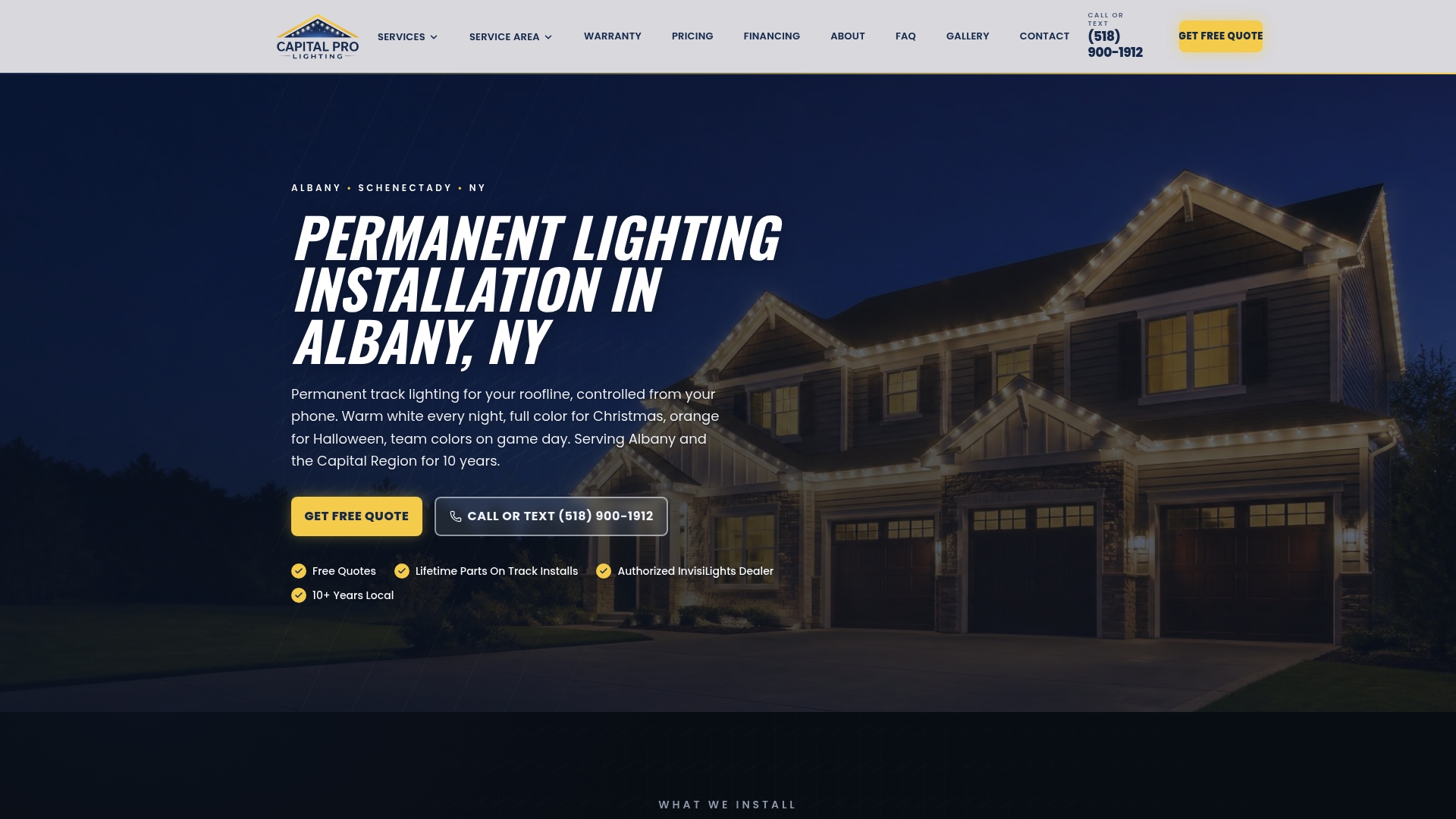
A typical estimate visit covers your roof type, existing electrical capacity, desired run length, and a walkthrough of warranty coverage, including the lifetime parts warranty on track installations. Check current pricing for InvisiLights and InvisiClips systems or read more about permanent outdoor lighting options before booking a visit.
Sources
Claims on ladder clearance and power line distance cite OSHA; GFCI and outdoor cord guidance cites ESFI; year-round string light certification cites UL. For low-voltage landscape lighting techniques outside the roofline itself, see this DIY installation guide.
- Electrical Safety Foundation International — Outdoor decoration safety tips
- OSHA — Electrocution: Work safely with ladders near power lines (transcript)
- UL — String lights and year-round use (UL 588 Supplement SD)
- DOE — Outdoor area lighting: advantages of LED technology and specification checklist
FAQ
How much does permanent roofline lighting cost?
Permanent roofline lighting costs depend heavily on system type and run length. Track-mounted systems like InvisiLights start from $2,500, while trackless clip-based systems like InvisiClips start from $2,000, with both figures reflecting a base installation.
How can I hang lights on a metal roof?
The safest approach uses seam clamps, clips, or fascia-mounted track hardware rather than fasteners driven directly into roof panels, since non-penetrating methods avoid leak risk and preserve the roof’s warranty. Where a penetration is unavoidable, it needs proper flashing and a sealant compatible with the panel coating.
How do I attach permanent outdoor lights safely?
Permanent outdoor lights should be wired to a GFCI-protected circuit using outdoor-rated cable, connectors, and drivers, with every junction sealed against weather. Work near a roofline should use a non-conductive fiberglass ladder and maintain the clearances OSHA recommends around any overhead power lines.
What type of Christmas lights are best for a metal roof?
Lights certified under UL 588 Supplement SD for year-round outdoor use hold up better on a metal roof than ordinary seasonal string lights, which UL notes aren’t designed for permanent installation. For homeowners who want the holiday look without leaving standard string lights up all year, a seasonal installation and takedown service is the more roof-friendly option.
Can you install lights on metal roofs without drilling into the panels?
Yes, seam-clamp hardware and fascia-mounted track systems both avoid drilling into the metal panel surface entirely. These non-penetrating methods are generally the preferred choice for preserving a roof’s manufacturer warranty.
Recommended
Ready for a Brighter Home?
Free, no-pressure quotes across the Capital Region.
No obligation. Local installer. Same-day callback.
Reviewed by Capital Pro Lighting
Capital Pro Lighting installs permanent outdoor lighting, architectural lighting, and holiday lighting across Albany and New York's Capital Region. We install UL listed permanent lighting systems and have 10 years in business. More about our team.


