
Installer Backed Homeowner Checklist to Hide Roofline Lights by Day

Installer Backed Homeowner Checklist to Hide Roofline Lights by Day
Permanent roofline lighting can be made nearly invisible during the day, and homeowners have three main paths to get there: color-matched track systems, recessed puck-style nodes, and low-profile trackless clips. Of the three, a flush-mounted, color-matched track tends to disappear best against most fascia and gutter lines. The result you get depends heavily on professional installation, correct IP ratings, and a warranty that backs the work.
TL;DR:
- Color-matched track systems are the most effective at hiding during the day, especially when installed flush and with correct UV-resistant finishes.
- Protruding hardware, mismatched sheen, and visible wiring are the primary causes of daytime visibility, often more noticeable than the fixture’s color.
- Installation quality, proper IP ratings, and warranties significantly influence the system’s concealment and longevity, with factory finishes outperforming field-painted ones.
- Controls like photocells ensure lights stay off during the day and on at night automatically, while app-based controls add layers of customization.
- Budget, roofline complexity, and desired permanence determine whether a permanent hidden system is a worthwhile investment despite higher initial costs.
What roofline lights actually look like in daylight
Daytime visibility comes down to a handful of physical details, not the brand of light you buy. Profile matters most: anything that protrudes from the fascia or gutter line will throw a shadow and catch the eye, even if the color is right. A channel painted to match your trim in a satin finish still stands out if the sheen reflects sunlight differently than the surrounding surface.
Exposed clips, visible wiring, and oversized node heads are the most common giveaways, especially when viewed from the street or a neighbor’s yard. Roofline geometry changes the equation too. A steep pitch, deep soffit, or ornate gutter detail can either hide hardware naturally or expose it at odd angles.
- Protrusion and shadow lines reveal hardware faster than color ever does.
- A mismatched sheen or hue is often more noticeable than the fixture itself.
- Visible wire runs or exposed clips break the clean line homeowners expect.
- Roof pitch, soffit depth, and gutter style all affect how well concealment holds up.
Comparing concealment methods: track, recessed nodes, and clips
Each method trades off differently between how hidden it looks, how long it lasts, and what it costs to install.
- Color-matched track systems run LEDs inside a low-profile channel that mounts flush to the fascia, hiding both the wiring and the individual diodes behind a continuous, paintable housing.
- Recessed or puck-style nodes sit flush against the surface and work well on flat fascia boards, though their round housings can still read as small dots up close or in raking light.
- Trackless clips hold individual bulbs or small fixtures without a channel, which keeps material cost down but leaves more wire and hardware exposed unless the installer routes everything carefully behind gutters.
Maintenance differs as much as appearance. Track systems typically allow a bulb or section to be serviced without removing the whole run, while clip-based setups often require detaching several fixtures to reach one failed unit. UL Solutions notes that outdoor luminaire categories, including line-voltage and low-voltage products, should carry appropriate IP ratings and UL or ETL listings regardless of which mounting method you choose.
Materials, finishes, and mounting details that keep lights hidden
The hardware matters less than what covers it. Factory color-matched channels hold their finish far more consistently than tracks painted on-site after installation, since field paint can chip or fade unevenly within a season or two. Matte, low-reflectance materials also help: a glossy housing catches sunlight and creates a visible glare line that a matte finish avoids entirely.
- Factory-matched finishes resist fading and chipping better than field-painted ones.
- Matte or low-gloss housings reduce catchlight compared to shiny plastic or metal.
- Custom low-profile brackets, including 3D-printed designs, tuck fasteners out of sight.
- UV-resistant, weather-rated materials prevent the yellowing or discoloration that makes older installs look dated.
UL points out that factory color-matched channels and low-profile brackets reduce the risk of a visible mismatch developing over time, particularly in high UV exposure.
Pro Tip: Ask any installer for a daylight photo of a past project taken from the street, not just a nighttime glamour shot.
How lighting controls keep systems unobtrusive during the day
Controls decide whether your lights stay off when they should, and that reliability is part of what keeps a system feeling hidden rather than half-finished. Dusk-to-dawn photocells remain the standard for outdoor lighting because they switch fixtures off automatically at sunrise without any homeowner input, according to a DOE primer on outdoor lighting controls.
- Photocells handle the basic daytime off, nighttime on cycle without scheduling.
- App or scene control lets you layer timers or holiday presets on top of that baseline.
- Dimming interfaces like 0-10V or DALI, both referenced in DOE’s outdoor lighting control primer, let installers add future flexibility if you specify a control-ready luminaire up front.
Color tuning is worth a separate mention here because it is often confused with concealment. The Department of Energy’s page on color-tunable LED products makes clear that tunable technology changes mood and appearance at night. It has no bearing on how visible the fixture is during the day.
Installation checklist: wiring, ratings, timeline, and cost
Before signing a contract, confirm the technical basics that separate a clean, lasting install from one that fails early or looks obviously bolted on.
- Ask whether the run uses line-voltage or low-voltage wiring, and whether conduit is needed for your roof type.
- Confirm UL or ETL wet-location markings and an IP rating suited to your climate by consulting Outdoor Lighting Installation & Control Systems | Tri-County.
- Request LM-79 photometric test reports, which the DOE’s outdoor area lighting guide recommends as a way to verify real fixture performance rather than marketing claims.
- Get the warranty terms in writing, including what counts as a covered part.
LED outdoor luminaires can last longer and use less energy than older HID fixtures, but the DOE notes that quality varies widely between products, which is why photometric testing and warranty terms matter as much as the fixture itself.
Installation timelines vary with roofline length and access, and homeowners should expect longer visits for steep or multi-story roofs where lift equipment or extra scaffolding is needed. Cost tends to scale with fixture type, the sophistication of the control system, and the total length of track or wiring run rather than any single component.
Pros and cons: is a hidden permanent system worth it
A discreet permanent system solves problems seasonal lights never will, but it is not the right fit for every budget or timeline.
- Benefits include year-round curb appeal, safer illumination near steps and walkways, app-based control, and the end of annual ladder climbing.
- Risks include a higher upfront cost and the real possibility of visible seams or glare if the installer skips color matching or proper sealing.
- Before hiring anyone, ask about warranty length, the fixture’s IP rating, which control protocols it supports, and whether they can show daylight photos of completed installs on rooflines similar to yours.
What one Capital Region installer looks for in a hidden install
Color-matched track paired with low-profile, custom brackets blends into most rooflines better than any other combination we install. A typical project moves through a site survey, a color-match plan pulled from your trim and gutters, installation, and a final commissioning check before completion.
— Luis T
Getting a truly hidden system installed the right way
Homeowners who want lighting that disappears by day and changes color by night typically ask about two options: InvisiLights Track Mounted, starting from $2,500, or InvisiClips / Trackless, starting from $2,000. Both come with a lifetime parts warranty on track installations and phone-based control for switching colors on the fly, whether for a holiday or a Tuesday.
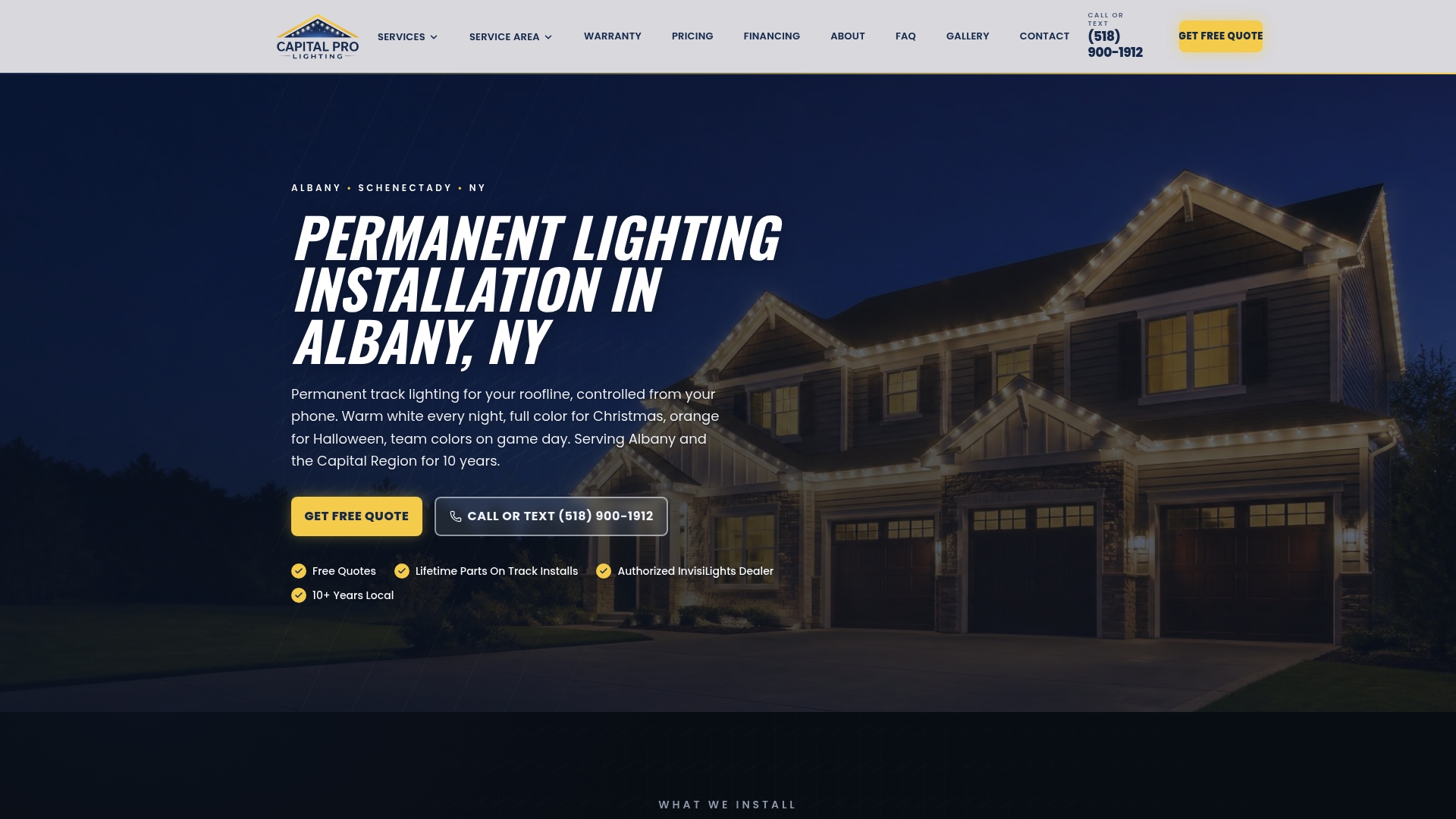
During a consultation, ask to see a color sample against your actual trim, confirm the IP rating for your fixture, and get the warranty terms in writing before you sign anything. Homeowners in Delmar and nearby communities can review examples of finished work on our permanent outdoor lighting page or check current pricing to get a sense of what a project on your home might involve.
Standards and guides to verify installer claims

Check any installer’s claims against UL’s landscape and outdoor luminaire guidance, UL 1598 safety standards, and DOE’s outdoor lighting control primer before signing a contract.
Sources
FAQ
What are concealed lights called?
Lights built to disappear into a roofline are usually called permanent roofline lighting, hidden accent lighting, or track-mounted architectural lighting depending on the mounting style. The common thread is a low-profile housing or channel designed to blend with trim color rather than stand out as a visible fixture.
What do you call lights that only come on at night?
These are typically called dusk-to-dawn or photocell-controlled lights, and the DOE’s primer on outdoor lighting controls notes that photocontrol remains the most common way outdoor fixtures switch off automatically during daylight hours. Some systems pair a photocell with app scheduling for more control over exact on and off times.
What are the best Christmas lights to use on my roofline?
The right choice depends on whether you want a seasonal, removable setup or a permanent system you can reprogram for the holidays. Capital Pro Lighting’s Christmas Light Installation service handles seasonal setup and takedown, while a permanent system with phone-controlled color changes skips the annual ladder work entirely.
What are the lights called that shine up on your house?
Fixtures that wash light upward along a wall or roofline are generally called uplights or architectural accent lighting. When they are mounted to be hidden in daylight, they fall under the same permanent roofline lighting category covered by UL’s outdoor luminaire guidance.
Recommended
Ready for a Brighter Home?
Free, no-pressure quotes across the Capital Region.
No obligation. Local installer. Same-day callback.
Reviewed by Capital Pro Lighting
Capital Pro Lighting installs permanent outdoor lighting, architectural lighting, and holiday lighting across Albany and New York's Capital Region. We install UL listed permanent lighting systems and have 10 years in business. More about our team.


