
9 Inch vs 12 Inch Light Spacing
Two numbers come up on almost every permanent lighting quote we write: 9 and 12. They describe how far apart the lights sit inside the track, and that one choice changes how your roofline looks at night more than the colors, the patterns, or the app ever will. The track, the fixtures, and the controls stay the same either way. Spacing is what decides whether your home reads as a smooth band of light or a row of distinct points.
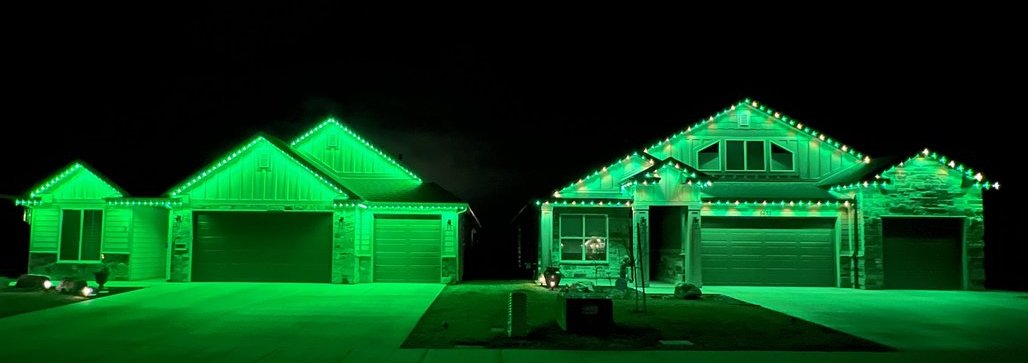
Two real installs, both running green. Elite Track on the left, Signature Track on the right. Both are app controlled and both carry the same warranty.
What Bulb Spacing Means
Every permanent track system mounts a row of LED lights inside an aluminum channel along your roofline. Spacing is the gap between one light and the next, measured in inches. Over a 100 foot roofline, 12 inch spacing works out to about 100 lights, while 9 inch spacing works out to about 135. Same roofline, same track, same app. The only difference is density, and density is what your eye reads from the street.
Both of our track options use the same commercial grade, UL listed fixtures and the same color matched aluminum track. The warranty is the same too: 10 years on parts and components, lifetime on the lights, and 10 years on labor. You are not choosing between quality levels. You are choosing between two looks.
12 Inch Spacing: The Signature Look
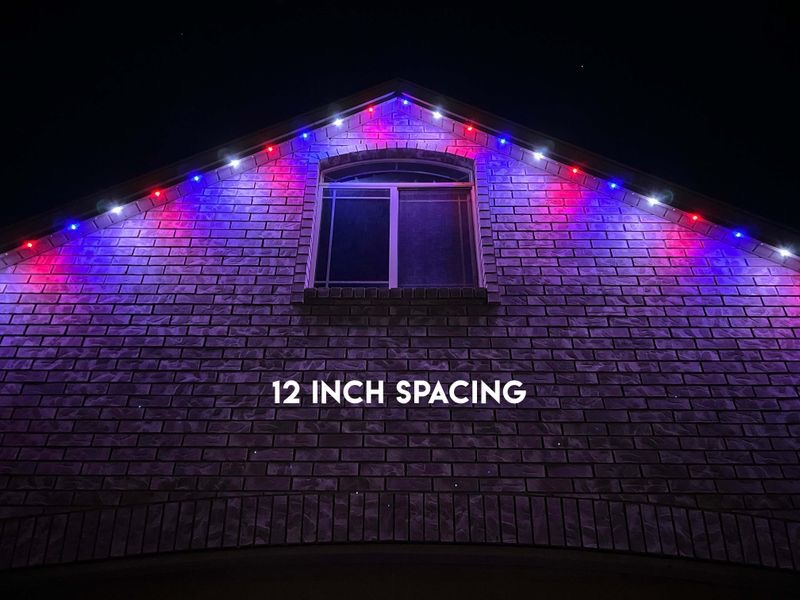
At 12 inches, each light stands on its own. The gaps between bulbs become part of the design, which gives the roofline a classic outline that echoes traditional holiday string lights. If you picture a house outlined in warm white for Christmas, with each bulb clearly visible, that is the 12 inch look.
Animated patterns read differently at this spacing too. A chase effect moves as a series of distinct points, one at a time, which feels closer to old fashioned incandescent bulbs blinking in sequence. Plenty of homeowners pick 12 inch spacing for exactly that reason.
Because fewer lights cover the same run, 12 inch spacing is also the more budget friendly of the two track options. On longer rooflines, the difference adds up.
9 Inch Spacing: The Elite Look
At 9 inches, the lights sit close enough together that their color washes overlap. Instead of reading as individual points, the roofline reads as one continuous band of light. Colors blend into each other, gradients look smooth, and the whole effect feels denser and more saturated.
Motion effects benefit the most. A chase or twinkle pattern moves through tightly packed lights with very little gap between steps, so animation reads as a fluid sweep rather than a hop from point to point. If you love the idea of game day animations and holiday scenes that flow, 9 inch spacing shows them off best.
The tradeoff is light count. The same roofline needs about 33 percent more lights at 9 inches than at 12, which is why Elite Track Lighting lands higher on the quote.
How To Choose
How far is your home from the street?
Viewing distance changes everything. From the road, 12 inch points stay crisp and defined. Up close, the gaps are more noticeable. If your home sits far back on the lot, both spacings read well. If visitors see your roofline from the driveway, the denser 9 inch layout holds up better at close range.
How long is your roofline?
Long, uninterrupted runs show off density. A ranch with a 100 foot straight roofline makes 9 inch spacing look like a ribbon of light. Homes with deep gables, dormers, and porches break the roofline into shorter segments, where 12 inch spacing keeps each feature outlined without blurring together.
How much do you care about animation?
If your plan is warm white most of the year with holiday colors in season, 12 inch spacing does the job beautifully. If you want flowing chases, smooth gradients, and game day scenes that move, 9 inch spacing is worth the extra lights.
What does it do to the price?
Tighter spacing means more lights and more track material per foot, so Elite lands higher than Signature on the same home. Every roofline is different, so we confirm your exact number after measuring. If you want a ballpark before we talk, our cost calculator walks through both options.
Pro tip: you do not have to decide from photos. During your estimate we can show you the track and fixtures in person, and our team will walk the roofline with you and recommend the spacing that fits your home's architecture.
Pick It Before Install Day
Spacing is built into the track when your system is assembled, so it is the one decision that cannot be adjusted later. Colors, patterns, schedules, and zones can all change in the app any time. Spacing cannot. That is why we walk the roofline with you first, agree on the layout, and only then build the system.
Want A Price For Your Roofline?
Takes about a minute, no site visit needed. We reply on weekdays, and Monday for anything that comes in over the weekend.
Spacing Questions We Hear
Can I mix 9 inch and 12 inch spacing on one home?
We recommend one spacing across the whole roofline. Mixing densities makes the sections visible from the street, and the transition point draws the eye for the wrong reason.
Does spacing affect the warranty?
No. Signature and Elite carry the same warranty: 10 years on parts and components, lifetime on the lights, and 10 years on labor.
Does tighter spacing use more electricity?
More lights draw more power, but the fixtures are efficient LEDs, so the difference on a typical home is small. It should not be the deciding factor.
Can I see both spacings before I decide?
Yes. During your estimate we can show you the track and fixtures in person, and our install map shows recent installs by town if you want to drive by one after dark.
Which spacing is more popular?
Both install regularly. Homeowners who want the classic string light outline lean toward 12 inch, and homeowners who want the fullest, smoothest look lean toward 9 inch. During your estimate we will tell you which one your roofline suits.
- Same UL listed fixtures and color matched track on both options
- Same warranty on both: 10 year parts and components, lifetime lights, 10 year labor
- App controlled scenes, schedules, and zones on both